Want more from Front Office Sports
in your search results?
The NCAA is inching closer approving its new “5-in-5” eligibility rule, which gives college athletes a standardized five-year window to compete. The countdown begins the academic year immediately following expected high school graduation or the athlete’s 19th birthday, whichever comes earlier. A Division I Cabinet vote is imminent.
Since the announcement of the proposal, which the NCAA calls “the age-based model,” hockey at all levels has been in panic mode. Although other sports—particularly Olympic sports—are set to be disrupted by the new rules, college hockey is in a uniquely precarious position because of its development pipeline.
Unlike other sports that sometimes offer a postgrad prep development year, hockey has an entire competitive developmental model that ladders up to college. Before jumping to the NCAA, many players first spend time in junior leagues, including the Canadian Hockey League and the United States Hockey League, where athletes can play until age 20.
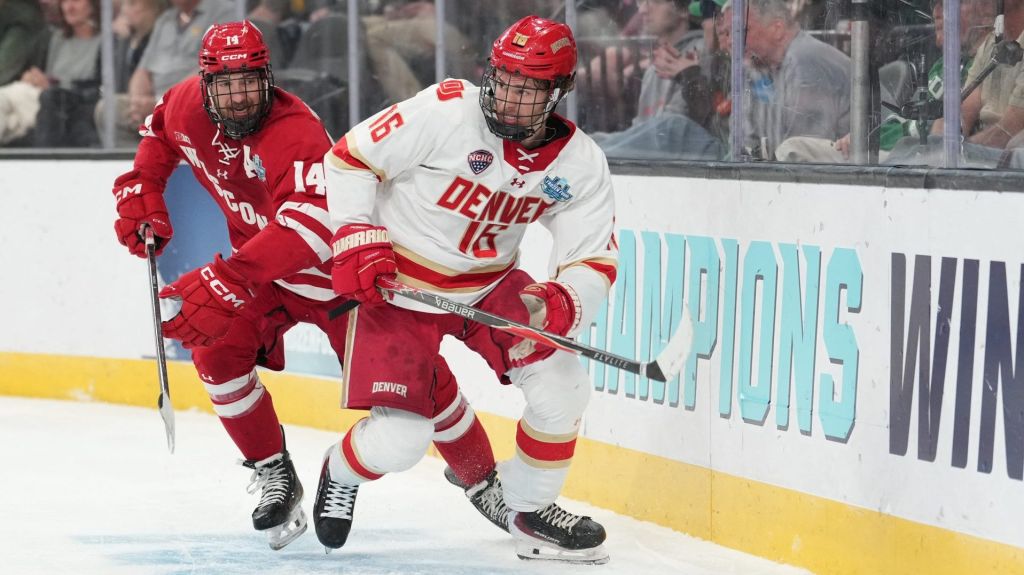
In 2025, 99% of first-year players across the 63 D-I men’s programs came from junior leagues, says Heather Weems, commissioner of the National Collegiate Hockey Conference, which includes 2026 national champion Denver. “It’s not an anomaly,” she tells Front Office Sports. “It’s not a loophole.”
This means many hockey players enter college programs a year or two after they leave high school. (There are some outliers for exceptional talent, including presumed No. 1 2026 NHL draft pick Gavin McKenna, who left the CHL early and played his draft-eligible season at Penn State as a 17-year-old.)
Mike McMahon of “College Hockey Insider” tells FOS that 80% of the 509 freshmen this past season were 20 or 21 when the season started. Only 100 players were between 17 and 19 the first time they hit NCAA ice. The new age-based rule would leave many players with just two or three years of eligibility when they start college.
The proposed rule has brought together hockey’s major stakeholders.
The group—led by the six college hockey conference commissioners, plus the American Hockey Coaches’ Association, CHL, USHL, USA Hockey, College Hockey Inc., and NHL— issued a set of letters as well as a whitepaper detailing the success of the hockey pipeline model and the proposed rule’s impact.
The powerhouse mix is striking, as it’s increasingly rare for every party in the sport to see eye to eye—especially after last year’s rule changes that enabled CHL players to continue to the NCAA for the first time. “I think it goes to show how much it would interrupt the hockey ecosystem for players at that age,” McMahon tells FOS.
“While we want to be good partners with the NCAA, we also feel like we have a responsibility to the sport of hockey and our developmental pathway,” Weems says. “We just didn’t want to be collateral damage because our system is just fundamentally different.”
Alongside the feedback, they also offered a counterproposal: begin the five-year countdown at age 19 or the start of college enrollment, whichever comes first.
That would add at least an extra year for athletes who choose to do developmental training, like going to the CHL or USHL. Weems acknowledges that the athletes who stay for their 20-year-old junior hockey seasons wouldn’t get the full five years, but says starting the clock later to give athletes even four years versus three makes a huge difference for players.
Importantly, hockey isn’t looking for a special carve-out for its sport—especially since the point of the NCAA’s age-based proposal is to create a universal standard of eligibility across college athletics. Instead, they’re hoping to push this counter-solution as an overall rule change for all sports.
The hope, Weems tells FOS, is sports such as soccer and baseball, where it’s common for athletes to take an extra prep-school year before enrolling in college, will also benefit.
As the NCAA hears feedback, hockey will also need the backing of other sports if the governing body is to be swayed.
With the vote potentially in late June, hockey is seizing the time to lobby allies. That has already included phone calls to members of the Division I Cabinet, meetings with the NCAA general counsel, and outreach to leaders in other sports that might benefit from an adjusted proposal. The Big Ten, which is the only multisport conference that plays D-I college hockey, may be specifically helpful in building bridges.
The NHL’s sign-on also delivers more heft. “If this was just the hockey commissioners and some junior hockey people sending in a proposal, I don’t know that they would even pay much attention to it,” McMahon says.
Driven largely by the nonstop onslaught of eligibility lawsuits the NCAA is fighting, including from football and basketball players, the current aged-based proposal has support from NCAA president Charlie Baker, the Division I Board of Directors, and several coaches in major conferences. At this point, it’s widely expected to pass, although it’s likely to be tested in court.
Weems is not deterred. “We’ve heard through the grapevine that they’ve been following it and are interested in what we have to say,” she says. “I don’t think it’s a slam dunk by any stretch of the imagination, but certainly knowing that there are others who are becoming vocal, I think that makes us feel more hopeful.”
Download the FOS App
The business of sports, in your pocket.



Scan the QR code to get the app now.