Want more from Front Office Sports
in your search results?
On Friday afternoon, two first-time Men’s College World Series participants in West Virginia and Troy will kick off the tournament by playing each other. The weekend prior, both teams unexpectedly hosted Super Regionals for the first time in their programs’ histories, resorting to non-traditional seating to meet demands that their ballparks couldn’t fulfill.
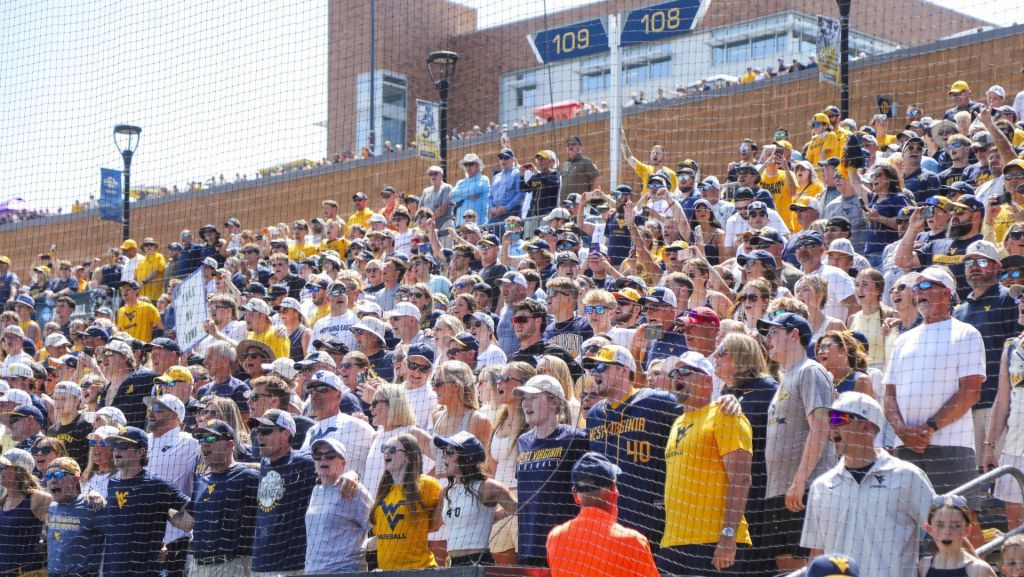
The 16-seeded Mountaineers, who were put in hosting position after their projected Supers opponent and top-seeded UCLA was eliminated in regionals, have just 2,500 permanent seats at their home venue, Wagener Field. However, WVU averaged 4,620 fans for its two-game Super Regional series against Cal Poly, as thousands of Mountaineer fans scattered on “Randy’s Ridge”—a hill located right above Wagener.
Meanwhile, Troy upset No. 8 Florida at the Gainesville regional, and was only put in Supers hosting position after its opponent, unseeded Little Rock, won the Hattiesburg regional. On Supers weekend, an average of 6,730 fans filled the Trojans’ 2,500-seat Riddle-Pace Field—as well as the grass behind its outfield fence, and the upper west stands of Troy football’s Veterans Memorial Stadium.
Both Troy and West Virginia set program attendance records during Super Regionals.
Overflow seating is common in college sports: MCWS participants Georgia and Texas also drew more than what their ballparks could hold during Super Regionals. But for the underdog Mountaineers and Trojans, Super’s weekend was an opportunity to think outside the box, setting the stage for the biggest moment in their program’s history.
Unprecedented Plans
Both West Virginia deputy AD Matt Wells and Troy AD Kyle George tell Front Office Sports that they anticipated significant crowds ahead of Supers, and spent the entire week leading up to the event coordinating with their respective college towns to prepare.
“This is literally the greatest event to ever happen in the city of Troy, and we made sure everybody rose together for it,” George says.
George says Troy obtained extra bleachers from Gulf Shores, Alabama (a four-hour drive from Troy), through a connection that a player’s father had. The Sun Belt university also rented a large video board that was installed just 55 minutes before Game 1 on June 5, meant to enhance the viewing experience of fans watching from its football stadium.
But even with these extra installations, there still weren’t enough seats to accommodate all fans. As a result, Troy decided to charge just $10 for fans without official stadium seating—George believes the “long term ROI” of a fan’s experience trumps the potential added revenue from thousands of extra fans. Similarly, West Virginia did not charge fans sitting on Randy’s Ridge as a service to regular season ticket holders who couldn’t get seats to Supers.
“We felt like that was a grassroots movement, and wanted to keep it that way,” Wells says of the free seats on Randy’s Ridge. “That was a nod to the fans, as a thank you for their support through the year.”
With the exception of a flying tent that injured five people at WVU’s Super Regional (Wells calls that a “bad and ugly situation”), the crowds in both Troy and Granville, West Virginia, garnered significant positive traction. It has both Troy and West Virginia thinking of how to next capitalize.
Wells acknowledges that he can’t think too big, noting that West Virginia’s Super Regionals crowd may not be representative of the team’s demand in the regular season (the Mountaineers averaged 3,3111 fans in 2026). But he still thinks the team’s Omaha appearance will lead to greater investment in baseball down the line, whether that be through coaching salaries, or ballpark renovations that will install more seats.
Meanwhile, George is looking to turn Troy’s facilities into “mixed-use” ones, including the use of football seats for baseball games. He also considered charging fans in football seats and on the outfield grass earlier this season but felt it wasn’t the right time. After seeing the Super Regional numbers, it’s on his mind for 2027.
But regardless of what the future holds, the West Virginia and Troy programs have each unveiled a newfound fan appetite for college baseball after reaching the sport’s highest stage for the first time.
“I feel like I was selling a vision and just had to get there,” George said. “It’s kind of like the Field of Dreams—if you build it, they will come.”
Download the FOS App
The business of sports, in your pocket.



Scan the QR code to get the app now.