Max Kellerman, LeSean McCoy Off DAZN Boxing Show As Mario Lopez Joins
Want more from Front Office Sports
in your search results?
When the NCAA lifted its ban on Canadian Hockey League players in college last November, a door opened for major-junior prospects. No longer would the NCAA consider CHL athletes pros, which permitted players from its three member leagues—the Western Hockey League, Ontario Hockey League, and Québec Maritimes Junior Hockey League—to join top Division I programs beginning in the 2025–26 season.
A few changes were certain: There’d be player movement between the CHL and NCAA; there’d be a tug-of-war for the most exceptional talent, too. But it was impossible to predict exactly how big the shift would be and how far it’d ripple out.
Now only a year removed from the announcement—just under halfway through the college hockey regular season—the effects have already been seismic. Leaders in junior leagues, NCAA programs, and prospect scouting tell Front Office Sports that we’ve barely scratched the surface.
The NCAA
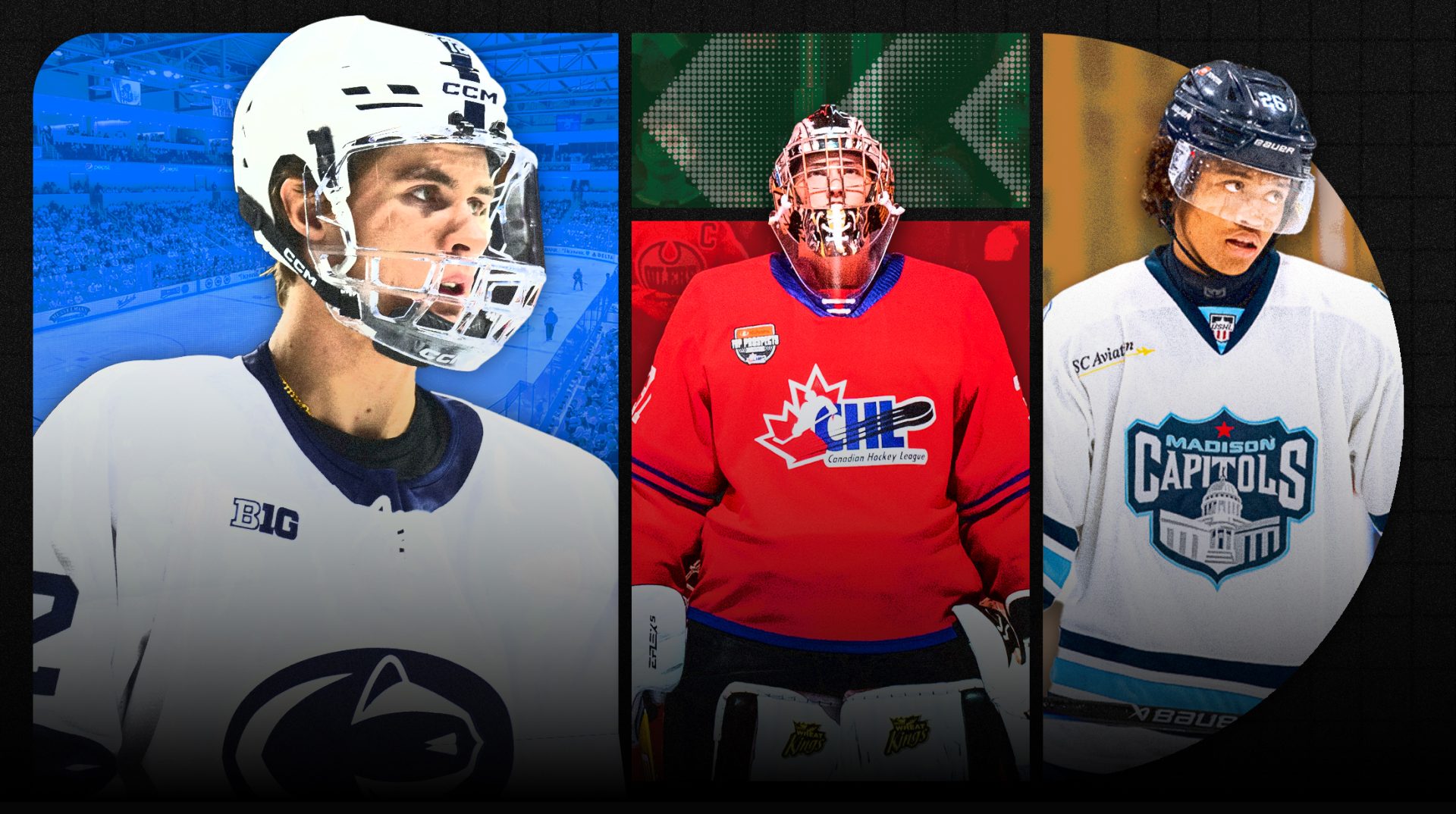
The CHL departure that quickly defined the rule change was that of 17-year-old Gavin McKenna, who in July left the WHL’s Medicine Hat Tigers to join Penn State in the Big Ten for his draft-eligible season. The Nittany Lions program made its first Frozen Four in 2025 after only beginning D-I hockey in 2012. Yukon-native McKenna, who is the widely presumed first-overall pick in the 2026 NHL draft, announced his decision on ESPN—the first time a college hockey player revealed a commitment on air.
“It’s a new player pool that, obviously, we were able to find some pretty impactful players across the conference—and some very, very impactful players,” Adam Augustine, Big Ten ice hockey commissioner, tells FOS. “Everybody quickly came up to speed and started to understand what the opportunities were.”
Alongside McKenna’s jump to Hockey Valley, the conference also landed Porter Martone, a Flyers prospect and sixth-overall pick in the 2025 NHL draft, to Michigan State from the OHL’s Brampton Steelheads. (McKenna was also tied to the Spartans just days before his Penn State commitment.)
Many of the most exceptional defections from the CHL—including McKenna, Martone, and Keaton Verhoeff of the NCHC’s North Dakota, who left the Victoria Royals of the WHL for his draft-eligible season—have largely posted solid starts in their respective college programs. McKenna’s performance has been the most picked apart; in his first 14 games, he’s banked 15 points with a minus-7 rating.
The players who have jumped from the CHL have mostly performed well. But there has been a learning curve, too—many aren’t putting up the same stratospheric numbers they did with their respective CHL teams.
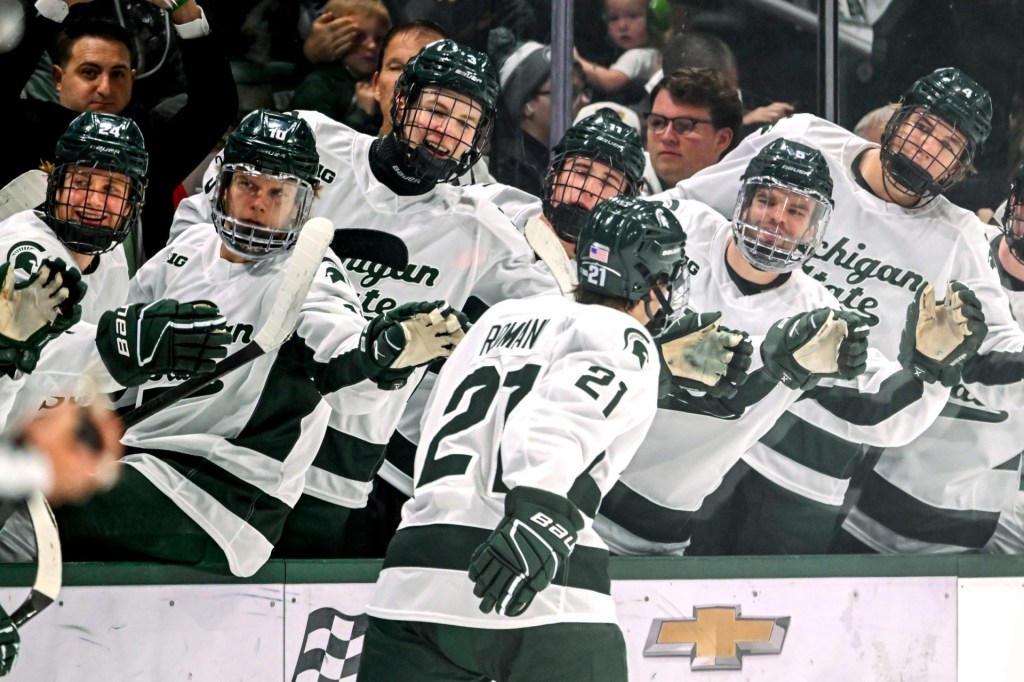
“You’re playing against older players, guys that are up to 23 or 24 years old, that are physically so much more mature, mentally more mature than some of these 17-, 18-, 19-year-olds that have made the jump—I think that’s been a bit of a wake up call,” says Cam Robinson, senior crossover scout at Elite Prospects.
Augustine believes the uneven transition is a testament to “the skill level and depth of college hockey, that it’s been tougher.” Whatever the reason, it’s been an early lesson for NCAA programs, which, while reaping the fruits of new talent, haven’t received plug-and-play superstars.
The NCAA has also had to build bridges with the CHL for the first time in order to dip into the deepest junior prospect pool. Augustine says it’s a brand-new process that’s happening mostly at the individual team level; many executives have leaned on the help of nonprofit College Hockey Inc. to help open the lines of communication. There is a lot to hammer out, including making sure CHL players understand the eligibility implications of academics.
Crucially, Augustine says he feels the relationship between the NCAA and the CHL is less adversarial than in past years.
This may be in part because the NCAA has the upper hand on many elements of recruiting: pro-level facilities, older rosters, and now NIL (name, image, and likeness) money. The latter is something junior leagues simply can’t contend with. “Hockey is going to benefit in a conference like ours that has some type of budget to work with,” Augustine tells FOS. Although the amount is unconfirmed, McKenna is rumored to have received a six-figure NIL deal.
It’s a much more competitive race to the top, but the Big Ten, for its part, is bullish that the NCAA is in the position of strength. “There will always be that kind of off-the-charts exceptional player like [2025 NHL first-overall pick and OHL Erie Otters defenseman] Matthew Schaefer, who’s ready to go play in the NHL at 18 and go do what he can do. And there should always be that opportunity for a player like that to go straight there,” Augustine says. “But for the vast majority of other players who still need some seasoning at 18 or 19, yes, I think college hockey is absolutely the place for them to continue that development.”
Still, Augustine is aware there’s pressure on the NCAA to put their money where their mouth is. Universities feel an imperative to keep improving facilities and resources, put in systems that support players transitioning from the CHL, and go hard on messaging that college is the right next step for the most talented athletes. The NCAA experience on paper doesn’t matter if the results don’t benefit the player—and word-of-mouth will quickly travel in the junior hockey pipeline.
“If first-class players come through and have the experience that we think that they’re going to have, I think you’ll see an uptick in players of [McKenna’s] age making this leap into college hockey,” Augustine says. “At the end of the day, it’s going to be a matter of, ‘Did these players get the developmental experience that they were looking for or not?’ And the proof will be in the pudding based on that evaluation, once we get through this first year or two.”
The CHL
As players began to leave during the summer—foremost, upon losing McKenna—the CHL quickly found itself vehemently defending its position as the world’s top developmental league for the NHL. It still is.
“Ninety-five percent of the players who left were ready to leave. They used up their eligibility in the CHL for the most part,” league president Dan MacKenzie tells FOS. Although more than a hundred players transitioned to the NCAA, he says only 19 moved for their 17-, 18-, or 19-year-old seasons. Highlighting the distinction has been key for the league’s goal of chipping away at the narrative that it’s hemorrhaged talent. The change is not about the strength of the league, MacKenzie says, but rather its “composition.”
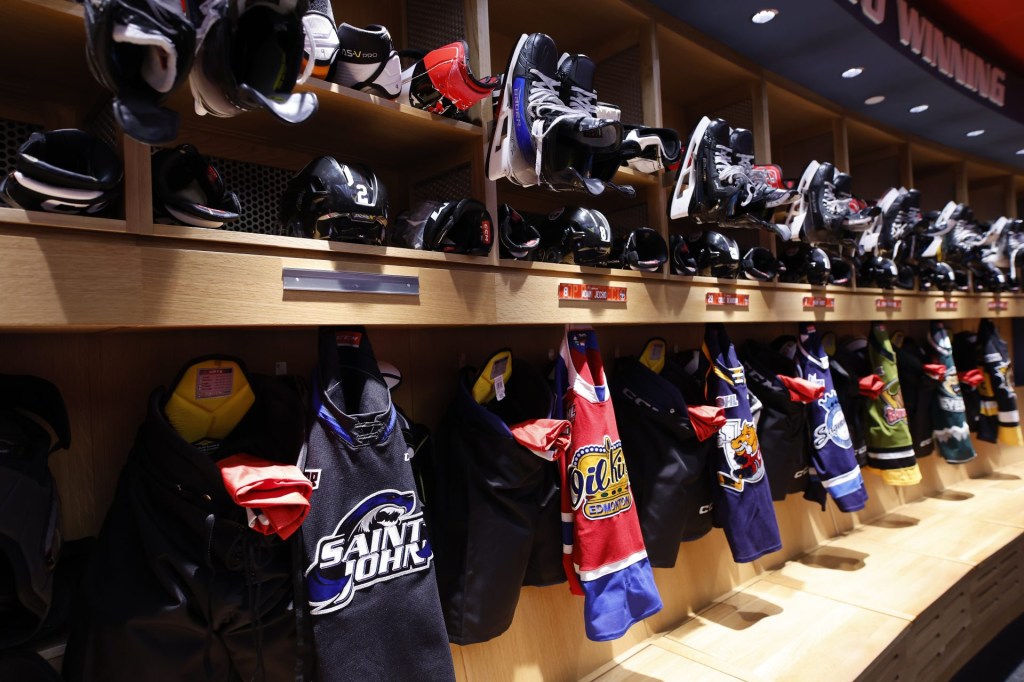
Yet the perception that the CHL is squaring off against the NCAA isn’t entirely misguided. “When you are at the top of the food chain for so long, it’s probably a little bit harder to swallow when you start to lose some of that shine,” says Robinson. “Now, they really have to fight.”
The CHL’s model is different—for one, a longer season in 64 to 68 games versus D-I’s 34—and it’s still making the case that it can be the best prep for the NHL, especially the grueling pro schedule swelling to 84 games next season under the new CBA terms. It is also making improvements to facilities, travel standards, and off-ice player development to become increasingly competitive with college hockey’s most-resourced programs. “We’re going to double down on that because we aspire to be the best development league in the world,” MacKenzie tells FOS. “We think we are right now.”
It’s too early to know just how much—or how little—the rule change has impacted the heft of the CHL’s 61 teams. But buried among the headlines of the talent shifting out is the simultaneous influx of players: Now that the door to college isn’t closed in an either-or system, the CHL is increasingly attractive.
In the past year, nearly 250 players from leagues including the United States Hockey League, British Columbia Hockey League, and the Alberta Junior Hockey League have moved up to major-junior hockey in the CHL. Many of these players are American. The current draft-eligible pool is the league’s strongest in at least a century, says Christopher Séguin, CHL media relations manager.
But even as the CHL is siphoning talent from other leagues and defending its ground as the top developmental destination, the framing of its place in the landscape has shifted slightly. MacKenzie is careful to speak about the CHL as “part of their path” in prospects’ larger pipeline puzzle.
“I think we need some time to see what happens,” he tells FOS. “But you wonder if eventually it’s going to get to a world where it becomes clear that the best thing to do is to max out both—play your junior career and then play your full college career afterwards.”
With this in mind, the conversations in the league have broadened to include U.S. college prep for the first time. “A part of it will be CHL players making sure that as they think about their next steps, they’ve got the right academic standing if they desire to play at the NCAA level,” MacKenzie says. “Especially if you’re a Canadian player, you need to know those rules.”
The CHL is closely watching a few storylines. First, there’s how many players the league loses to college who haven’t exhausted their eligibility. Robinson doesn’t expect a “groundswell” of movement. “[The CHL] has forever been the top feeder league to the NHL for a reason. I don’t think that that’s going to stop,” he says. “I still think that they’re going to hold on to the majority of the top draft-eligible prospects that they have, and then they’re just going to lose the very chosen.”
The most important metric, the CHL tells FOS, is its alumni representation in the NHL: “For us, that speaks directly to the CHL’s ongoing role in developing not just the next wave of NHL players, but the scale of that impact across the sport.”
The USHL
The USHL has always been a pathway to the NCAA. Its main existential proposition has hung on its players being eligible to transition into college while the CHL’s could not.
Macklin Celebrini (Chicago Steel/Boston University), Adam Fantilli (Chicago Steel/Michigan), and Jeremy Swayman (Sioux Falls Stampede/Maine) are among the players who’ve gone on to college after playing in the USHL system. That also includes the U.S. National Team Development Program, with alumni including Brady Tkachuk (Boston University) and Jack Eichel (Boston University). Last year, more than half of players on D-I rosters had USHL experience; the league says it has also developed the most draft choices of any junior hockey league since 2012.
As an example of what the USHL does best, league president and commissioner Glenn Hefferan points to last season’s midyear departure of goalie Mikhail Yegorov from the Omaha Lancers to Boston University, where he was a major factor in bringing the Terriers to the 2025 D-I national championship game. “We’re happy to see them go,” says Hefferan. “We live for it. It’s what we want.” With McKenna’s Medicine Hat departure, he says, “nobody celebrated.”
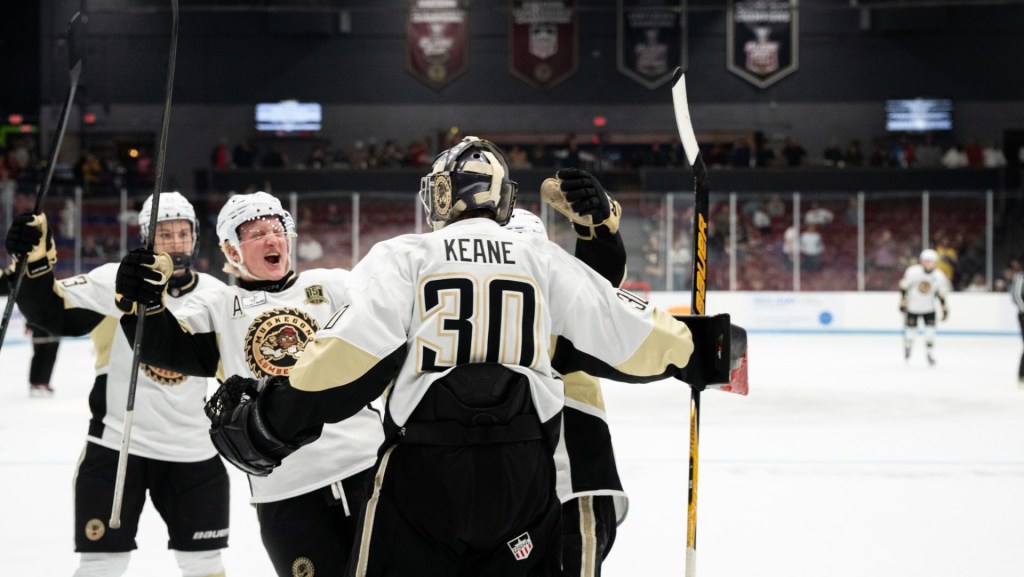
But the rule change has meant the 16-team USHL has begun losing players to the CHL.
Hefferan tells FOS there is an “adversarialness” over talent and recruiting. “I think [the CHL] kind of fancies themselves as, ‘Hey, we play an NHL-style schedule.’ [The USHL doesn’t] believe 16-to-19-year-olds should be playing an NHL-style schedule,” says Hefferan. “We’re always going to have a good league. We didn’t all of a sudden, when the eligibility rule changed, forget how to develop players.”
The defense, however, is proving tricky. It’s not just players moving into the more competitive CHL—it’s also a growing concern that the USHL is losing its main proposition now that it isn’t necessarily the primary choice for prospects who want to play in college. “I think the league that’s in the most trouble is the USHL, and the CHL just has to adapt and change a little bit as they move forward,” says Robinson, who is concerned that the defection of players is leaving the USHL “watered down.”
In early November, following a summit with the NHL in New York, Le Journal de Québec reported that the CHL is evaluating the possibility of bringing the USHL into its fold due to the rule change—and that the NHL is supportive of the idea. The USHL did not confirm the specifics of the meeting or merger proposition, but tells FOS that it “participated in collaborative discussions” and was pleased with them.
Figuring out if this is the right path hinges on the next few seasons, when the USHL will see what it loses versus what the CHL gains. “Things are sorting itself out. [The CHL] is the new toy on the block,” says Hefferan. “But I think when it all settles out, we’re going to continue to develop players really, really well.”
The Future
The answers are still a moving target—the questions, too. Each league has its own problems to solve, but they are all also watching the same things.
“At the end of the day, we were all kind of looking at the same 14-, 15-, 16-year-olds, and trying to encourage them to make decisions,” the Big Ten’s Augustine says. “I think we all know and all see that it’s the players who are benefiting from this.”
That pool of rising-prospect teenagers is also eager. “They’re going to start looking at, ‘Hey, what’s the proof of concept?’ Here are these guys that leave at 17—are they struggling? Is that impacting their draft years? Are they developing still? Are they getting the minutes that they need in production, that they need so that they can quickly turn pro? Or is it not going so well for them?” Robinson says. “Their eyes are big and bright and looking towards the future.”
Download the FOS App
The business of sports, in your pocket.



Scan the QR code to get the app now.