Want more from Front Office Sports
in your search results?
The NFL’s media policies were the stated topic of a House Judiciary Committee hearing held Wednesday, but much like many other things these days in Washington, the session soon veered in broader political divides.
The league’s collective rights negotiations on behalf of all 32 teams, as well as a growing embrace of streamers, received bipartisan rebuke from legislators—but only to a point.
Just as there was shared concern over increasing financial and logistical hurdles for NFL fans amid increasing media fragmentation, Democrats and Republicans squabbled over how to address those issues.
“Sixty-five years [after the Sports Broadcasting Act of 1961] it is fair for this body to ask whether the professional sports leagues have held up their end of the bargain,” said Rep. Scott Fitzgerald (R., Wisc.) during the roughly two-hour hearing. “In my opinion, they have not, and sports fans are paying the price because of it. … Because [the NFL] does not follow America’s antitrust laws for television agreements, they can charge consumers inflated prices that would otherwise be illegal.”
Democrats, however, said the Republican majority that leads the committee is improperly not as concerned about megamergers and accelerating consolidation elsewhere in the media industry. Foremost among that wave is a planned $110 billion takeover of TNT Sports parent company Warner Bros. Discovery by CBS Sports parent company Paramount—something that has taken on overt political overtones due to Paramount CEO David Ellison’s close ties to U.S. President Donald Trump.
“This law absolutely deserves a serious reexamination. It was written for a media landscape that no longer exists,” said Rep. Jerry Nadler (D., N.Y.) of the SBA. “But you cannot examine the Sports Broadcasting Act in a vacuum, and that is exactly what the majority is asking us to do today. The same administration that has suddenly discovered a concern for NFL fans has, over the past year, waved through one of the most aggressive waves of media consolidation in modern American history.”
There but Not There
Two powerful figures were not present, but a constant factor throughout the session. The first is Fox chairman emeritus Rupert Murdoch. The Murdoch-led Fox Sports is approaching a rights renegotiation with the NFL, one that is set to bring higher fees and that the network is likely less equipped to absorb than other league rights holders.
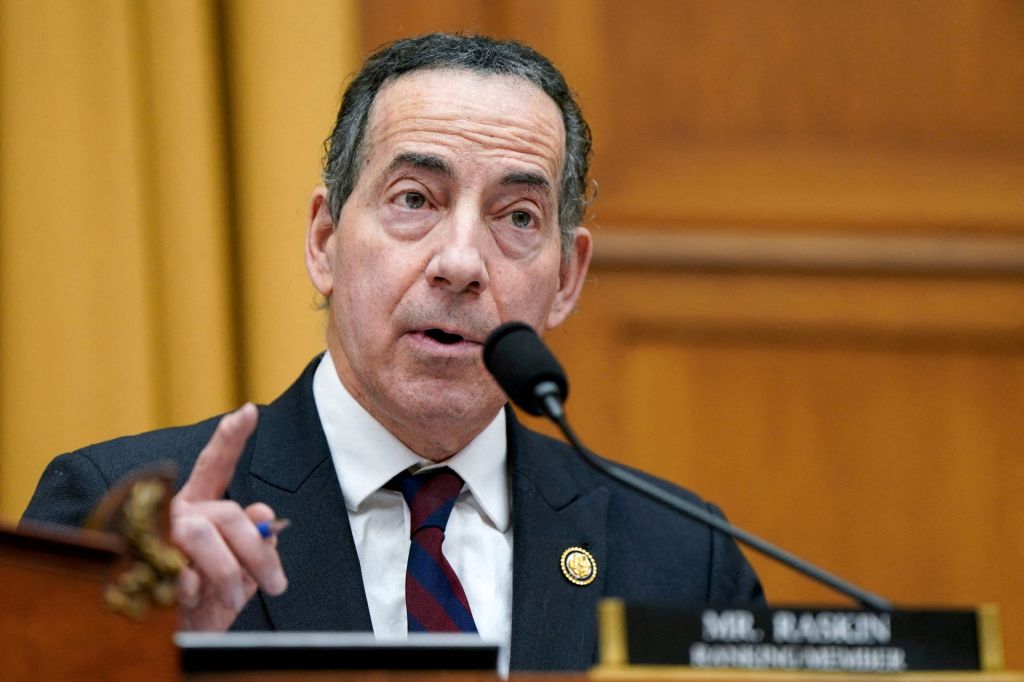
With that looming, Murdoch reportedly met in February with Trump. Soon after, political and regulatory pressure began to ramp up on the NFL, including an antitrust investigation by the U.S. Department of Justice. Democratic committee members, including Rep. Jamie Raskin (Md.), repeatedly referenced that, and called it a “heckling” of the NFL.
“The DOJ’s investigation, like this hearing, appears to be all about helping Mr. Murdoch get a better broadcast deal for Fox,” Raskin said.
The second major figure not present, but referenced, was NFL commissioner Roger Goodell. The committee invited him to testify last week, but he declined. Instead, the league relied on long-standing talking points, including its planned 87% of games in the 2026 schedule that will be aired primarily on broadcast television.
Instead, the hearing’s four witnesses were FCC commissioner Anna Gomez, OutKick Media founder Clay Travis, a frequent critic of the league, along with National Association of Broadcasters president and CEO Curtis LeGeyt and Jim Hallers, founder and managing partner of Tailgators Pub & Grill in Texas.
What’s Next?
The key question going forward is whether legislators will revise the NFL’s antitrust exemption, amend the Sports Broadcasting Act of 1961 that provides the league’s current regulatory freedoms, or both.
The answer to that remains unclear, as committee members are still divided on a specific path. As that deliberation continues, though, there are at least four other regulatory and legislative efforts unfolding to address the NFL’s current policies.
“The 2025 season was our most viewed since 1989 and reflects the strength of the NFL distribution model and its wide availability to fans,” the league said in a statement. “When it was just three major broadcast networks buying sports rights, none offered the full slate of out-of-market games to viewers.”
Download the FOS App
The business of sports, in your pocket.



Scan the QR code to get the app now.