SportsGrid Up for Sale Amid Revenue Slide
Want more from Front Office Sports
in your search results?
The Rams are the widely proclaimed Super Bowl favorites as the NFL season nears.
Their star-studded roster with quarterback Matthew Stafford, wide receiver Puka Nacua, and pass rusher Myles Garrett could soon add defensive tackle extraordinaire Aaron Donald if he makes his expected return from retirement.
They are, at first glance, a case study in how a team can utilize the salary cap accounting rules to stretch the NFL’s spending limit sufficiently to accommodate such a glitzy group of on-field standouts that includes both the reigning league MVP and Defensive Player of the Year. They have embraced their all-in, seize-the-moment reputation once again, hearkening back to GM Les Snead wearing a “Fuck them picks” shirt at the team’s last Super Bowl parade.
But the truth about the Rams’ roster-construction methodology is far more nuanced than “fuck them picks” in favor of proven, expensive veterans.
Their football-side brain trust of Snead, assistant GM John McKay, and coach Sean McVay has actually used the draft quite effectively—just in rounds other than the first. Those picks have given Los Angeles a foundation of young, comparatively inexpensive, and cap-friendly talent that complements the big-name, high-priced, attention-grabbing additions.
“I admire the way in which Les and John and ownership there are very aggressive and are unapologetic as far as how they approach trying to not [just] be competitive, not sell personal seat licenses and jerseys, but trying to win championships,” Louis Riddick told Front Office Sports. “I love how they do it. It would be a great place to work,” said the former NFL player, scout, and front office executive who is now an NFL and college football analyst for ESPN.
The L.A. Misnomer
The Rams are a model of skillful roster construction, resourceful salary cap management, and front office acumen. Just not in quite the way that so many perceive.
“That is really a misnomer,” Joel Corry, a former agent who is now an NFL contracts and salary cap expert for CBS Sports, told FOS about Snead’s mantra. “It gets the traction just because of what Les Snead said and the fact that they’d gone multiple years without a first-round pick. But in some of those years, they’ve had a full complement of draft picks because they’ve traded down and accumulated more picks. And after that down year [in] ’22, they’ve drafted well. Because in that ’23 draft, they got arguably the best receiver in football in the fifth round in Puka Nacua. And they picked up some other guys that same year. … They’ve drafted well enough.”
The Rams kept and used only one first-round draft selection between 2017 and 2025. That came when they took pass rusher Jared Verse with the No. 19 overall pick in 2024. Yet they have done well by drafting key players such as Nacua; running backs Kyren Williams and Blake Corum; guard Steve Avila; pass rushers Byron Young, Kobie Turner, and Braden Fiske; and defensive backs Kamren Kinchens and Quentin Lake.
“I love how they’ve approached it,” Riddick said. “When you look at their roster, even though Les said, ‘F them picks’ and they had that shirt and all, look at some of the players they have that are homegrown that they drafted.”
Williams, a three-time 1,000-yard rusher, was chosen in the fifth round of the 2022 draft. Lake was selected in the sixth round of that draft. The Rams’ draft haul in 2023 included Avila in the second round, Young and Turner in the third round, and Nacua with the final pick of round 5, No. 177 overall in that draft. He’s a two-time Pro Bowler in three NFL seasons and led the league with his 129 catches last season. Fiske was taken in the second round in 2024, followed by Corum and Kinchens in the third round.
Potential contributors from this year’s draft could include second-round tight end Max Klare, third-round offensive tackle Keagen Trost, and sixth-round wide receiver CJ Daniels.
“They’ve kicked the shit out of it, O.K.?” Riddick said. “They just have … with the draft picks that they have made in those rounds 2, 3, 4, 5, 6—they killed them. They’ve actually killed them. Which, to me, speaks even more to the harmony between the evaluation and scouting and then development and utilization. … It’s the perfect blend of using all the different tools at your disposal to build a roster.”
Of course, the Rams also act boldly with big moves when they see their opportunity. They won the Super Bowl in the 2021 season after trading for cornerback Jalen Ramsey in 2019, trading for Stafford in early ’21 and making in-season additions by trading for pass rusher Von Miller and signing wide receiver Odell Beckham Jr.
They’re back at it after losing last season’s NFC title game to the Seahawks. Stafford announced when he was given his first MVP Award during Super Bowl week that he would return for this season rather than retire. The Rams made a blockbuster trade in March, sending first-, fifth-, and sixth-round draft choices this year and a third-rounder next year to the Chiefs for cornerback Trent McDuffie, then signing him to a four-year, $124 million contract extension that includes $100 million in guaranteed money.
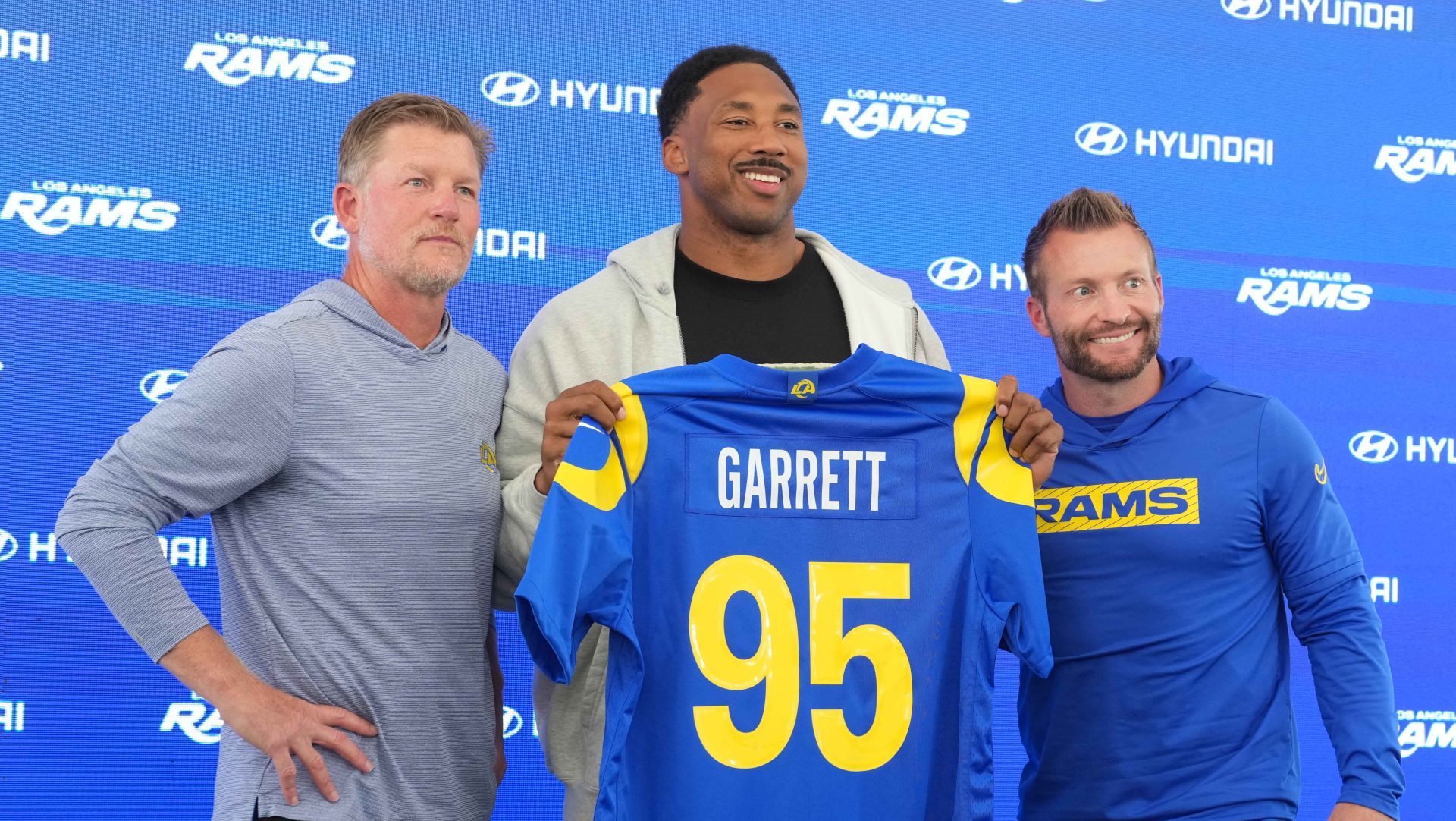
The even bigger trade came in June when the Rams sent Verse and three picks—a first-rounder next year, a second-rounder in 2028, and a third-rounder in 2029—to the Browns for Garrett, the two-time NFL Defensive Player of the Year who set the single-season sack record with 23 last season. The Rams are the first NFL team to have both a quarterback who is the reigning MVP and the Defensive Player of the Year from the previous season.
“They’re in a win-now mode,” Corry said. “They’ve got a quarterback who’s in the twilight of his career, although he’s still an elite quarterback. Matthew Stafford is a year-to-year proposition. They probably thought they should have won the Super Bowl last year. … So they’re like, ‘We’re right there.’ They’re the classic team that you could understand why they would go all in.”
Donald is a three-time NFL Defensive Player of the Year for the Rams who retired following the 2023 season. Now he could make his comeback at age 35. He participated in a formal workout Tuesday with the Rams.
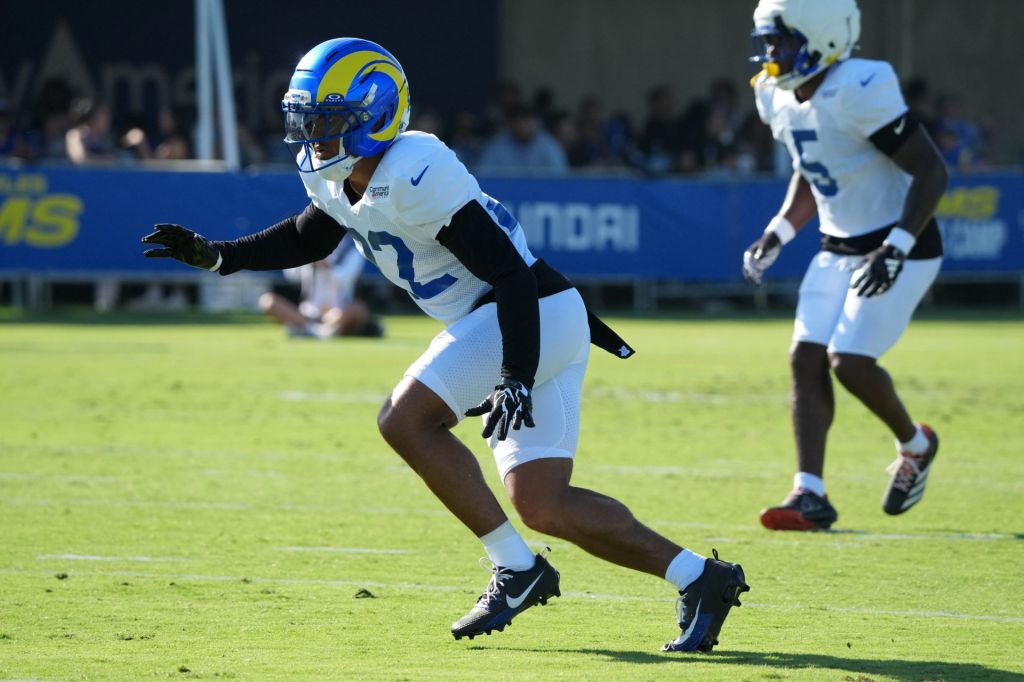
“I’m careful to say, like, things are going in the right direction,” McVay said at a news conference Thursday at the team’s training camp. “He’s feeling good, but we’re not to where we are able to say whether or not he is or isn’t ready to do it. But he’s doing great and he looked outstanding, as I think all of us would expect.”
Donald had one season remaining on his contract with the Rams when he retired. That remains in effect, for approximately $30 million. The Rams have $16.4 million in available salary cap space, according to NFL Players Association records. Many in and around the league expect there would be an agreement on a revised contract if Donald does come out of retirement to play this season.
“They can rework the deal,” Corry said. “I’m assuming they would do that when he comes back. I’m assuming Aaron Donald can still play at an extremely high level. It’s been a couple years. And who knows. Maybe he doesn’t want to be paid top dollar anymore. I don’t know. So we’ll see where that all shakes out.”
Time to Pay the Piper?
The NFL’s salary cap for this season is a record $301.2 million per team, although it varies from team to team based on carryovers from last season. Teams can exceed the figure by taking advantage of cap accounting procedures that allow a team to prorate guaranteed bonus money over the remaining years on a player’s contract. According to Spotrac, the Rams rank 12th in the league with their $357.9 million in cash spending for this season on players’ contracts. They will perhaps move into the top three or close to it if Donald returns with a hefty salary.
Reworking players’ contracts to fit them under the salary cap—often by converting much of a player’s non-guaranteed annual salary to guaranteed bonus money that can be prorated over multiple seasons—can have down-the-road implications for NFL teams in the form of so-called “dead money,” or cap space taken up by charges for players no longer on the roster.
“Before Tampa got Tom Brady, that was a team which would not restructure a contract unless you stuck a gun to their head,” Corry said. “And then you go out and get a quarterback that’s over 40 [and] you win a Super Bowl in the first year, you start restructuring every contract known to mankind because your window is now. Obviously [Stafford is] not as old as Brady was. But [it’s] a similar, related concept. That’s why you make moves like, ‘Hey, this is our window. We can win a Super Bowl this year.’ And then … who knows what the Super Bowl does. Would it push [Stafford] into retirement? If they don’t win, does he want to come back? Who knows. But he’s already probably got himself in the Hall of Fame with the MVP and the Super Bowl ring. But the future is now for them.”
The Rams declined to comment on their cap management tactics.
“What they’re doing with Stafford’s contract is borrowing a page from the Eagles where they’ve got all these multiple option bonuses,” Corry said. “So there’s going to be … enough dead money when he’s done because there’s so much proration tied into that deal. They’re picking up voiding ‘dummy’ years like Philadelphia started doing. Teams have become more comfortable with significant dead money. … Philadelphia is comfortable with a lot of dead money. So there’s going to be some whenever [Stafford] retires or whenever he’s done.”
But Corry also said: “They can, for the most part, outrun it, unless you just bet on the wrong guy.”
Riddick expressed similar sentiments. “I’m not convinced that all of a sudden it’s going to be like, ‘Well, here it is. Now it’s time to pay the piper,” he said. “The salary cap reaper is coming, and now you’re going to suck because you had all those.’ No. … The salary cap, as it continues to increase, is going to allow you to absorb some of these higher future cap figures. … Does it put more pressure on your ability to draft young players on rookie contracts and have them be meaningful contributors? Yeah, it does.”
The Rams kept the No. 13 overall pick in this year’s draft, obtained in a previous trade with the Falcons, and used it on a prospective quarterback of the future in Alabama’s Ty Simpson, a move that was criticized by some observers. His development will become a central issue for the Rams once Stafford is done playing. For now, Simpson is slated to be little more than a spectator this season, provided that Stafford remains healthy and in the lineup, as the Rams chase another Super Bowl title.
“They, to me, are the unquestioned favorite,” Riddick said. “But it’s not like it’s just the Rams and the rest of the field. No, it’s not that. … They’re the favorite. But there are a lot of teams right on their heels. And Seattle’s going, ‘We’re the one who won the damn thing last year. So don’t forget us.’”
Download the FOS App
The business of sports, in your pocket.



Scan the QR code to get the app now.