Want more from Front Office Sports
in your search results?
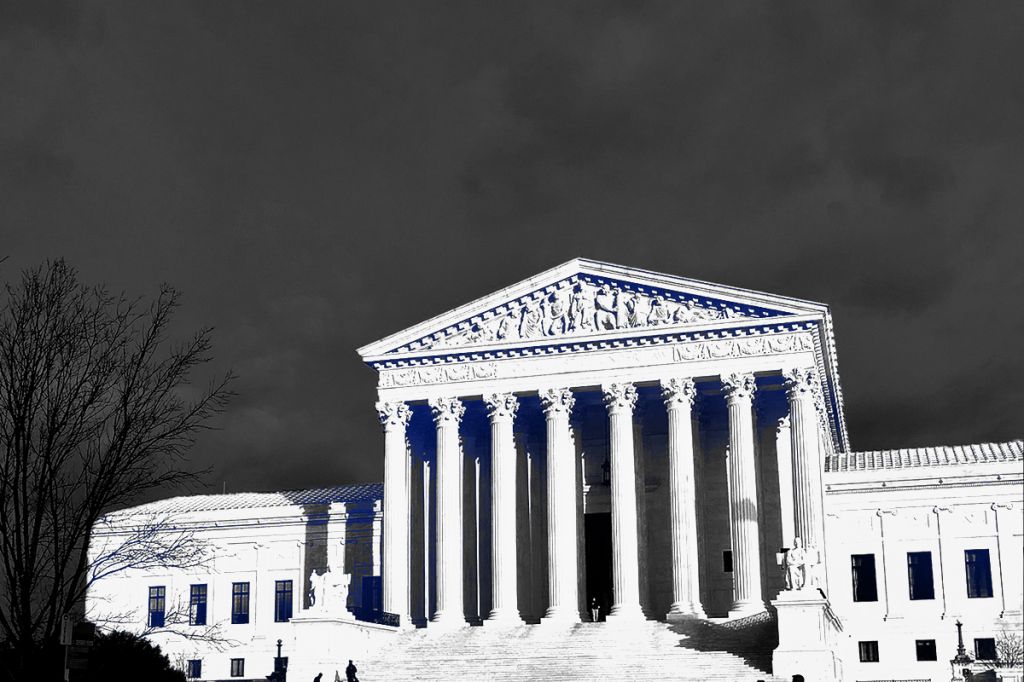
The Supreme Court ruled unanimously in favor of college athletes in the case NCAA v. Alston on Monday. It found that the NCAA did violate antitrust law by limiting the amount of “non-cash education-related benefits” that schools can offer FBS football and basketball players.
The majority opinion was written by Justice Neil Gorsuch. Justice Brett Kavanaugh, extremely critical of the NCAA during oral arguments in March, wrote a searing concurring opinion.
It’s a landmark decision that shows the NCAA’s beloved model of amateurism is not safe in the high court: The ruling leaves the door open for athletes to challenge amateurism in court in the future.
The ruling also has implications for how strict the NCAA can write its rules governing athletes profiting off their name, image, and likeness.
“While today’s decision preserves the lower court ruling, it also reaffirms the NCAA’s authority to adopt reasonable rules and repeatedly notes that the NCAA remains free to articulate what are and are not truly educational benefits, consistent with the NCAA’s mission to support student-athletes,” the NCAA said in part in a statement.
Jeffrey Kessler, lawyer for the plaintiffs, did not immediately respond to a request for comment.
NCAA v. Alston was originally brought in 2014 by a plaintiff class led by former West Virginia University running back Shawne Alston. It came on the heels of another landmark case, O’Bannon v. NCAA, which found that the NCAA violated antitrust law by not compensating athletes for the use of their name, image, and likeness in EA video games.
The ruling itself centers on whether the Ninth Circuit Court correctly applied the test to see whether an organization violated the Sherman Antitrust Act. The Supreme Court affirmed that the lower court did this properly, and systemically took down the NCAA’s arguments one by one.
But the ruling itself was narrow. “The court was careful to explain that it’s decision only applies to the NCAA’s rules that limit educationally related benefits,” Kennyhertz Perry sports attorney Mit Winter told FOS. “It doesn’t apply to the NCAA’s rules that limit compensation related to athletic performance, such as the value of an athletic scholarship or cash payments for performance.”
The NCAA will have the power to define what education-related benefits are, however. Conferences or schools can also legally set their own limits.
This may have an immediate impact on the already complicated recruiting landscape. Winter doesn’t think many schools are ready to expand their education-related benefits immediately. “Those that start offering them first may gain a recruiting advantage,” he said.
The ruling also has several broader implications. The high court took down a major legal defense the NCAA has used for decades. In many cases, it has cited pro-amateurism language from the opinion in a 1980s antitrust case NCAA v. Board of Regents as a bulletproof defense of not paying players.
But the Supreme Court’s opinion rejected this defense. “Board of Regents may suggest that courts should take care when assessing the NCAA’s restraints on student-athlete compensation, sensitive to their procompetitive possibilities,” Gorsuch wrote. “But these remarks do not suggest that courts must reflexively reject all challenges to the NCAA’s compensation restrictions.”
The court then went on to say that if “market realities” change with the times, so to may the assessment of antitrust violations.
“That language was a key part of the NCAA’s legal strategy,” Boise State sports law professor Sam Ehrlich, who submitted two amicus briefs for the case, told FOS. “And this opinion harms that in a big way, despite its relative narrowness.”
Concurring opinions are generally less binding than the main opinion. But if the main opinion gave athletes a legal roadmap to challenge amateurism in the future, Kavanaugh’s concurring opinion provides an open invitation.
“The NCAA couches its arguments for not paying student athletes in innocuous labels,” Kavanaugh wrote. “But the labels cannot disguise the reality: The NCAA’s business model would be flatly illegal in almost any other industry in America.”
He provides examples in other industries, including: “All of the restaurants in a region cannot come together to cut cooks’ wages on the theory that ‘customers prefer’ to eat food from low-paid cooks.”
The ruling could also affect how the NCAA can write rules governing athletes to profit off their name, image, and likeness. The NCAA still hasn’t passed rules, claiming it was waiting for the Justice Department — and this ruling — to see if its strict proposal might violate antitrust law.
Now that the court has made it clear the NCAA is subject to normal antitrust scrutiny, it may have to tread more carefully and pass less restrictive rules. In the NCAA’s statement on the case, President Mark Emmert said he is still “committed” to passing NIL rules.
The NCAA “will have to proceed very carefully on NIL (and everything else) moving forward,” Ehrlich said.
Six state laws will take effect on July 1, restoring this right to NCAA athletes. But because of the NCAA’s delay, athletes in many states won’t have state laws by July 1. Congress will not pass a federal law by then, Sen. Maria Cantwell (D-WA) told reporters in attendance at one of two Senate hearings on the subject in the past two weeks.
The NCAA plans to discuss temporary proposals this week, according to a letter written by NCAA president Mark Emmert that was obtained by the Associated Press.
As the college sports industry grapples with the ruling, it’s clear that, as Kavanaugh wrote, “The NCAA is not above the law.”
“I think this opinion shows that sports exceptionalism arguments will no longer carry the day,” University of Baltimore sports law professor Dionne Koller told FOS. “Coming to court and arguing that the magic of college sports will be lost if the NCAA doesn’t get complete deference is no longer a winning position.”
Download the FOS App
The business of sports, in your pocket.



Scan the QR code to get the app now.