Want more from Front Office Sports
in your search results?
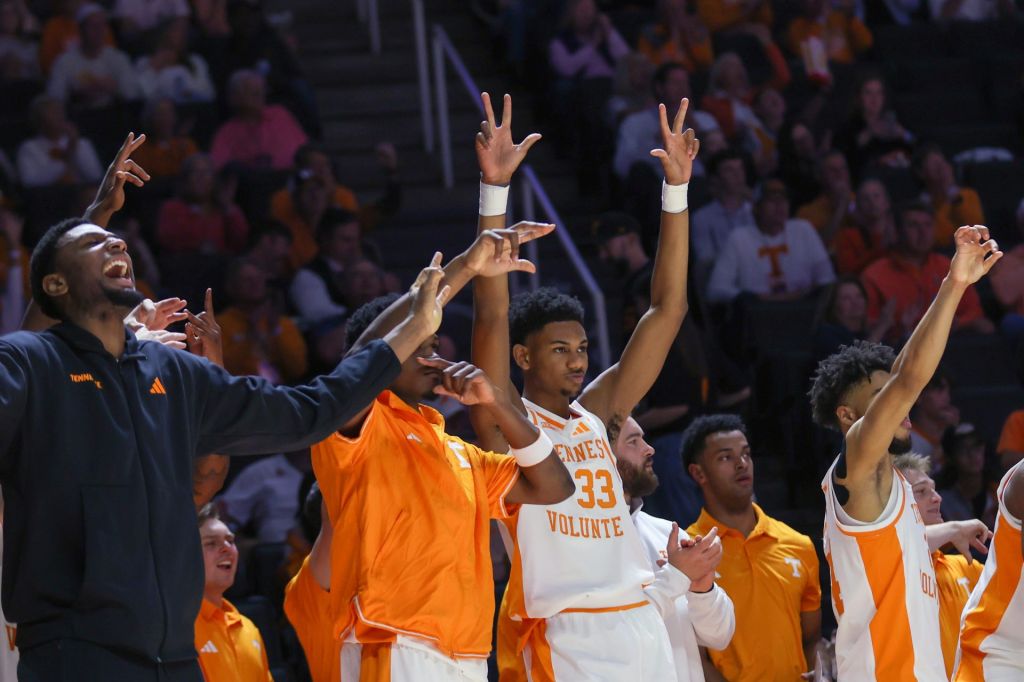
Tennessee men’s basketball players are dipping their toes into collective bargaining.
The Vols negotiated a model collective bargaining agreement with the university, according to an announcement Tuesday. The term sheet for the agreement, a summary of which was shared with Front Office Sports, addresses a range of key issues, from player compensation and health insurance benefits to transfer portal and eligibility rules.
Athlete-advocacy group Athletes.org (AO) facilitated the negotiation with the school’s involvement. AO, a nonprofit that has taken funding from private equity investors, is one of several groups attempting to organize college athletes. The organization hopes to ultimately serve as a college athlete union.
Though Tennessee men’s basketball players aren’t the first to consider collective bargaining—players at Northwestern, Dartmouth, Stanford, and Oregon State have attempted at times to unionize—Tennessee is believed to be the first college team to put together a model collective bargaining agreement.
Tennessee’s football program also engaged in the process, AO said, but decided to pause it during the season.
The agreement itself hasn’t been ratified, and the players haven’t formally created a union. Instead, the negotiation serves to prove that collective bargaining could offer a solution to the biggest question in college sports: Who has the power to create and enforce rules?
“If we repeated this process with every Power Four university today, we could solve most of college sports’ problems by tomorrow afternoon,” AO co-founder and former NFL player Brandon Copeland said in a statement.
Term Sheet
The agreement came together through months of conversations, meetings, and negotiations that began in the summer. After AO pitched the idea, the team elected three player representatives: graduate student Tyler Lundblade, junior Campbell Duncan, and freshman DeWayne Brown II. Once the players solidified their positions, they took the agreement to Tennessee athletics officials, including athletic director Danny White. The players then brought a revised proposal back to their team on Sept. 30.
White, one of the few athletic directors to publicly encourage the college sports world to consider collective bargaining, said that “sharing perspectives through meaningful dialogue isn’t something to be afraid of.”
The term sheet addresses issues from revenue-sharing to player movement:
- It would establish player payment minimums and requirements for athletic department spending on revenue sharing. The agreement didn’t settle on a specific “salary cap” number, instead offering negotiated options, such as requiring schools to spend a percentage of athletic department budgets.
- The agreement establishes a transfer window agreed upon by players for men’s basketball, as well as a five-year eligibility window and a prohibition on players returning to college once they declare for the pros.
- Players agreed to a system to regulate agents, including a centralized registry of agents, caps on agent fees, and an agent certification process.
- Additional issues addressed: negotiated offseason practice time, injured reserve designation, post-eligibility medical insurance benefits.
The agreement would also require AO to represent the players not just in negotiating the CBA, but also for additional services like maintaining an agent database and negotiating group licensing deals.
“In my conversations with athletes over the years, they want a lot of the same things we want,” White said in a video posted Tuesday. “Collective bargaining and mutual understanding of how things work—that’s where this is going in the future. Just look at how every pro sport in our country is structured. What better way to start all of this than engage with the athletes now?”
Legal Questions
Every major professional sports league in the U.S. utilizes collective bargaining. But for years, college sports officials refused to utilize it—even as college sports continued to grow more unstable. Instead, the NCAA, conferences, and schools have poured millions into lobbying Congress to enshrine a federal law, and leagues have explored conference-level governance—so far to no avail.
Detractors of collective bargaining in college sports have argued that collective bargaining would be too complex, given the vast differences between budgets across sports, athletic departments, and divisions. They’ve also pointed to potential unintended financial consequences if players were deemed employees (a prerequisite to formal private-sector unionization under the National Labor Relations Act or public-sector unionization for state employees).
Others have argued collective bargaining wouldn’t be possible currently because players at public schools would be considered public state employees, many of whom don’t have the right to unionize. (Those in this camp include advocates of the Protect College Sports Act, which would enshrine player compensation, transfer, and eligibility restrictions into federal law. The bill passed the Senate with a bipartisan vote in September, but is unlikely to pass the House.)
AO argues that players could negotiate a CBA on a school-by-school basis without being employees right now, because they would simply be negotiating a contract with their school.
AO also argues the process for a more traditional collective bargaining unit across multiple schools is feasible through a “private centralized employer or a multiemployer” bargaining unit. In this scenario, players would be considered employees not just of their schools, but also of their conferences. Because conferences are considered private entities, the NLRA would apply to them—allowing them to bargain as private sector employees.
“What it proves is, despite the myths that people try to say about why it can’t work, and why ‘we should just make the decisions for them, they’re too young to make these decisions’—it can happen,” Copeland told Front Office Sports’s Dan Roberts. “It’s a lot simpler of a process than trying to go to Congress. And it’s also the most equitable process for the schools, the universities, and for the future of the actual industry.”
Download the FOS App
The business of sports, in your pocket.



Scan the QR code to get the app now.