Want more from Front Office Sports
in your search results?
College football entered its most consequential month this week. And two of its biggest brands are afterthoughts.
Rivals Ohio State (6-3, 4-2) and Michigan (5-4, 2-4) fell on Saturday as home favorites, both possibly sealing their seasons.
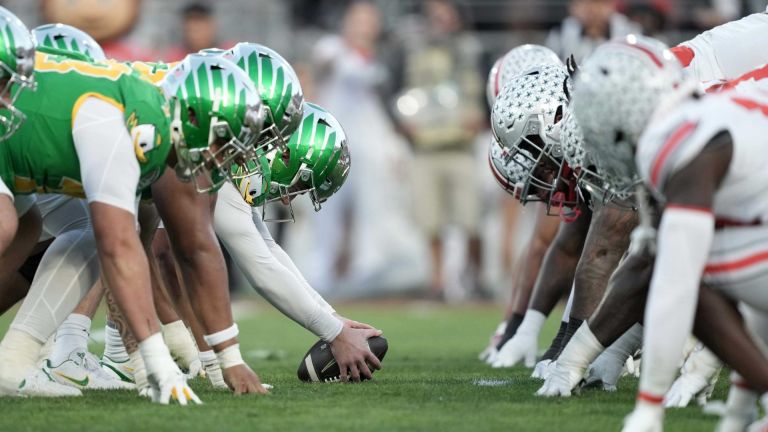
Ohio State entered Saturday No. 12 in the initial College Football Playoff rankings, one spot out of the field, but a 41-28 loss to No. 23 Oregon all but ousted its playoff chances. The Buckeyes took a 14-0 lead in the first quarter before surrendering 38 unanswered points. Ohio State fell 30-18 to USC last week, marking two straight regular-season losses for the first time since November 2011. This is also the first time since 2011 where Ohio State has at least three losses in the regular season.
Ohio State fell to No. 21 in Sunday’s AP poll, its lowest ranking since the CFP era began in 2014 and the first time the AP preseason No. 1 team fell outside of the top 20 during the regular season since USC in 2012.
“We didn’t expect any of this to happen,” Buckeyes head coach Ryan Day said after Saturday’s loss. “I thought the way that we came out was how we thought we would play in this game. Once the momentum swung, we just weren’t able to stop that and then swing it.
“Two weeks in a row, to get this kind of result, there’s something that needs to change and needs to get fixed. So we’ve got to look at all those things and figure out what that is.”
Michigan’s rocky 2026 campaign continued with a 15-6 loss to rival Michigan State, which was winless in Big Ten play (0-5) entering Saturday night. It’s another setback for first-year coach Kyle Whittingham, who didn’t mince words following the game. The last time Michigan had at least four losses in three straight seasons was 2012–14.
“I’m as disappointed as I’ve ever been as a head coach and as frustrated as I’ve been as a head coach tonight. That’s where I am,” Whittingham said.
“We didn’t expect any of this to happen,” said Day. “I thought the way that we came out was how we thought we would play in this game. Once the momentum swung, we just weren’t able to stop that and then swing it.”
Big-Money Investments Gone Awry
Ohio State’s season outlook is particularly disappointing considering the level of investment at multiple levels. The Buckeyes spend the most on football operations in the Big Ten, totaling $92,359,308 during fiscal year 2025. Michigan ranks No. 5 on that list at $61,663,185.
Not only does Ohio State have one of the most expensive rosters in college football at around $50 million, the Buckeyes also have one of the most expensive coordinator tandems in the country. Defensive coordinator Matt Patricia is the highest-paid coordinator in the country at $3.75 million, and offensive coordinator Arthur Smith is making $1.5 million.
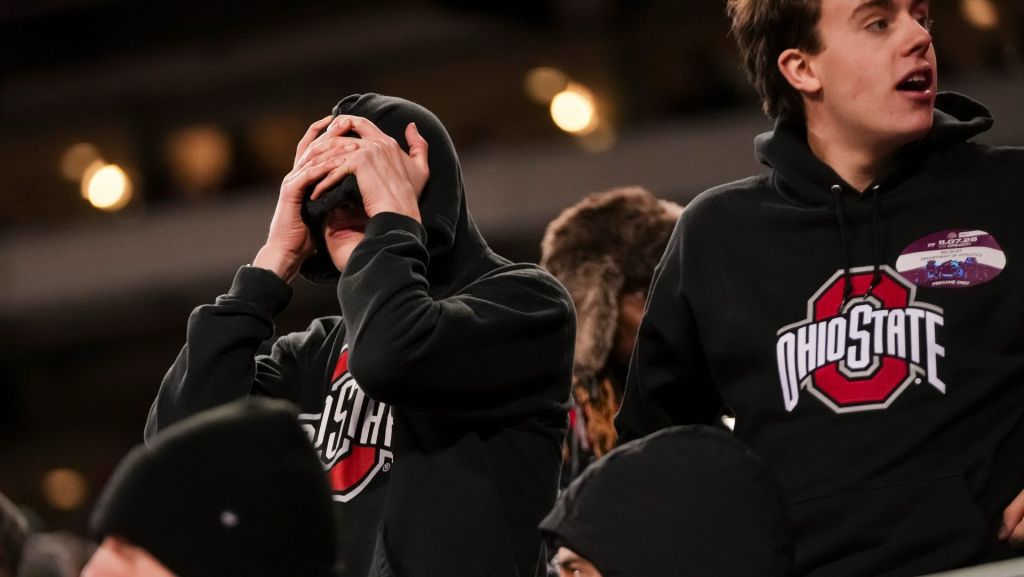
Frustrations with the program have boiled over.
“Can’t allow a team to come in the shoe and be the bully,” former Buckeye All-American and national champion Curtis Samuel said Saturday night. “That’s unacceptable and for sure not the culture.”
Ohio State’s current situation revolves around quarterback Julian Sayin, a Heisman Trophy finalist a season ago, who is likely out for the season after an arm injury against Indiana on Oct. 17. True freshman Luke Fahey has taken over in his place to mixed results. Two of Ohio State’s three lowest point totals have come under Fahey.
“I think the kid’s trying his tail off,” Day said. “It’s a tough spot to be in for a true freshman. But the expectation is to come in and play and win.”
Similarly, Michigan’s invested heavily to subpar results. The Wolverines have the highest-paid coordinator pairing in college football at $5.7 million between offensive coordinator Jason Beck ($3 million) and defensive coordinator Jay Hill ($2.7 million).
Michigan’s struggles this year were also compounded by quarterback play. Former No. 1 overall recruit Bryce Underwood, who signed a lucrative deal with Michigan in 2025, was benched in October in favor of true freshman Tommy Carr, who has accounted for just five total touchdowns since taking over on Oct. 17.
Michigan’s offense ranks 126th in scoring offense and 132nd in total yards this season.
“There’s nothing productive about this game,” Whittingham said after Saturday night’s loss. “It’s not one step back; it’s three steps back.”
Currently Ohio State (6-5) and Michigan (5-6) are among the lower half of Big Ten teams in overall win-loss record over the last 11 games, dating back to Nov. 29, 2025, the final weekend of the 2025 regular season.
The only teams in the conference that have performed worse:
- Nebraska (5-6)
- Michigan State (4-7)
- Maryland (3-8)
- Purdue (3-8)
- Rutgers (2-9)
Coach Contract Situations
Whittingham signed a five-year contract worth $41 million last December. His contract includes a 75% buyout, which would equate to around $24.6 million if he were fired after one season. Despite the struggles, Whittingham remains optimistic about the future.
“When you look down the road, the recruiting class we put together for the 2027 class, we feel really good about,” Whittingham said. “We’ve got a (NCAA transfer portal) season coming up in a month and a half, two months, and just continuing to build the depth and the talent level, just continuing to add to what we’ve got.”
Day signed a seven-year contract shortly after Ohio State’s national championship season in 2024, valued at $12.5 million per year through 2031. A potential buyout, worth an estimated $75 million, would be one of the most expensive in college football history.
“I’ve got to evaluate everything and try to come in and figure out with the staff the things that we’re just coming up short on and figure out how to adjust those things,” Day said. “And I think it all starts with the staff, and then it goes to the players. So there needs to be accountability for all of it, and then we go from there.”
Download the FOS App
The business of sports, in your pocket.



Scan the QR code to get the app now.