Want more from Front Office Sports
in your search results?
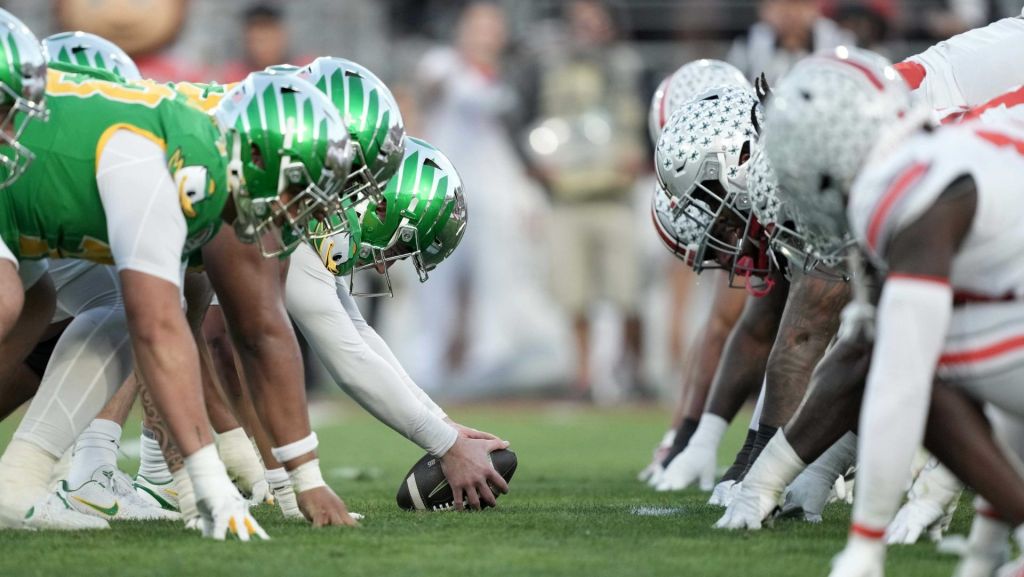
Ohio State and Oregon occupied nearly 80% of the first-place votes (54 out of 69) in the preseason AP Top 25 poll. Nearly three months later, both programs—which have invested heavily in their rosters—will meet on Saturday in a game that’s fallen short of its preseason hype. The two teams have a combined five losses entering Saturday’s matchup in Columbus: three for the Ducks (5–3 overall, 3–2 Big Ten) and two for the Buckeyes (6–2, 4–1).
It’s still one of seven ranked matchups this weekend, but No. 12 Ohio State and No. 23 Oregon’s placements in the initial College Football Playoff rankings aren’t where either team envisioned itself, especially considering the two programs are projected to have the two most expensive rosters in college football at around $50 million apiece.
On Oct. 28, the Big Ten’s presidents and chancellors announced that they’ve adopted a conference rule that would cap institutional involvement in athlete NIL (name, image, and likeness) deals at $49 million per school, mirroring the framework of the proposed Protect College Sports Act. The $49 million is represented by a split between $27.5 million in third-party NIL agreements and $21.58 million in current revenue sharing under the House settlement agreement.
The presidents and chancellors unanimously agreed to the rule. At Big Ten media days in July, Ohio State coach Ryan Day supported an increased cap, but with regulation. To this point, the agreed-upon $21.58 million from the House settlement was the maximum amount a school could pay out.
“I think we all would like to see more structure when it comes to the salary cap and then how things are handled above the salary cap,” Day told reporters in Chicago. “Call it a ‘soft cap.’ I think if you’re talking about that, yeah. Do I think the cap should be higher? Absolutely.
“What does that mean in terms of parity and all that? I don’t know. But I can tell you right now, we want to pay our players and we certainly would like to see that cap go much higher.”
Both coaches have maintained the importance of this game for their 2026 season outlook and respective brands. Looking ahead, these are also two programs that will have to reimagine their spending to become compliant with the conference’s new rule, which took effect immediately.
“I think that Ohio State speaks for itself,” Oregon coach Dan Lanning told reporters earlier this week. “They’re a really good team, and it’s a real challenge this time of year. I mean, it’s part of what makes it exciting about being at Oregon or being at a place like Ohio State: to get to play in games like this. So this is one that certainly means a lot to both of us.”
New Spending Limits
The Big Ten has publicly supported the Protect College Sports Act, which, among other things, features a cap on athlete spending. The conference’s move last week was a proactive measure to get ahead of a potential financial shakeup.
“It is imperative our member institutions can begin to plan, budget and build their rosters approximating the act’s economic structure,” Big Ten Council of Chancellors/Presidents chair Pamela Whitten said in the official release. “Our institutions remain in full support of the Protect College Sports Act and this rule not only allows for a much smoother transition into the policies put in place by the act once it passes, but demonstrates our commitment to it.”
However, the future of the bill is in serious jeopardy after Democrats regained control of the House and Senate in this week’s midterm elections. In September, the PCSA had strong momentum after the bill passed the Senate with a bipartisan vote of 77–22. But the bill faced an uphill battle in the House even before the midterms; now that challenge is even greater.
The United States House Committee on Rules is set to meet next Monday, Nov. 9, but the Protect College Sports Act is not on the agenda.
Quarterback Misfortune
Ohio State and Oregon’s current situations revolve around setbacks at quarterback. Ohio State’s Julian Sayin, a Heisman Trophy finalist a season ago, is likely out for the season after sustaining an arm injury against Indiana on Oct. 17. True freshman Luke Fahey took over in his place and started his first game last week at USC, which the Buckeyes lost 30–18.
On the other side, Oregon’s Dante Moore was a projected first-round pick in last year’s NFL Draft but returned to Oregon with significant preseason expectations. Moore suffered a concussion on Sept. 26 against USC in a controversial play that resulted in a targeting penalty and the ejection of Trojans defender Desman Stephens II. Moore isn’t expected to return this season. The Ducks have one of the most notable backup quarterbacks in the country in Dylan Raiola, but he’s played to mixed results thus far. Oregon is 3–2 with Raiola in the lineup. Within the offensive shakeup, Oregon fired offensive coordinator Drew Mehringer last week.
Playoff Implications
Despite disappointing results, there’s still a pathway to the 12-team Playoff for each team with a win. Ohio State is currently the first team out in the projected bracket, but another win over a ranked team would bolster its resume and put the Buckeyes in position to move upwards if a team ranked ahead of them loses.
Oregon is further outside of the 12-team bubble, but a win on the road at Ohio State would vault the Ducks upward. Oregon needs to win out to finish 9–3 and likely needs more losses from teams ahead for better positioning. However, a loss would be very notable for both programs; Oregon hasn’t lost four regular-season games in a season since 2018, and Ohio State hasn’t lost three regular-season games since 2011.
“The margin for error here is tiny,” Day told reporters this week. “We better recognize that if we don’t get things fixed and play better, it’s not going to go better against Oregon … The urgency better be very high for everybody, coaches and players included.”
Download the FOS App
The business of sports, in your pocket.



Scan the QR code to get the app now.