Want more from Front Office Sports
in your search results?
Earlier this year, the NCAA reported targeting penalties were declining. But an illegal hit on Oregon quarterback Dante Moore shows there’s still work to do before eliminating it from the game.
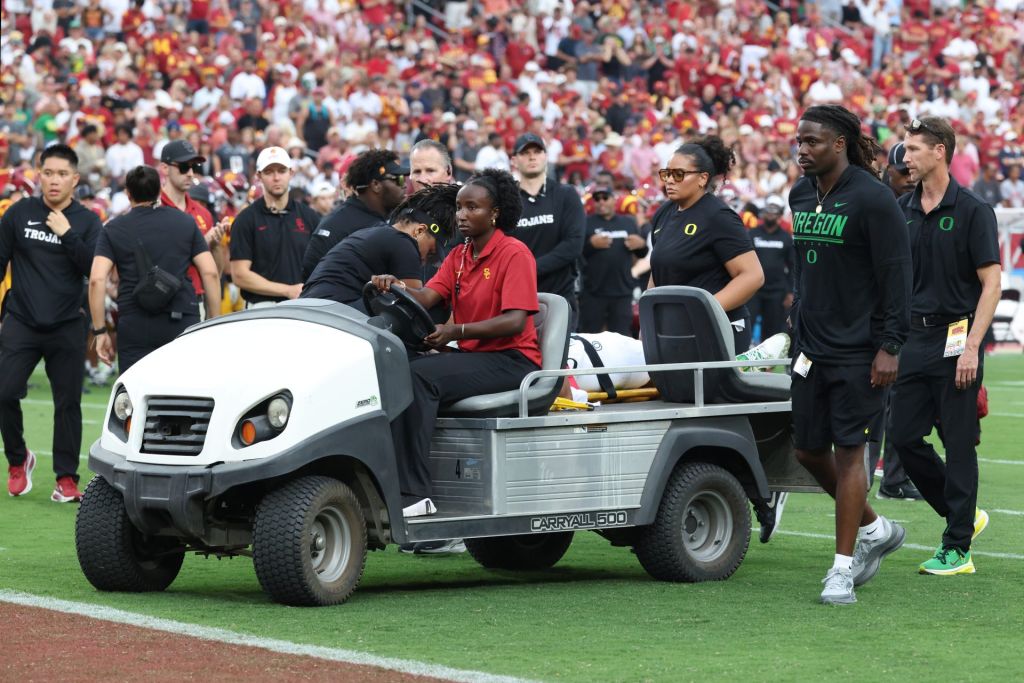
Moore was carted off the field early in the second quarter after sustaining a hit from USC defender linebacker Desman Stephens II. With Oregon trailing 7–3 with 10:10 remaining in the second quarter, Moore scrambled for 11 yards and attempted to slide feet-first, while Stephens II made forcible helmet/shoulder contact to Moore’s head and neck.
Officials called Stephens II for targeting, and Stephens II was ejected from the game.
This season, the NCAA implemented new targeting rules, highlighted by a one-year trial rule that would allow a player disqualified to play in his team’s next game regardless of which half the penalty was assessed. Previously, players disqualified for targeting had to sit out the rest of the game, and if the penalty occurred in the second half, they were disqualified from the first half of the next game.
Although the hit occurred in the first half and therefore doesn’t impact Stephens II in this instance, under the rule, penalties increase with each offense. A player flagged for targeting a second time during the season will sit out the first half of the next game. A third targeting ejection in the same season would mean the player misses the next game entirely. The NCAA reported 117 total targeting fouls enforced last season, and 64 occurred in the second half, so those players had to sit out the first half of the next game. Those players wouldn’t lose additional playing time under the proposed rule if it’s their first targeting call.
Moore, a projected first-round pick in the 2027 NFL Draft, remained on the ground for a long time after the hit. NBC sideline reporter Kathryn Tappen reported that Moore was able to move his fingers and feet on the field and was transported to Los Angeles General County Hospital for further evaluation.
The NCAA first implemented a targeting rule in 2008, making it illegal to initiate contact with the crown of the helmet or hit a defenseless player above the shoulders. The initial penalty was just a 15-yard penalty without an ejection.
In 2013, ejections were added as an automatic penalty, along with second-half suspensions carrying over to the first half of the next game—which continued until this year’s rule change. In 2019, mandatory video reviews were introduced for all targeting calls.
Download the FOS App
The business of sports, in your pocket.


Scan the QR code to get the app now.