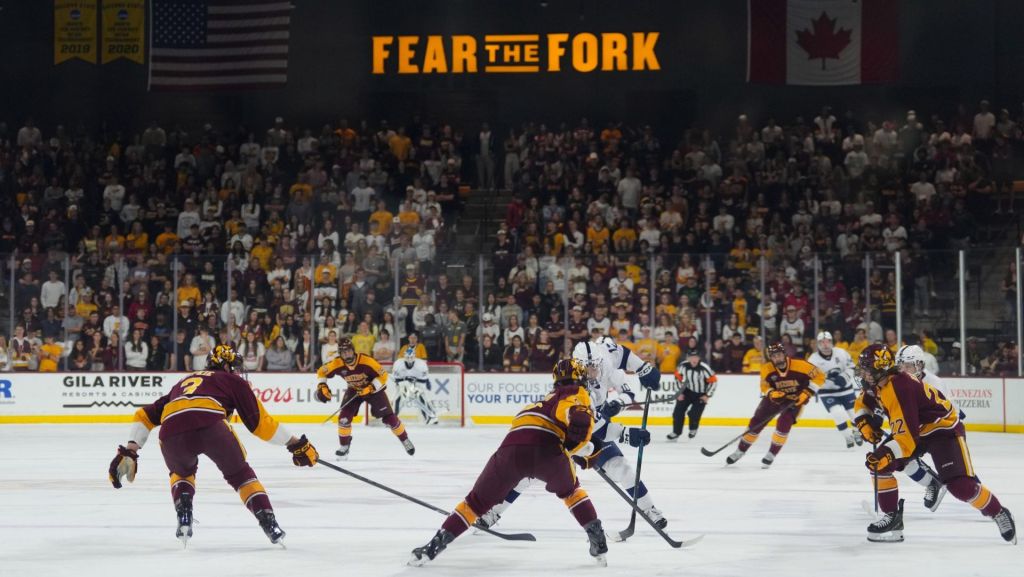
Arizona State hockey player Matthew Mayich remains hospitalized after collapsing during a workout conducted at campus facilities on Aug. 20.
The offseason session was run by Tim Zeisel, a former Green Beret who was not an ASU employee. According to multiple reports, Zeisel conducted the approximately one-hour morning workout in roughly 90-degree temperatures, which led 21-year-old Mayich to develop exertional heat stroke that caused a lack of oxygen to the brain.
Zeisel’s lawyer told The Arizona Republic that the workout, which was the first in a planned three-day program, was mid-intensity, “not a Green Beret or SEAL workout.” Mayich’s legal counsel, Rob Carey, has disputed this. Regardless of each party’s description of the ASU session, third-party, military-inspired workouts have become part of elite-athlete training at both the college and pro levels.
There’s no strict definition for what constitutes “military-style” training. Adam Annaccone, a clinical associate professor in kinesiology at the University of Texas at Arlington, tells Front Office Sports they can often include simple exercises like sprints or crawls, usually performed at high volume or intensity and with limited recovery. They are not necessarily all deeply physically strenuous, drill-practice programs, and are usually not intentionally designed to push athletes to the brink.
Often, he says, the point is not for complete functional exhaustion, but rather team-building—think problem-solving, communicating, and following directions while fatigued and uncomfortable. Annaccone, who was an associate athletic trainer with the Phoenix Suns from 2013–16, says the team held Navy SEAL–led programming during training camp to develop bonds.
He believes the idea of putting teams in situations of adversity is good for training and leadership. So, when things get dangerous, it’s not necessarily due to the “military” nature of the workouts themselves. Rather, it’s when the authorities facilitating them haven’t evaluated the plans in advance from a physiological-principle standpoint to make sure they’re safe and effective, or put in place action to address emergencies if they do occur.
“The body shouldn’t be jeopardized to try to create adversity to then build the leadership component. You almost need to separate out the two,” Annaccone says.
This management is incumbent on schools. The NCAA provides guidelines for athlete safety and recommendations to prevent catastrophic injuries and illnesses, including exertional deaths; it does not bar specific types of conditioning, but rather stipulates that it expects member schools to follow “evidence-based” procedures. (The workout that hospitalized Mayich, who had arrived on campus earlier that week, did not follow the NCAA’s climate acclimation protocol, according to Carey.)
That leaves individual institutions responsible for evaluating each plan and creating a governance system.
This is what Tufts did following a military-style conditioning session in 2024 that left nine students hospitalized. On Sept. 16, the men’s lacrosse team underwent a 75-minute workout run by a third-party, who was a recent alumnus, former lacrosse-team equipment manager, and current Navy SEAL. Among the exercises in the session, athletes were asked to complete 250 burpees. Following the workout, which was approved by the Tufts Director of Sport Performance the same day it was submitted, 24 of the 61 participating students developed exertional rhabdomyolysis, a condition resulting from overtraining that causes acute skeletal muscle injury.
The D-III university, which competes in the NESCAC, commissioned an independent investigation, released in January 2025. It found the Navy SEAL workout was “unusually intense,” and did not follow NCAA, NESCAC, or university guidelines of acclimatization.
A Tufts source told FOS that the university installed a full-time athletic director for compliance shortly after, a move expedited by the incident. While the source is not aware of whether military-led workouts are now banned at the university, Tufts has instituted a stringent “vetting process” on any proposal for third-parties to work with its athletes; now, conditioning is conducted almost exclusively by its own internal athletic-department staffers.
“Bringing outside people into the building to do workouts at this point would be a pretty hard sell,” the source says.
In general, many internal sports-medicine departments have become better equipped so fewer third-parties are conducting workouts. But issues still arise from internal athletic staff being unprepared, says Rod Walters, national director of athlete safety for Andrews Athlete.
“When I go to some places, their exertional heat policies are non-existent. Their emergency action plan, non-existent,” says Walters, who conducted the Tufts investigation. “Eighty-five percent of the cases I’ve dealt with as an expert witness deal with failure of an emergency-action plan, and that’s the lowest-hanging fruit we have.”
The publicly disclosed protocols concerning heat-related illness FOS could identify on ASU’s website are on the business school’s safety-resources page. FOS inquired directly with the university about any specific safety procedures it had in place for the Zeisel-led workout or other third-party-led conditioning sessions, or overarching general governance around athlete workouts before Aug. 20. ASU referred to its Sept 3. statement:
“ASU has institutional guidelines and requirements relating to the engagement of outside entities who interact with ASU student-athletes and sport programs. Sun Devil Athletics also has heat-illness guidelines in place; these guidelines are informed by the National Athletic Trainers’ Association. SDA student-athletes regularly practice and train outside, under coach and trainer supervision.”
In the current, wider landscape, Walters tells FOS he doesn’t expect the injuries and even deaths to slow down in college sports. “It’s like the definition of insanity… We keep training players the same way,” he says.
The workout that crucially injured Mayich could mark a turning point, but at least at ASU for now, no institutional changes have yet become public since Aug. 20. ASU says it has opened a “review,” but its athletic director clarified it is not a formal investigation. The ASU hockey team posted an acknowledgment of Mayich’s “incredibly difficult time” on X/Twitter on Sept. 5, and ASU confirmed to FOS its program is preparing for the upcoming season without any staffing changes, which will be contingent on the results of the review. And for Mayich, Carey says the St. Louis Blues prospect has “zero chance of recovery.”
In the meantime, Annaccone believes military-inspired sessions will continue.
“Everyone’s looking for that little bit of competitive advantage. You’re trying new things and different types of activities to see what connects and what can pull a team together. You’re asking, ‘What’s one thing that would make us a little bit better or help us win a championship?’,” he says. “With our military, we talk about how [Navy SEALs] can predict each other’s steps and their thought processes. From a competitive standpoint, that’s very appealing. But you can’t abandon your principles to get that done.”