Want more from Front Office Sports
in your search results?
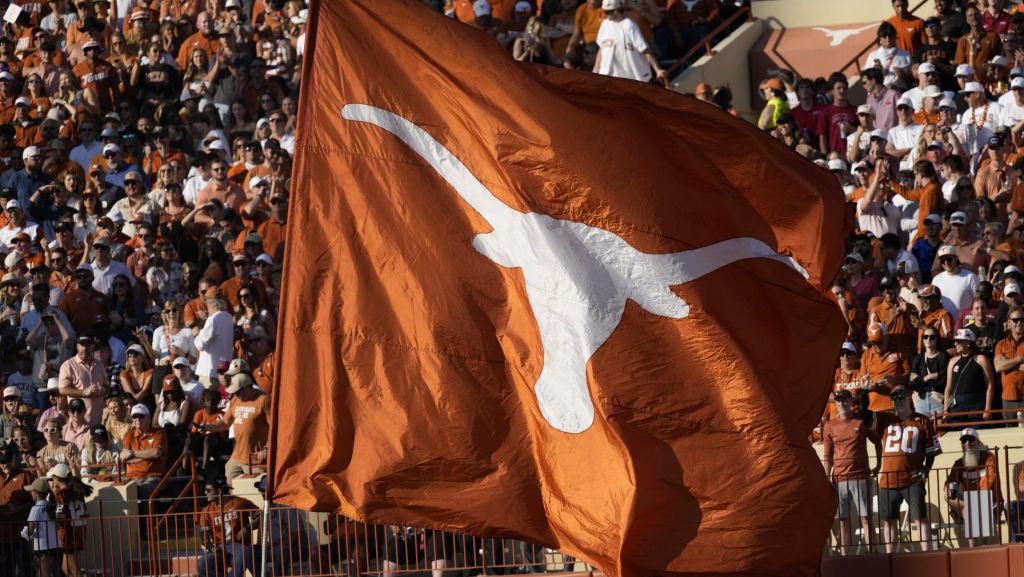
On Friday, University of Texas athletic director Chris Del Conte announced the launch of Bevo Lab, an initiative that will develop artificial intelligence-driven tools for coaches and student-athletes across its 21 varsity athletic programs, including sport-specific chatbots and roster evaluation models.
Dell Technologies, Google Cloud, and SHI International are supporting the project, which is being led by acclaimed sports data analyst and author Kirk Goldsberry. Now the executive director of the Business of Sports Institute at Texas’s McCombs School of Business, Goldsberry previously oversaw analytics operations for the NBA’s Spurs and Team USA Basketball for the 2016 Olympics. He is also an NBA analyst for The Ringer and makes frequent appearances on The Bill Simmons Podcast.
Goldsberry spoke with Front Office Sports about how Bevo Lab plans to give Texas a competitive edge, the opportunities and ethical questions that come with bringing AIinto college athletics, and how he squares the uniquely human appeal of sports with the industry’s growing embrace of technology.
This interview has been lightly edited for length and clarity.
Front Office Sports: What has your own personal journey with AI been? Have you always viewed this as a valuable tool, or is it more a matter of “Well, if everyone else is going to use it, I need to use it too?”
Kirk Goldsberry: I’ve been using AI in sports analytics for a long time, long before ChatGPT and Claude gave us AI for the masses, for lack of a better term. It was a logical extension of things we were working on in sports analytics, specifically with predictive modeling. I think if there was a community that was pretty ready for this to happen and explode, it might have been sports analytics among all the other STEM fields and statistical modeling fields.
FOS: You were at the forefront of basketball’s analytics revolution during your time with the Spurs. Is there anything you can draw on from that experience with regard to what we’re now going through with AI and sports? How is it similar or different?
KG: The Spurs, among other things, are one of the great model organizations in sports. So some of those best practices and the standard the Spurs set have come with me into this approach at the University of Texas, which I love.
We’re a college campus after all, so we’re very well equipped to do certain things with technology, and I think you know part of the answer to that question is just like “Why not college sports? Why are we doing this in pro baseball, in pro basketball, in the NFL, but not doing it in college sports?” This is a multi-billion-dollar industry too.
FOS: The stated goal of the Bevo Lab is to help Texas athletes and coaches “become more efficient in their training and preparation.” Can you give a concrete example of two of what that means or looks like in practice?
KG: For our coaches, like when people think about “Moneyball,” the book by Michael Lewis—it’s still the best book of the 21st century in my opinion by the way—it really said we could use data and analytics to make us better prepared as strategists and to help us find competitive advantages in business and in sports. So why not Texas football? Why not Texas volleyball? Why can’t we use these same approaches and bring it to help our coaches be a little bit smarter, have a little bit more decision support as they approach a big game or a recruiting cycle or the transfer portal.
As for the athletes, it’s the same thing. The athletes can’t understand their performances, their limitations, their strengths, or their weaknesses without data. I always say a strategy without data is a wish. And really, what Bevo Lab is providing our coaches and our athletes is very curated data and intelligence for their needs, so that their strategies are in fact strategies.
FOS: What has Steve Sarkisian’s reception been like to this initiative? There’s a perception of football coaches being “football guys” who are set in their ways.
KG: I should say this project wouldn’t be possible without our athletic director Chris Del Conte, and it starts at the very top, and he is absolutely over-the-moon passionate. He’s like, “We need to do this. This is the way it’s going to be.” And if I didn’t have that support, I can’t walk into our coach’s offices in any sport, let alone football, and say, “Hey, hey, can we do this project together?” That’s just not going to happen.
So, the most important piece is that leader at the very top of the organization. With his support, I can go into football and talk to coaches, and they’ve been great too. Steve Sarkisian is not a typical college football coach. He has NFL experience; he’s seen how pro sports operate. He and his team know that their data isn’t being optimized, so they’ve handed over all their processes and their reports for us to start to understand and to streamline.
FOS: Most uses of AI are met with pushback around and/or criticism, but an anti-AI sentiment can feel especially strong among the sports community sometimes. (Fans have a lot to say when teams or networks use AI-generated content or graphics; and athletes are frequent targets of AI slop misinformation, as a few examples.) How do you square your own sports fandom with your embrace of AI in this way?
KG: It’s a great question. I’ll start by saying, as an educator, AI has upended our classrooms. Best practices have changed in real time. From when the seniors in my classes right now were freshman, the approach to teaching and learning has completely changed, and a lot of people are upset and cynical about this stuff, and I’m sensitive to that.
As it relates to sports, I think this project provides a really good opportunity for our university to demonstrate that nothing is as good at turning a lot of data into a lot of intelligence as AI is, especially when properly driven. So we’re going to blend the resources of faculty and staff and experts in the fields and our tech partners to help us get literal wins out of data via artificial intelligence.
There are reasons to be skeptical about AI and its impact in many domains—and trust me, I’m there. I’m a writer. But when it comes to sports analytics, it’s pretty clear that this stuff is going to lead to a lot of improvement and a lot of new standards for best practices in that field.
FOS: On that front, one of the main arguments against AI is that it can cost people jobs. Do you anticipate the Bevo Lab reducing labor costs or needs at Texas?
KG: No, quite the opposite, and I have the budget I’m putting together to prove it.
There’s going to be a lot of new and exciting jobs for our students to apply their emerging skills and STEM skills to these cool sports projects. And oh, by the way, that’s going to help place them land in real grown-up jobs in 2029 and 2030. They’re going to end up working for our partners—Dell and Google and SHI—and that’s part of the thing I’m proudest about of this whole deal. It’s like, what if I accidentally built this cool vocational experience at the university in sports that ended up enhancing our students’ abilities to get not only jobs while they’re here on campus to pay for beer and pizza, but also get real jobs in sports or in tech once they’re done.
FOS: Another key output of the Bevo Lab is chatbots built specifically for Texas athletes, coaches, and athletic administrators. How will or do these look and feel different from a standard-use one, like ChatGPT?
KG: It looks different in a really minor way. It’s attached to a pretty small amount of the world of data. So, it’s attached to a really good data set about, let’s say, our next opponent in baseball. Let’s say it’s baseball season and we’re playing Vanderbilt for three games, and we have all the data from all Vanderbilt’s games—their pitchers, their hitters, and our baseball manager, Jim Schlossnagle, says, “Who’s starting Friday night?” Instead of going into a spreadsheet and with a highlighter like he’s done for the last 30 years, he can be like, “OK, what are this guy’s top three pitches? How often does he throw the fastball? Is it a two-seam or a four-seam?”
That ability to have that conversation in natural language is one of the biggest things AI has given us. What we’re taking away is that need to be a super nerdy quant, and we’re allowing our baseball coaches to interact with the data and ask questions naturally. They can say, “Hey, give me a graph of this guy’s velocity over the last five outings, or when he misses pitches, where does he miss? After he throws a fastball, what is he likely to throw next?” Just those natural language conversations are a breakthrough for sports analytics because it allows an untrained STEM person to do really things that were 10 years ago very hard to achieve without advanced knowledge of computer science and statistics. And let’s face it, coaches are really good at a lot of things, but not many of them went to school for computer science or statistics.
FOS: Other universities and their athletic departments are building out AI initiatives of their own. Do you think there should be some sort of regulatory or governance mechanism for the use of the technology in college sports—particularly football? Or is a free-for-all arms race a good thing?
KG: I wouldn’t want a free-for-all. There’s some really sensitive data sets about student-athletes, who are young people. We have to get that right. And again, leaning on, say, Google Cloud- in this case- they deal with medical data all the time. They deal with privacy at very, very big institutions, including the U.S. government. So if I say, “Hey, I need to make sure that our data sets are protected and secure at the highest levels, and that only people who have credentials can even see that data,” I’m pretty glad to have those partners on my team here.
I think there is a blurry line between, say, medical data and sports analytics, and there are some significant ethical concerns that I’ve taught about for years in this field. So when you say free-for-all or arms race, that’s pretty scary, and I would hope if other universities are are doing something similar, they’re taking this as seriously as we are at the University of Texas and making sure that the data sets are treated with the reverence and respect and privacy that they demand. I don’t think many other universities are doing anything like this, but I bet that’s about to change. And there needs to be a serious conversation at each of these universities to make sure that things are being done ethically and correctly.
FOS: A popular narrative that gets parroted by brands and sports properties is that sports is one of the last AI-proof industries—that it’s live, human work that can’t be manipulated in real time. What do you make of that given your work?
It’s true to an extent. I don’t know if AI-proof is the right term, but when you go watch a live event and you’re watching the Texas Longhorns play basketball against the Oklahoma Sooners, there are human beings doing amazing things in front of you that robots can’t do or computers can’t do. It reminds us that human beings are capable of amazing things, and that’s why I think performing arts are also in a similarly strong position—the demand for watching people be amazing is going to increase. And in that sense, I would say sports are only going to get more and more popular.
But behind the scenes of music, behind the scenes of sports, there’s computation. And wherever there’s computation now, there’s AI. AI has been a long-time partner of mine in this field. But at the end of the day, it is pretty cool that it’s just athlete versus athlete out on a basketball court or a baseball field, and I think that’s that’s that’s truly awesome, and more so as everything else becomes more and more computational.
Download the FOS App
The business of sports, in your pocket.



Scan the QR code to get the app now.