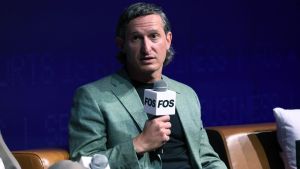
Renowned sports attorney Jeffrey Kessler is taking on a different kind of assignment.
Kessler, partner and co-executive chairman of Winston Taylor, signed on to represent Paramount Skydance as the entertainment company defends its merger with Warner Bros. Discovery from mounting opposition. He appeared on CNBC on Tuesday to advocate for the merger as Paramount fights 12 state attorneys general who have filed a lawsuit attempting to block the merger.
In Kessler, Paramount has enlisted one of the most powerful lawyers in the entire sports industry. Kessler is known for representing individuals against leagues or governing bodies—including the NFL, NCAA, and U.S. Soccer, among others. (Though not a sports-specific case, Kessler also recently represented dozens of state AGs in a legal battle alleging antitrust violations against Live Nation and Ticketmaster.)
In the Paramount case, however, he’s arguably taken the opposite side: representing a multibillion-dollar company looking to defend against allegations that a merger with another multibillion-dollar company, WBD, violates antitrust law.
“If you follow my career, you know that I try to take on significant cases that will advance the goal of competition that underlies the antitrust laws,” Kessler said in a statement to Front Office Sports. “Often, these are plaintiff cases, such as my cases against the NFL, NBA, NASCAR, the NCAA, and, most recently, against Live Nation. But I also have done many defense-side antitrust cases when I believe the antitrust claims being asserted would actually hurt, not help, competition. This is why I took on the defense of the Paramount–Warner Bros merger.”
In the college sports space, Kessler is most known for representing athletes against the NCAA in two lawsuits regarding athlete compensation—considered two of the most consequential and industry-shifting decisions in recent memory.
In 2021, he garnered a 9-0 Supreme Court ruling in favor of athletes NCAA v. Alston, a Supreme Court case over whether the NCAA’s restrictions on education-related benefits violated antitrust law. The precedent set by the case opened the floodgates of lawsuits against the NCAA on antitrust grounds, as it found that the governing body was subject to strict antitrust scrutiny.
Kessler also served as a lead attorney on the landmark House v. NCAA lawsuit (first filed in 2020, while Alston was ongoing) against the NCAA and power conferences. The parties settled last year, implementing an agreement that allowed college athletes to get paid by their schools for the first time.
Among Kessler’s other notable college sports clients: former Texas Tech quarterback Brendan Sorsby. Kessler convinced a Texas judge to grant him NCAA eligibility despite engaging in years of gambling activities. (Sorsby ultimately opted not to stay in college, and Kessler represented him when requesting a spot in the supplemental draft of the NFL, which the league denied.)
Beyond college, Kessler has represented the U.S. Women’s National Team in their successful legal battle against U.S. Soccer for equal pay. He’s also represented the players’ unions for the NFL, MLB, NHL, and NBA, and represented players in McNeil v. The NFL in the early 1990s, the case that led to NFL free agency.
Now, in representing Paramount, he takes on a different role—even though he sees it as in line with the same ideological goals of defending competition.
In his statement to FOS, Kessler said the Paramount–WBD merger represents “a transaction that will have procompetitive effects by creating a more able streaming competitor to the industry giants—Netflix, Disney, and [Amazon] Prime—and lead to more theatrical pictures and stronger cable channels to support linear broadcasting. That is the very competition that the antitrust laws encourage.”