Want more from Front Office Sports
in your search results?
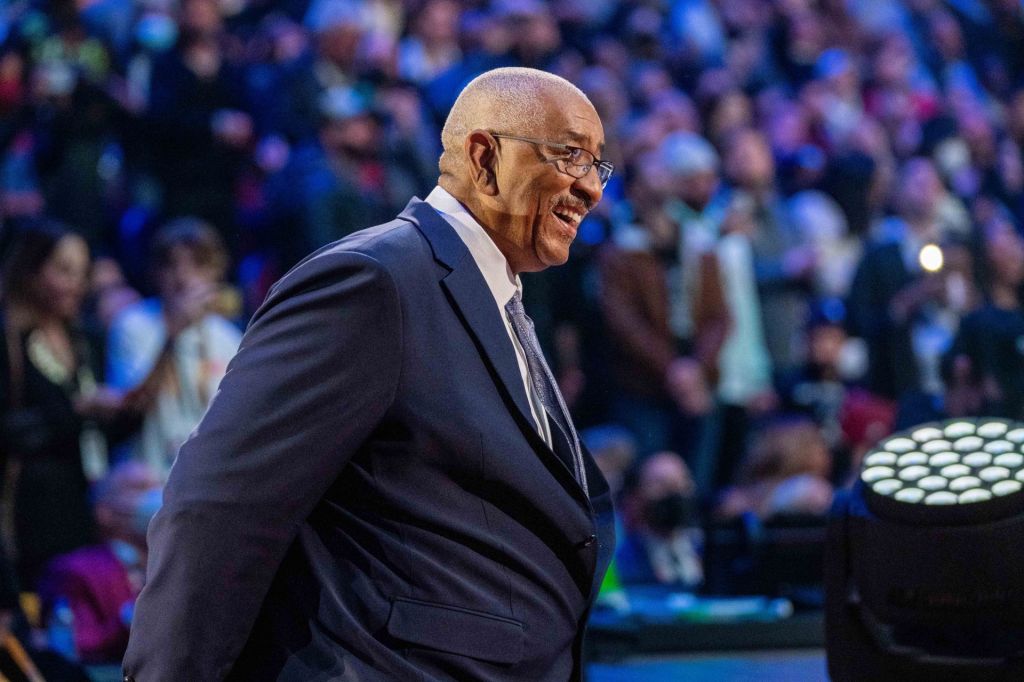
George Gervin was known as “Iceman” for decades before Caleb Williams was even born, but the NBA legend has been rejected in his initial attempt to trademark the term, and the Bears quarterback appears to have a procedural advantage because his application was filed first.
The application from Williams was denied June 24 because Oregon-headquartered Lacrosse Footwear has held the “Iceman” registration since 1988 for insulated boots. That decision, however, isn’t final and the quarterback can respond to the U.S. Patent and Trademark Office with evidence for why he should be granted the registration. It’s not clear if Lacrosse Footwear still sells the boot, and a representative for the company has not responded to requests for comment.
Gervin, through Gervin Interests LLC, filed applications to trademark the terms “Iceman” and “Iceman 44” four days after finding out Williams was making a push to trademark his longtime nickname. The NBA Hall of Famer has now also received initial denials.
The first denial, issued June 26, relates to Gervin’s “Iceman 44” filing. It explicitly states that the application was denied because of a “likelihood of confusion” with Williams’s application. The second, issued July 9, denied Gervin’s application to trademark “Iceman” for a variety of purposes, including clothing, live entertainment services—such as appearances on TV or in movies—and basketball camps.
Both Williams, 24, and Gervin, 74, now have at least three months to respond to the initial denials and provide evidence for why they deserve the trademarks.
Intellectual property attorney Josh Gerben wrote that the June 26 decision puts Gervin and Williams on a “collision course.” He tells Front Office Sports that while Gervin has the stronger cultural claim to the nickname, that doesn’t matter when it comes to USPTO procedure.
“The government will say ‘hey, you can file all the responses you want; we’re going to suspend your filing and see what happens with Caleb,’” Gerben says.
‘Hilarity of the Situation’
Another wrinkle is that while the USPTO cited Williams’s application in denying Gervin’s attempt to trademark “Iceman 44,” it didn’t specifically cite the quarterback in denying Gervin’s application to trademark “Iceman” by itself. In that denial, the USPTO said there are a variety of existing trademarks that are too similar, so giving Gervin “Iceman” could cause confusion in the marketplace.
It refers to the Lacrosse Footwear insulated boot, as well as a musical group called “The Icemen,” and a minor league hockey team called Jacksonville Icemen.
“This certainly goes to show a little bit of the hilarity of the situation,” Gerben tells FOS. “There are a lot of Icemens.”
He adds that while Gervin’s application for “Iceman” was just for clothing, his application for “Iceman 44” was perhaps too broad. Gervin’s team can narrow the “Iceman 44” filing to try and work around the other refusals, but the issue of the existing registration owned by Lacrosse Footwear and Williams’s “Iceman” trademark may still hamper the former basketball player in his pursuit of both trademarks, according to Gerben.
Meanwhile, the ensuing months will ultimately show whether Gervin and Williams can continue to remain cordial in public. To date, despite competing filings, they have been making nice. Gervin told ESPN in March Williams is a “special young guy getting ready to come up.” In April, Williams told FOS “it’s all respect to George.”
But what will happen if the USPTO follows through on what it indicated in the June 26 denial of Gervin’s “Iceman 44” application?
“If Gervin and Williams don’t work something out, Gervin may oppose Williams’s application,” Gerben tells FOS. “You can say whatever you want, but the truth of how they really feel will always work itself out in actual legal filings.”
Amid the brewing battle between Gervin and Williams, there’s a third sports figure who has also staked a claim to the nickname. In 2022 former UFC fighter Chuck Liddell filed to trademark “Chuck ‘The Iceman’ Liddell.” The USPTO on June 29 granted him a six-month extension to prove that he has been using the trademark in connection with the sale of clothing, boxing gloves, and other mixed martial arts equipment and goods. That was the last time Liddell could seek an extension, according to the USPTO.
Representatives for Gervin, Williams, and Liddell did not immediately respond to requests for comment.
Download the FOS App
The business of sports, in your pocket.



Scan the QR code to get the app now.