Want more from Front Office Sports
in your search results?
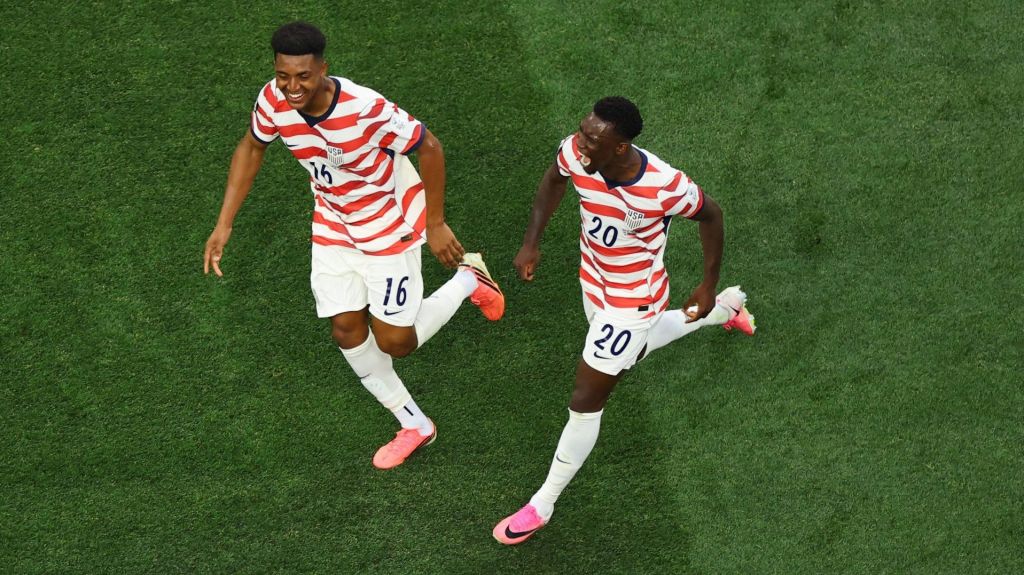
When USMNT goalkeeper Matt Freese looked out at his teammates during his team’s emphatic 4–1 win over Paraguay, 9 of the 10 outfielders he saw play their club soccer in Europe—including striker Folarin Balogun, who netted two goals in the victory. The tenth was the captain, Tim Ream, who returned to MLS after more than a decade in England in 2024.
Although no two careers in soccer are exactly the same, there is a clear pattern emerging among this generation of the USMNT. They are leaving the U.S. earlier to spend their best years in one of the top five leagues in Europe—in England, Spain, Italy, Germany, and France—where the wages, cachet, and quality of the soccer are all at their peak.
Take right-back Alex Freeman. He was born in Baltimore, moved to Florida to play a higher standard of youth soccer, and signed as an academy player with MLS’s Orlando City. He established himself in the first team for the 2025 season at age 20 and played 38 games. A year later, Orlando accepted a transfer offer of $7 million from a Spanish top-tier team, Villarreal. Freeman adapted quickly to a new league, helping earn him a fifth cap for the USMNT against Paraguay.
Midfielder Tyler Adams had a very similar path. He played two full seasons for the New York Red Bulls, when he was 18 and 19, before RB Leipzig took him to Germany. He is now a starter for Bournemouth in the Premier League.
Three other stalwarts of the team—defender Chris Richards, midfielder Weston McKennie, and forward Christian Pulisic—have zero combined MLS minutes. All three were offered contracts by German giants when they were teenagers. Pulisic moved to Borussia Dortmund (and later to Chelsea and AC Milan) and has become the poster boy for this USMNT generation. Richards and McKennie were both enrolled in the FC Dallas academy when the offers came in to head to Deutschland.
Throughout the past decade, the number of American players appearing in the big-five European leagues and, more importantly, the number of minutes that they played, more than doubled, according to data from soccer statistics site FBref. Simply, in the 2016–17 season, the U.S. was ranked 41st by minutes played by nationality in these leagues; a decade later, it has jumped to 22nd.
The market for American players is stronger than ever.
European soccer clubs are largely meritocratic. There are rules governing the number of homegrown players that must appear in match-day squads, but, beyond that, player quality drives who appears on which team. Elite clubs have made major investments into their data analytics capabilities in this time, meaning that they have a better sense than ever of where the talent is and how far it might improve if given the platform. More than ever, they are open to foreign players.
And alongside clubs’ willingness to look abroad for players, there’s also more U.S. talent for European leagues to pursue.
The number of American children playing soccer in high school has climbed slowly but steadily since the U.S. previously hosted the World Cup. MLS clubs—most notably FC Dallas, Philadelphia Union, and the New York Red Bulls—have built impressive youth academies.
Across MLS, around 2,000 US teenagers are now enrolled in fully funded academy programs. American agents are also playing a role. “We are spending a lot of time reaching out to European clubs to put our guys in the shop window”, explains Remy Cherin from Remington Ellis, which represents members of USMNT and USWNT.
This pattern is also self-perpetuating. The more success that European clubs have in signing American players who go on to perform well in the top leagues, the more willing they will become to take a punt on the next MLS academy graduate. And, as Cherin suggests, “a good U.S. performance in the World Cup will lend more credibility to the league as the competition that produced these players.”
As for the one member of the USMNT team who has not played in Europe, Freese told Front Office Sports that he hopes the World Cup will “to continue to grow the beautiful game in this country.” He also wants to emulate his predecessors, Tim Howard and Brad Friedel, who “both had incredible careers, with hundreds of appearances in the Premier League.”
Another strong showing against Australia in Seattle on Friday will only boost the profile of Freese and his teammates.
Download the FOS App
The business of sports, in your pocket.



Scan the QR code to get the app now.