Want more from Front Office Sports
in your search results?
MANHATTAN — The WNBA and WNBPA resumed their marathon bargaining session at a hotel in Midtown on Wednesday at 2 p.m. in an effort to hammer out a new collective bargaining agreement without delaying the league’s 30th season.
Only hours earlier, both sides had wrapped a 12-hour-long meeting before calling it a night at roughly 5:20 a.m. on Wednesday morning without a deal.
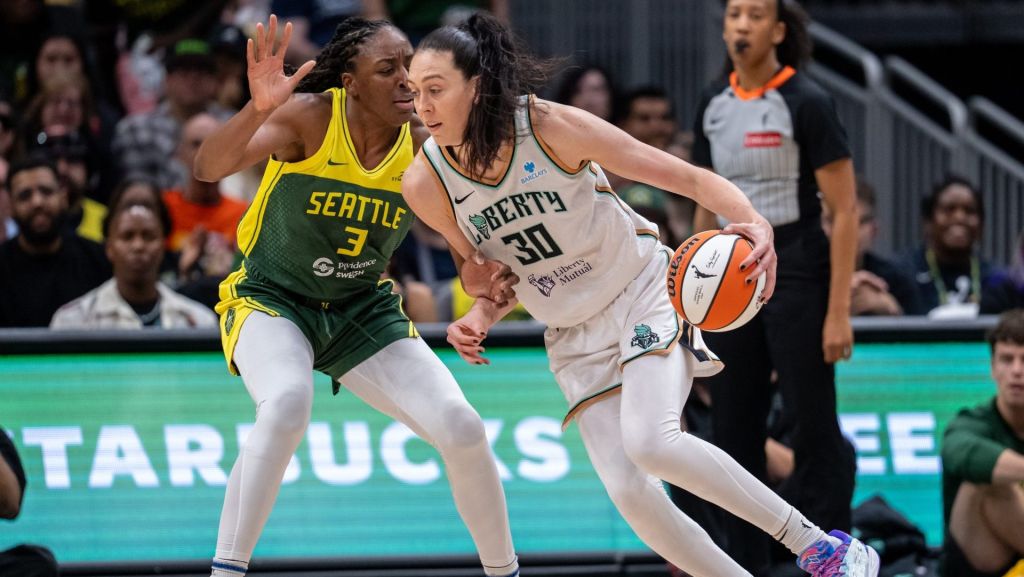
WNBPA executive committee members Nneka Ogwumike, Breanna Stewart, Brianna Turner, and Alysha Clark arrived at the Langham Hotel at roughly noon to meet with union staff and prepare for another long day of negotiations. Commissioner Cathy Engelbert and New York Liberty owner Clara Wu Tsai were back in attendance, and Connecticut Sun president Jennifer Rizzotti was a new addition at the bargaining table on Wednesday.
Just before midnight, the players departed, telling reporters they had morning workouts. WNBPA executive director Terri Carmichael Jackson and union staff remained to negotiate with the league until roughly 1:30 a.m., when bargaining officially broke off for the night.
There was still no deal, but they acknowledged movement has been made.
“We’re feeling movement,” Ogwumike told reporters Wednesday night. “We’re sticking to the process. That’s something we’ve always been true to from the very beginning.”
Eight proposals had been exchanged heading into the third straight day of negotiations.
‘We’re Fighting Hard’
On Feb. 23, the league told players that if a deal was not reached by March 10 the season would face delays. After the first day of negotiations concluded and that deadline passed, Engelbert declined to get into specifics regarding a timeline for the upcoming season.
“We’ve read a lot of things about timelines,” Ogwumike said. “There’s been timelines that have been thrown out, but for us we’re trying to get a good deal done and we want to play this season. So, to me that’s the time that we’re on.”
One differentiator between the bargaining session that began Tuesday evening and Wednesday’s was the way both sides spent their breaks.
During Tuesday’s 12-hour session neither side exited the hotel until negotiations concluded. On Wednesday, players, union staff, league executives, and staff were all seen leaving the hotel at various times in the day to enjoy some time outside of the confines of the negotiating rooms.
“It’s obviously a long process and we’re fighting hard,” Turner said. “It’s an exciting process, fighting for the past, present, and future of the WNBA.”
Revenue share and player housing have been two of the most critical sticking points over the roughly 17 months of negotiations.
The league’s most recent proposal, according to a source familiar with the negotiations, includes a $6.2 million salary cap and, as in past proposals, a roughly 70% share of net revenue. If 20% is still going to the supermax salary, that would result in a base supermax of $1.24 million. The average salary will be roughly $516,600 before revenue sharing is factored in. However, given the potential constraints on roster construction—if 20% of the cap is allotted to the supermax—the average salary would likely be far less than that number under this proposal.
Engelbert called the deal on the table “transformational and historic.”
Players didn’t get into specifics when asked where the most progress had been made after more than 20 hours at the bargaining table over the last two days.
“With each hour and each proposal that goes across the table, it solidifies more and more amongst ourselves, amongst communication with other players, what it is that we’re fighting for,” Ogwumike said. “Also, us needing to lock in to what we got going on. At the end of the day, we want a season. We want to play. We’ve heard that from the other side as well. We need to see a more robust demonstration of that as we continue on in these negotiations.”
When both sides come to a verbal agreement, it will need to be ratified by board of governors approval and approval from a majority of voting players.
The expectation is that once a deal is reached, it will take weeks to formalize, after which the expansion draft for the Portland Fire and Toronto Tempo can begin.
The timeline communicated by the league to general managers had the expansion draft occurring in early April, followed by free agency, and then the standard collegiate draft on April 13. But that schedule was subject to a deal being reached by March 10.
Training camp is less than six weeks away. The WNBA’s 30th season is currently scheduled to tip off on May 8.
“Time is of the essence to get this deal done,” Rizzotti said. “And that’s what we’re working for.”
Download the FOS App
The business of sports, in your pocket.



Scan the QR code to get the app now.