
Max Kellerman, LeSean McCoy Off DAZN Boxing Show As Mario Lopez Joins
Want more from Front Office Sports
in your search results?
Around 10:40 a.m. on April 14, members of the Quinnipiac women’s rugby team received an email from assistant AD Sarah Fraser, telling them to meet in a conference room without their coaches. In that gathering, Fraser and AD Greg Amodio read prepared remarks that the women’s rugby would transition from varsity to club status.
“I’ve never been in a room where so many people were trying to catch their breath from sobbing,” freshman Emily Hartman tells Front Office Sports. “Girls walked out to throw up in the hallway. It was tears for everyone. Our lives just got flipped upside down, and some could say ruined, in three minutes.”
Shortly after the team meeting, a Quinnipiac press release made the news public.
Not only was varsity women’s rugby and its entire coaching staff on the cutting-room floor, but Quinnipiac would also add a men’s indoor and outdoor distance running program. The university said that rugby’s varsity-to-club demotion ahead of the 2026–27 season would enable the school to reallocate resources to programs that they thought had more “long-term competitive” stability.
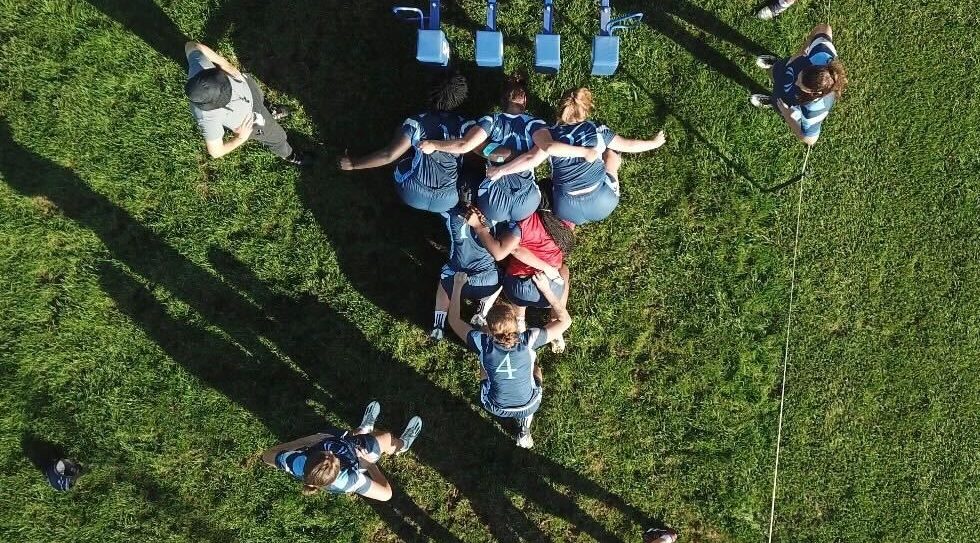
Quinnipiac women’s rugby is among the sport’s most storied Division I programs.
It was the second-ever D-I team, won three national championship titles, and is the alma mater of 2024 U.S. Olympic Rugby Sevens bronze medalist Ilona Maher. The school’s men’s hockey program, with its single national title in 2023, is the only other Quinnipiac team to reach similar heights.
The NCAA classifies varsity women’s rugby as an Emerging Sport for Women, which means it does not develop or oversee its playing rules. (A sport needs 40 teams across three divisions to become an official NCAA-sanctioned sport.) Still, it is robust and competitive: the Bobcats play in the 24-team, cross-divisional NIRA (National Intercollegiate Rugby Association), a group that includes four Ivy League institutions, Army and Navy, and two neighboring Connecticut schools.
The removal of the varsity program has left its players rudderless, and its alumni incensed—especially because some reasons for Quinnipiac’s change remain opaque.
“The way our reactions were was as if there was a death in our families, because a part of us died,” says junior Grace Hinton. “We all laid out on the field together, just sobbing, not knowing what was next.”
Murky Reasoning
Quinnipiac said that Title IX compliance “was a central component” of its decision. The logic left the now-former women’s varsity team confused about exactly how.
Title IX demands equal athletic participation opportunities between men and women relative to the male-female student ratio on campus. Quinnipiac fields seven men’s varsity teams compared to 14 women’s teams. During the 2025–26 school year, the athlete population was roughly 64% female and 36% male, according to roster analysis by FOS. The ratio is similar to the overall student body composition, which is 60% female, 40% male.
It’s currently unclear how—or whether—the school is in violation of Title IX, and how removal of varsity women’s rugby addresses the issue. Additionally cloudy is how the addition of a men’s distance team factors in; as far as Hinton understands, that program will consist of existing cross country athletes, which would not add additional roster spots for male athletes.
In response to FOS’s inquiries, Quinnipiac pointed to an online FAQ.
Players have met with the Quinnipiac student government organization and participated in a protest Thursday to “show how many people stand behind [them],” Hinton says. In a statement to FOS, the team also blasted the university’s decision as a “blatant disregard for [Quinnipiac] female student athletes and coaches.”
Despite multiple attempts to contact Quinnipiac athletics, the only communication players say they have received—besides similar directions to the FAQ—was an email from assistant AD Fraser. That email referenced a meeting opportunity where the school’s governing body for club sports, RecWell, would answer questions. Quinnipiac senior and 2025 captain Kelsey Thomas tells FOS the team did not attend the meeting as they believed it did not apply to them as varsity players.
She says a few players approached university president Marie Harden in person about the decision on April 14, but she said she didn’t “have an answer,” and redirected them to athletics. Now a week out from the encounter, Harden will meet with the team on Thursday, Thomas tells FOS.
But she still feels the administration has largely tried to avoid the players. “They pointed us back to Title IX. They pointed us to the frequently asked questions that they had already worked up to answer our questions.”
Searching for ‘Transparency’
Baffled the day after the change, former Quinnipiac assistant coach and alumna Colleen Doherty launched a Change.org petition to reinstate Quinnipiac women’s rugby. That petition has more than 20,000 signatures—nearly four times the number of Quinnipiac’s total undergrad population.
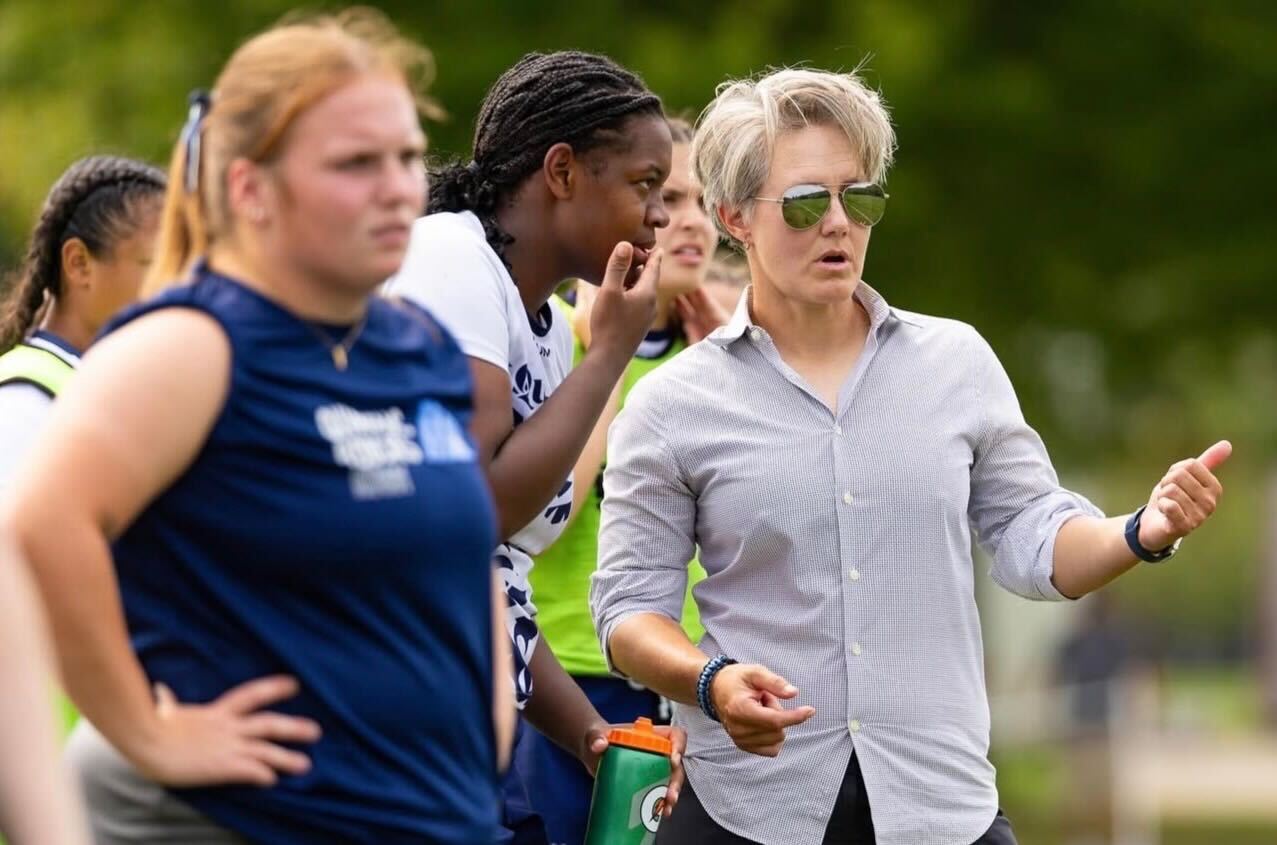
“The end goal, I would love to see that this program is reinstated by the administration,” Doherty says. “In the interim, I would ask—is there an opportunity to have a conversation with those that have made this key decision to clarify their decision with transparency, with some data?”
Libby Moser, a 2023 graduate who played on the team, acknowledged to FOS the gender discrepancy in sports participation at Quinnipiac, but still similarly desires communication—and an opportunity to reinstate women’s rugby at the varsity level.
So far, she says alumni have also not heard back from the administration. To address any concerns around operating costs, Moser sees a potential revenue-generation opportunity in commercial jersey patches, which will be approved on NCAA uniforms starting Aug. 1.
“If it’s a reduced operating budget, a different allocation of resources, is that an avenue that can be explored?” Doherty says. “Does it have to be taking opportunities from women to achieve the same goal?”
Future Fallout
Thomas says the men’s cross country captain reached out to women’s rugby to “apologize that their gain was [rugby’s] loss,” and that the team has received an outpouring of support from their athletic community.
But it’s also an uncomfortable situation to navigate.
“We walk around campus, we walk into our athletic training room and people just sit there and stare,” Hinton says. “We’ve never had this kind of attention before, and it just sucks that the main attention is now negative.”
In an email sent to all Quinnipiac students, faculty, and staff, obtained by FOS, university chief experience officer Thomas Ellett said that athletic scholarships of every women’s rugby player and “scholarship commitments made to incoming students” would be honored. (Ellett told FOS he is “not involved in this.”)
Hartman and Hinton are both in the transfer portal, though Hinton is leaning toward staying and playing club her senior year while finding another team to play varsity rugby for as a graduate student. Two other players are having a deja vu moment; they transferred to the Bobcats after their previous program, Central Washington, was discontinued in 2025.
Current players also worry for the future of incoming freshmen, who will have their scholarships honored but only have until the rapidly approaching May 1 deadline to commit to a new college if they want to play D-I rugby.
With the cut to one of the most significant programs, women’s rugby players are concerned about the wider status of the collegiate game and its ability to reach the 40 teams needed to gain official NCAA status. They worry the cut will cascade to other schools.
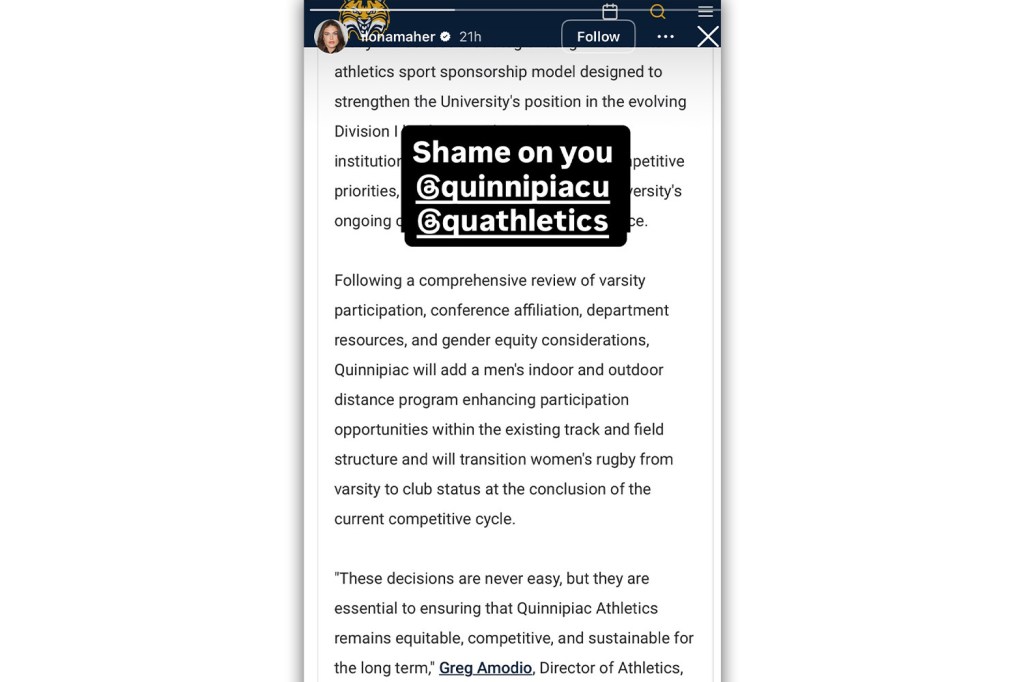
Doherty says that Maher, who competed at Quinnipiac from 2016 to 2018, is in contact with her former teammates about the situation. In an Instagram story, Maher tagged Quinnipiac—which promoted her during the 2024 Olympics—and wrote “shame on you.”
“Some of us could have gone on to play in the Olympics, and NIRA is a huge feeding pool for the Olympic team,” Hartman says. “To cut the program cuts off our opportunity to bring home Quinnipiac another Olympic medal or give it any publicity.”
Along with pressing the Quinnipiac administration, players are also filing an Office for Civil Rights Title IX complaint.
But the Quinnipiac team feels like they shouldn’t be in the situation at all. “I’m 21, this is not what we’re supposed to be trying to figure out,” Hinton says. “We’re supposed to be studying for exams and going to class, not trying to figure out the fine print of Title IX.”
Download the FOS App
The business of sports, in your pocket.



Scan the QR code to get the app now.