Want more from Front Office Sports
in your search results?
Ice Cube envisions the Big3 being around for 100 years, and he tells Front Office Sports that now is the right time to take the 3-on-3 basketball league public amid challenges in securing outside capital due to NBA restrictions on owner investment.
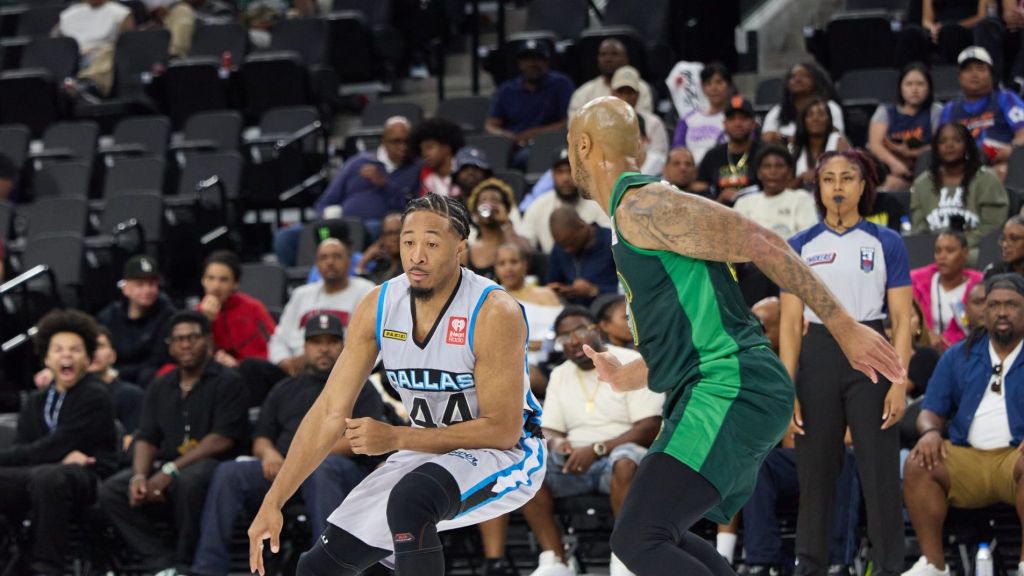
The league’s ninth season opened with a bang over the weekend, as a fight led to one-game suspensions for former NBA players Lance Stephenson and Michael Beasley. Cube apologized for the incident after the game, although the passion that led to the fracas proves part of his thesis for taking the league public: Big3 is not a novelty act; it’s a competitive league whose players want to win.
“We want guys who still got a chip on their shoulder, who still wanna play basketball against their peers at a high level,” cofounder and CEO Ice Cube, whose real name is O’Shea Jackson, told FOS ahead of the Big3’s opening weekend. “We don’t just want your name though, that does us no good. We want your game.”
The league has plenty of big names. In addition to Stephenson and Beasley, players this season include Naismith Memorial Basketball Hall of Famer Dwight Howard and other longtime NBA pros like Derrick Favors, Montrezl Harrell, Corey Brewer, and Mario Chalmers. Founded in 2017, it currently has eight teams with a season that runs through the end of August.
Player salaries are not made public. Big3 cofounder and president Jeff Kwatinetz says there are standardized salary tiers; captains make the most but all captains earn the same amount, for example. Players also ultimately earn 50% of the league’s net profits at the conclusion of the playoffs, with each team’s share depending on how they finished. Last year, the first-place Miami 305 took home $650,000 and the second-place Chicago Triplets got $350,000.
“We’ve always believed that having players negotiate different deals makes the game more about the money and less about wanting to play,” Kwatinetz tells FOS. “We also believe our system creates more camaraderie.”
Now, it’s preparing to take its product to the public markets. Big3 HoldCo LLC announced on June 12 that it will go public at a $290 million valuation through a special purpose acquisition company merger with Graf Global Corp. Shares are expected to trade later this year on either the New York Stock Exchange or Nasdaq under the ticker symbol TONT.
“Most leagues are owned by a bunch of billionaires,” Cube tells FOS. “Fans, all they get to do is watch, buy some merch, get a ticket, and bet on the games. But they can’t invest. We want to change that. In my vision, we’re here 100 years, not just 9.”
Big3’s SPAC Deal “Has a Chance to Be Successful”
SPAC mergers involve an existing business combining with a shell entity, or a SPAC, that has raised money through its own IPO—Graf Global held its IPO in 2024, raising $200 million. Such deals are not new, although they gained steam following the COVID-19 outbreak in 2020 as investors sought alternative ways to take companies public.
This year, SPACs are back, according to University of Florida finance professor Jay Ritter. He tells FOS there have already been about 108 SPAC IPOs this year, “the highest number since the boom year of 2021.” However, a successful SPAC IPO does not ensure a successful SPAC merger; there have been only 19 completed mergers in 2026, Ritter says, and in general the stock of companies that go public through SPAC mergers doesn’t always soar, with many seeing “big price drops soon thereafter.”
“But Big3 has a chance to be successful,” Ritter says. “Most mergers with SPACs have a problem with very little cash being raised because most SPAC investors redeem their shares at the time of the merger, asking for their money back. But that might not occur here, with Big3 receiving a large cash infusion, allowing them to expand.”
Kwatinetz tells FOS the timing reflects both momentum and demand for exposure to sports assets.
“We’re coming off our best season,” he says. “We feel like we’re at a tipping point.”
Big3 ratings were up over 25% last year, with the playoffs reaching more than 790,000 viewers on CBS (for context, NBA games regularly average more than 1 million viewers, and the NBA championship-clinching Game 5 drew 24.5 million viewers). This season marks the seventh year Big3 games are being broadcast on CBS (“we’ve got the same crew that worked on the last Super Bowl,” Kwatinetz says). Beginning this year, BET will rerun the CBS games in primetime on Monday evenings. It will also be streamed on the Fubo Sports Network, and for the first time Big3 has a streaming partner in China: Big3 games will be available there through a deal with Migu Video Co., according to a statement shared with FOS.
NBA Ownership Restrictions
The decision to go public is also aimed at helping the league continue to raise money, something Cube says has been a challenge due to restrictive NBA rules. He tells FOS the NBA considers Big3 a “competing league” and therefore prohibits NBA owners from investing in the league or its teams.
“This has been problematic without a doubt,” says Cube, who’s perhaps more known for his rap and acting career. “It has really hampered the growth of the league. Finding the right investors to take it to the next level has been challenging. It hasn’t been impossible, because we’ve done it. But it has been a huge challenge.”
A person familiar with the matter tells FOS the NBA does prohibit team owners from investing in Big3, but the policy is part of longstanding league rules governing investments in competing men’s basketball properties and is not specific to Cube’s league. (The policy is only for competing men’s leagues, not women’s, meaning the restriction does not extend to the 3-on-3 women’s basketball league Unrivaled.)
Still, in 2023, the U.S. Department of Justice reportedly launched an investigation into whether the NBA was engaged in anticompetitive practices regarding Big3. That probe began under the Biden Administration. It’s not clear whether it remains ongoing, and a representative for the DOJ did not immediately respond to a request for comment.
NBA spokesperson Mike Bass told TMZ in 2023 that the claims against the NBA were “not true” and said “we have been supportive of the Big3 since its inception, but we declined to invest.”