Want more from Front Office Sports
in your search results?
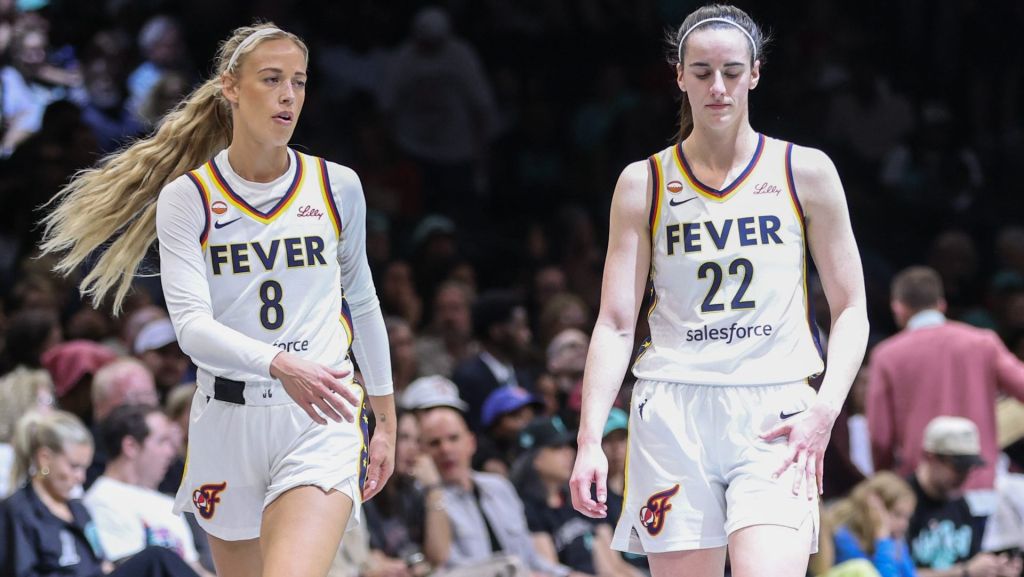
Sophie Cunningham is not just Caitlin Clark’s bodyguard on the court; she’s become her bodyguard in the court of public opinion. If I were WNBA commissioner Cathy Engelbert, I’d thank Cunningham for protecting the health and image of the league’s biggest star on and off the floor.
Notice I said biggest star, not best player. That’s four-time MVP A’ja Wilson of the Aces. But the 24-year-old Clark is without question the league’s biggest attraction in terms of TV ratings, box office, and merchandising. Despite her fame, Clark is “politically anodyne,” notes The Ringer’s Seerat Sohi, especially compared to the NBA’s biggest star, LeBron James.
Unlike the Chosen One, Clark doesn’t want to talk about politics or social issues. She doesn’t pick a side in the political proxy wars dividing the WNBA and fans over race, sexuality, and transgender athletes. Clark just wants to hoop.
But that’s been impossible since Clark entered the WNBA with great fanfare from Iowa in 2024. The NCAA’s all-time leading scorer was heralded as a Magic Johnson/Larry Bird-like savior who would take the WNBA to the next level. But many veterans seem to think their league didn’t need saving.
To be sure, Clark is polarizing in her own right—she can be a complainer and flopper on the court, not unlike King James. But she’s also been on the receiving end of way too many cheap shots and hard fouls over her first three seasons—while refs have made a habit of looking the other way.
At the same time, NBA commissioner Adam Silver notes that Clark has been exploited as a “political football” by both the Right and the Left in culture wars. That’s not going to change. She’s too polarizing; she generates too many clicks. Plus, there will always be overwrought critics like USA TODAY’s Nancy Armour who argue Clark’s on-court conduct contributes to the racist abuse other players receive. Conversely, there will always be Clark supporters who argue her frequent praise of league pioneers is never enough. Why is Clark constantly asked to genuflect to the “sisterhood” of the WNBA, they ask, when nobody else is?
Enter Cunningham, the feisty, 29-year-old Fever sharpshooter, who’s embraced the role of Clark’s older sister/protector. NHL clubs have long used on-ice enforcers to protect their skill players. When Jacy Sheldon and Marina Mabrey of the Sun got physical with Clark last year, Cunningham reacted like Wayne Gretzky’s Oilers enforcer Dave Semenko. On a fast break at the end of the game, Cunningham yanked Sheldon down with a flagrant foul. When Sheldon jumped up to brawl, Cunningham put her in a headlock for good measure. A star was born.
As ESPN’s Hallie Grossman wrote in a widely circulated profile published last week: “In the year to come, Cunningham will have a billboard outside Madison Square Garden, star in the Sports Illustrated Swimsuit Issue, moonlight as a ring girl at UFC 329, receive her own colorway on an Adidas shoe, be floated as a future vice presidential candidate and, of course, unleash the finger point that launches a thousand memes. You’ve seen it. The White House has seen it. We’ve all seen it.”
Fast-forward to the current season. Once again, Clark wants to focus on her game, not get dragged into polarizing political debates. Once again, Cunningham is acting as the lightning rod, fearlessly wading into the debate regarding transgender athletes. As she told ESPN: “I want to protect young girls in a locker room, or young girls in sport who shouldn’t have to go against biological men.”
Whether intentional or not, Cunningham has become the story instead of Clark, who’s averaging a career-best 21.5 points per game in her third season in the W. When the media tried to make Cunningham backtrack on her ESPN comments, she stuck by her position that little girls–and all women–need protection. “I said what I said. I think it’s kind of common sense.”
You can agree or disagree with Cunningham’s opinions. Hell, even her podcast co-host, West Wilson, disagrees with her on the transgender athlete issue, warning: “Right-wingers have convinced a massive portion of people in our country that (transgender athletes) are a threat to sports in America, when mathematically that’s not the case at all.”
But Cunningham still comes off more measured than Storm minority owner Celeste Keaton, who allegedly called two young Cunningham fans “effing insane” as they sat courtside this week. (The team’s majority owner, Ginny Gilder, apologized for Keaton’s conduct in a statement to Front Office Sports.) On X/Twitter, Cunningham noted “everybody is welcome” at her table, including biological girls, biological boys, trans women and trans men. But she also threw a jab at Keaton, tweeting: “Truly embarrassing of the co-owner. Unfortunately shows the type of leader she is.”
On both the Right and the Left, there are voices trying to paint Cunningham as “MAGA Barbie.” But Cunningham insists she’s politically independent. “I’m very much in the middle. I agree with things on both sides, disagree with things on both sides,” she told ESPN. “And that’s all I’ve ever said about my political beliefs. But people love to assume.” If Cunningham truly sees herself as politically independent, that approach resembles a marketing playbook that served stars like Michael Jordan and Tiger Woods well: appeal to as many people as possible without being defined by politics.
Whether Cunningham can stay in the middle as scrutiny around her intensifies remains to be seen. Especially with more “Support Sophie Cunningham” rallies being organized around upcoming Fever games in Portland and Minneapolis. Either way, whether it’s intentional or not, she’s the one making headlines—not Clark.