Max Kellerman, LeSean McCoy Off DAZN Boxing Show As Mario Lopez Joins
Want more from Front Office Sports
in your search results?
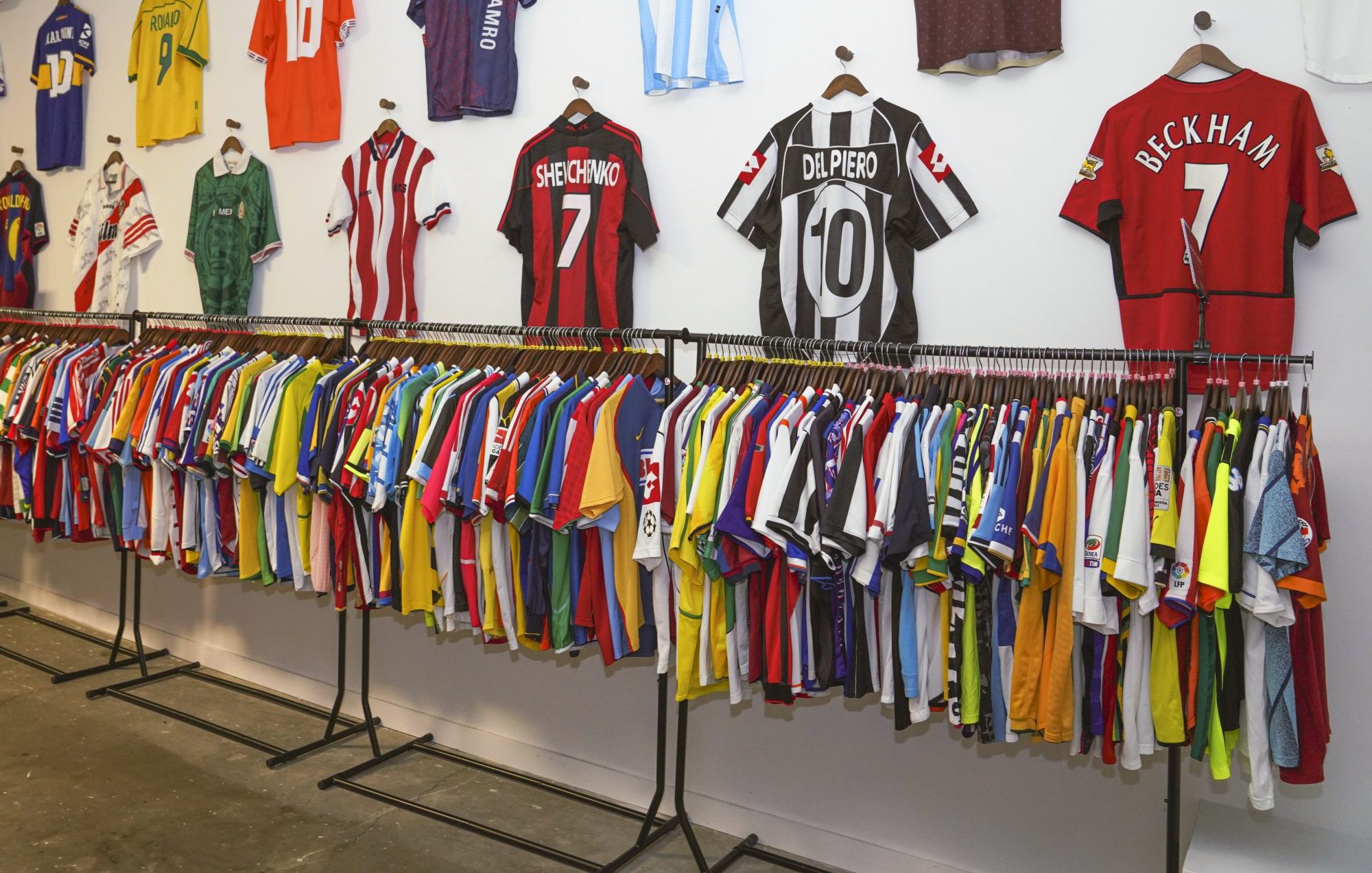
In September 2022, Gregg Berhalter walked into a pop-up store in New York, and found himself surrounded by a rainbow of vintage soccer jerseys. One particular shirt caught the eye of the then-coach of the U.S. men’s national soccer team. He walked out with a mint-condition USA 1994–1995 home jersey, worn by the USMNT at the first World Cup hosted in America—a wavy red-and-white striped Adidas design meant to resemble the flag.
The jersey now fetches nearly $400 at Cult Kits, the U.K.-based online vintage jersey retailer that opened the temporary storefront in Manhattan’s SoHo neighborhood. “It wasn’t a marketing ploy—he just walked in,” Cult Kits cofounder Josh Warwick tells Front Office Sports. “An American recognized him. It was just ahead of the Qatar World Cup—he teased us, saying he shouldn’t really be speaking to us” with the looming U.S.-England group-stage matchup.
Berhalter hadn’t received an invitation, and neither had the other customers who quickly inundated the four-day pop-up. Fans were in a frenzy for the retro soccer shirts: the usual big sellers, such as Manchester United and Barcelona classics; and the niche, lurid away jerseys belonging to mid-ranking, mid-’90s Premier League sides. “We had to ship a ton of stock from England just to cope with the sales volume,” says Warwick.
Vintage soccer jerseys sit at a cross-section among fandom, streetwear, and sports memorabilia—and the combination is proving lucrative. Today, overseas vintage soccer jersey retailers are fast-tracking their entry into the U.S. market—and boosting their retail footprints—ahead of the 2026 World Cup in North America. American companies have caught on, too. Across the country, fans are clamoring for the kits to make a statement, and both investors and retailers alike see there’s plenty of money to be had.
In Los Angeles, buyers are flocking to the California outpost of Classic Football Shirts—the industry’s biggest player. Founded in 2006 by students in Manchester, England, the company was selling upward of 750,000 pre-owned shirts a year by May 2024, when it received a $38.5 million investment from U.S. private equity firm The Chernin Group (TCG). The retailer is set to make $50 million in sales this year.
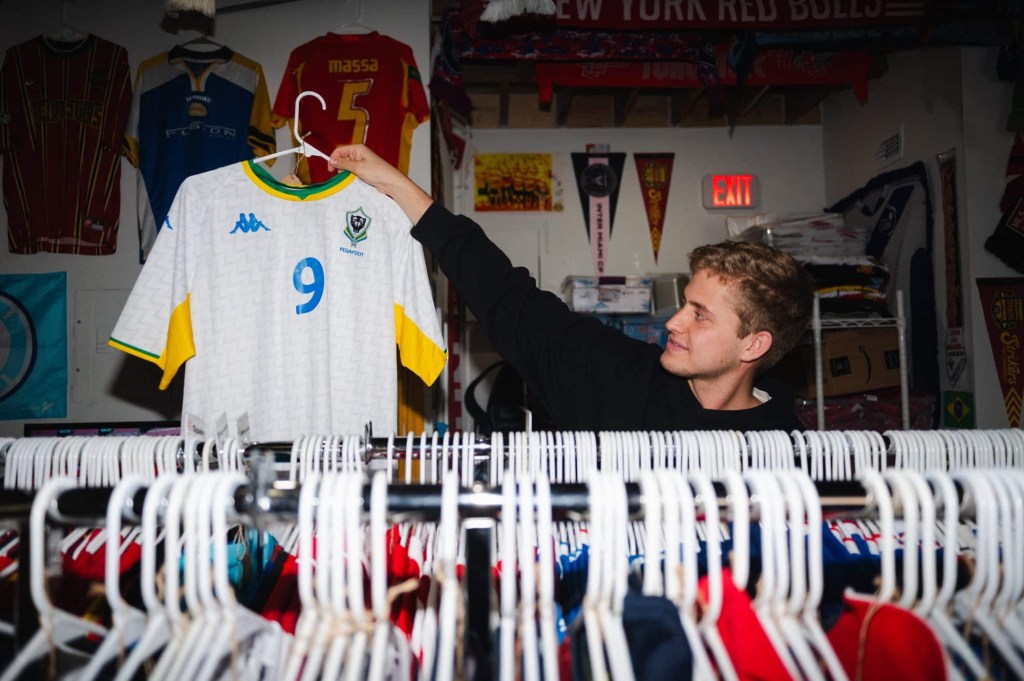
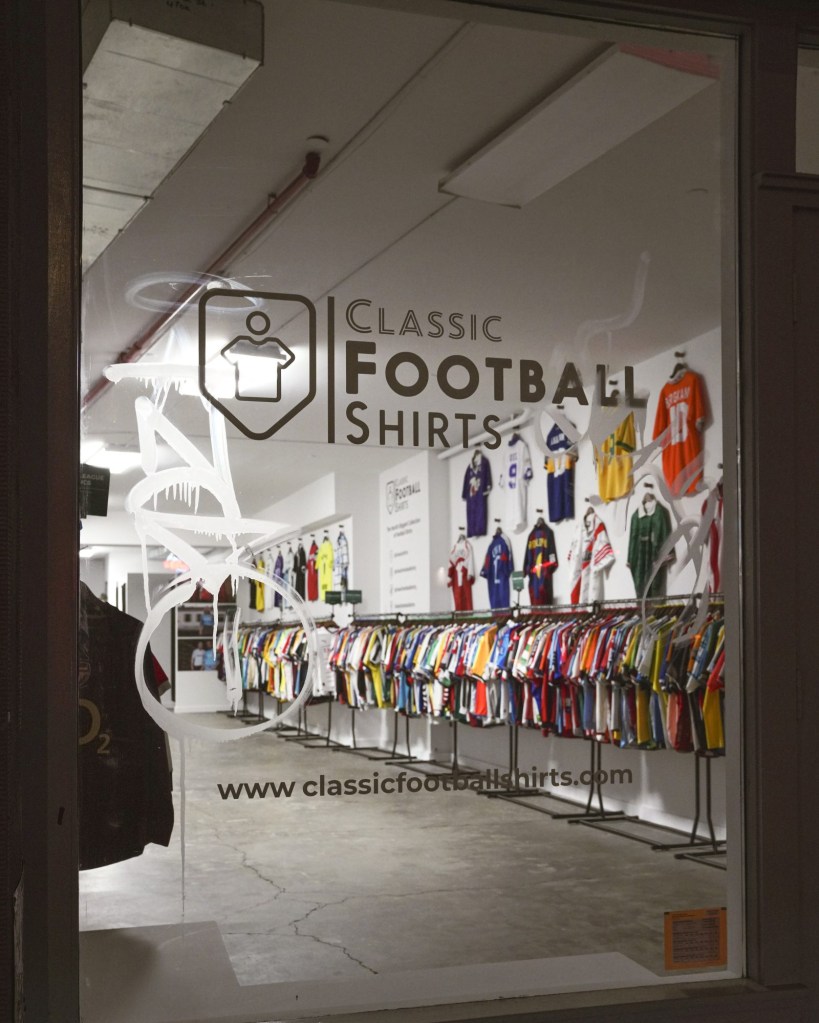
Classic Football Shirts’ U.S. growth is now also supercharged. Accounting for around 15% of sales, America is the fastest-growing market, according to the company; its year-over-year revenue has doubled. In May, its first permanent Stateside store opened in New York; L.A. followed in October; and Miami is next. “We’ve seen a cumulative effect in the U.S.,” cofounder Gary Bierton tells FOS. “We began with a small, single-rail exhibition at the Rockefeller Center for the 2018 World Cup. By the time of our L.A. pop-up last November, there was a queue down Melrose—we broke our sales numbers.”
Greg Bettinelli, partner at TCG, tells FOS global sales of new soccer shirt sales fetch beyond $6 billion annually, and he estimates the pre-owned market is currently growing by more than 100% year over year.
Iconic match-worn or autographed jerseys are also becoming U.S. sporting treasures, akin to grails like Shohei Ohtani’s 50th home run ball that sold for $4.4 million, or Michael Jordan paraphernalia that routinely reaches seven-figure sums—Diego Maradona’s “Hand of God” jersey from the 1986 World Cup sold for $9.28 million in 2022. But the most crucial factor driving the spiking consumer demand may be more a matter of fashion than anything.
Compared to NBA or NFL jerseys, soccer shirts are far more versatile, says Bettinelli. While Classic Football Shirts stocks some vintage apparel from the Big Four sports leagues, he believes those retro markets are much smaller. “[Soccer] shirts are functional; you can wear them anywhere. From an investor perspective, you look at your addressable consumers—they’re worn by 19-year-old kids and 40-somethings, both men and women.”
Cult Kits’ Warwick says, “We’ve seen that our market isn’t just [soccer] nerds—it’s customers who want to wear a shirt based on aesthetics.” He estimates U.S. sales have increased by 70% over 18 months, and says the U.S. has become the company’s biggest market in revenue.
Fashion trends—fueled by luxury fashion houses and “Blokecore” DIY styling videos on TikTok, plus the return of ’90s and 2000s style—mean more young customers now sport 2001 Sheffield Wednesday and Blackburn Rovers jerseys. “We’ve seen a huge increase in 18- to 24-year-olds shopping for [soccer] shirts,” says Bierton. “But I think Balenciaga making a [soccer] kit isn’t as influential as Travis Scott wearing one onstage.”
Soccer jerseys also tie neatly with the big-revenue sneakerhead movement. “I see [soccer] shirts as the sneaker culture of 10 years ago,” says Bettinelli. “They tell a story: Your tastes, style, background. They can be worn or collected. It’s like sneakers before they were mainstream, when it was a deliberate fashion choice, primarily made by younger people.”
American brands with an eye toward fashion see the opening, too.
Launched online in 2018, retailer Saturdays Football now has five U.S. stores, all opened since 2023—alongside ’90s-inspired branded tees and sweatshirts. Its classic kits are presented as fashion pieces, neatly hung from rails, minimalist-style. “We get Juventus, Man United, and Chelsea shirts all in the same order,” says Saturdays Football creative director Mat Davis, adding that 80% of online purchases are for vintage items.
The expanding U.S. market has an advantage Europe does not: team agnosticism. In the U.S., sales are unfettered by the club-specific, tribal following associated with overseas soccer fandom. Simply, a Newcastle fan isn’t going to show off a vintage Sunderland jersey, no matter how cool it may look. But, says Davis, “There are no rules for soccer fans in the U.S.” For most consumers, anything visually appealing is on the table for purchase.
The country’s market-growth potential is also primed to explode due to immigration patterns, says Matteo Trevisani, the Brazil-born cofounder of Miami’s Golaço Kits. One of the largest vintage soccer stores in the country, it caters to the city’s Latin American community—its 5,000 or so pre-owned jerseys include Liga MX sides, obscure Guatemalan teams, and defunct South American clubs. There was a surge in sales during Copa América, he tells FOS. “Miami was a host city—we sold out of Argentina and Colombia shirts. And we saw a big uptick when Lionel Messi joined Inter Miami.”
The fervor for vintage soccer jerseys isn’t just making U.S. retailers salivate. American A-listers are also bullish on the category’s success.
In September, U.S. soccer legend Alex Morgan and Wrexham AFC co-owner Rob McElhenney became Classic Football Shirts co-investors. The latter is a previous customer, says cofounder Bierton—his haul, consisting entirely of vintage Wrexham shirts, was acquired during the takeover talks. “For many [soccer] fans in America, the shirt is a means of becoming invested and educated on a club. Rob’s been on that journey: I don’t think he knew much about [soccer] before 2020, but is now super knowledgeable of lower-league English [soccer]—he bought the shirts and now understands the culture.”
Meanwhile, Morgan’s role is future-focused. “Women’s [soccer] is still a small percentage of our overall product,” says Bettinelli. “The ongoing success of women’s sports should change that. She’s a great partner as we think about building the brand in the U.S., targeting younger females, and product line extensions.”
Now, with the 2026 World Cup only 18 months away, retailers are marking the event—spread across Canada, Mexico, and the U.S.—as a sales bonanza. They’re right to anticipate a big bump from an international tournament: Bettinelli says Classic Football Shirts’ U.S. business virtually doubled over the summer, between Euro 2024 and Copa América, which the U.S. hosted.
Stretching from San Francisco to Boston, Seattle down to Miami, Classic Football Shirts aims to have a presence in each of the 11 U.S. host cities, says Bierton—whether that’s brick-and-mortar stores or tiny pop-ups. “We are 100% geared towards that tournament. It’s the first World Cup in America since USA ’94, and that was huge for the sport. That helped grow awareness around [soccer]—this will be the movement towards full engagement.”
Download the FOS App
The business of sports, in your pocket.



Scan the QR code to get the app now.