Want more from Front Office Sports
in your search results?
In the era of the expanded College Football Playoff, non-power-conference programs have a guaranteed spot in the postseason for the first time.
But they’re still left clawing for spots as the power conferences get bigger and stronger—especially the SEC and Big Ten—from rankings to revenue distributions.
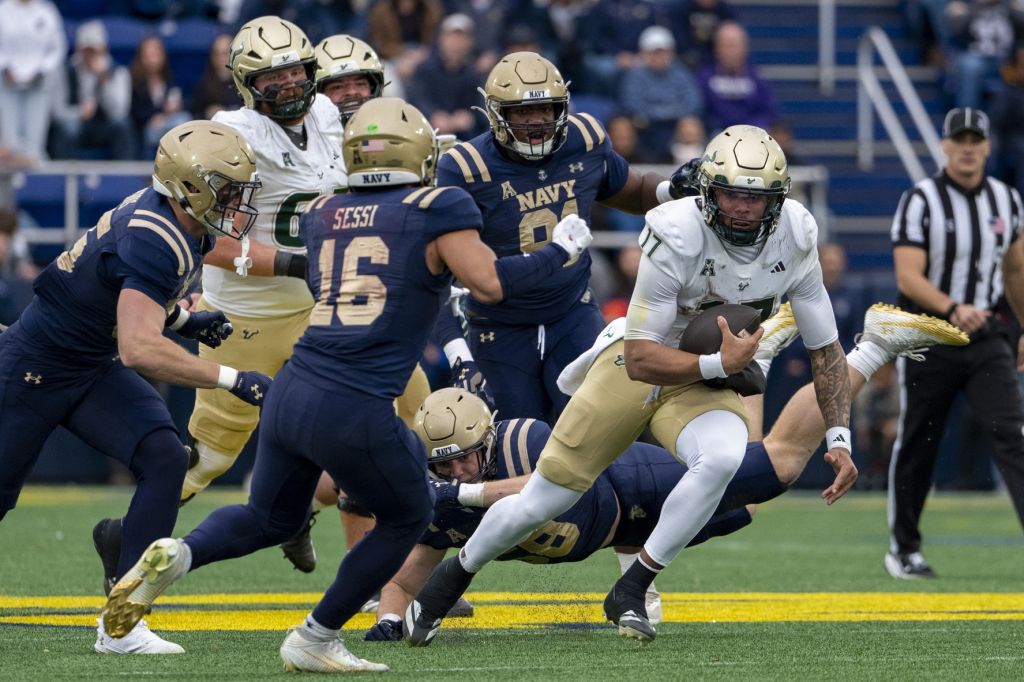
Last year, that Group of 6 spot went to Boise State, hailing from the Mountain West. This year, that spot will likely come from the American conference, which has had multiple schools appear in this season’s CFP Top 25 rankings. Last week, the committee ranked the University of South Florida at No. 24; this week, it dropped USF in favor of Tulane, also at No. 24.
But that doesn’t mean either program will actually make the CFP.
The Automatic Qualifier
The 12-team College Football Playoff guarantees at least one non-power-conference school will earn a CFP berth, since the five highest-ranked conference champions automatically qualify, and the remaining seven spots are filled by at-large bids based solely on rankings. That means a guaranteed spot for the top-ranked Group of 6 conference champion. It’s also possible for two Group of 6 conference champions to automatically qualify if they ended the season ranked higher than one of the four power conference champions.
Because the Group of 6 automatic qualifier comes from the conference championship game, the spot is up for grabs regardless of CFP rankings—though the rankings can offer a glimpse into which conference’s champion the committee might choose.
Beyond South Florida and Tulane, there’s Navy, currently first in the American with an 8–2 overall record and 6–1 conference record, which hasn’t been ranked at all, and could certainly win the American championship game. North Texas and Memphis have been in conversations as well.
“The American is a really good conference this year, a really top-heavy conference,” CFP selection committee chairman Hunter Yurachek told reporters after Tuesday night’s rankings reveal.
But that doesn’t guarantee an American team will make it. The committee, at least at this point, discussed the merits of ranking Tulane over JMU, from the Sun Belt—another potential CFP contender if it wins its conference championship and can somehow leapfrog the American conference champion in overall rankings.
In theory, Group of 6 teams could also be awarded one of CFP’s seven at-large bids. But that would mean they have to be ranked overall in or around the top 12—which so far has not happened this year.
However, the Group of 6 champion will face a new twist this year. Last year, the four highest-ranked conference champions received the top four spots in seeding. That’s why Boise State was seeded No. 3 last year ahead of the ACC and Big 12 conference champions, earning it a bye, despite its overall ranking being No. 9. But this year, seeding will be based solely on ranking—meaning no conference champions will receive automatic seeding boosts for their conference titles.
Sharing Revenue
The finances of the College Football Playoff are in flux, as last season and this season created a holdover of conference distributions for the four-team Playoff that will re-adjust starting in 2026. The changes will also reflect the dissolution of the Pac-12, which went from being counted as a power conference to a Group of 5 (now Group of 6) conference.
And while Group of 6 leagues make significantly less than power conference leagues, they still have eight-figure payouts waiting for them.
Last year (and this year), the CFP distributed 80% of conference revenues to power conferences and 20% to Group of 6 conferences. Last year, for example, they received about $93.07 million each, according to the CFP. The non-power conferences shared $116.09 million total. The revenue has been adjusted to ensure conferences don’t distribute less money to schools after expanding.
There are also performance bonuses for appearing and advancing in the CFP. This year, the bonus structure will offer each conference $4 million per school to make the Playoff—including both automatic qualifiers and at-large bids. They’ll then earn another $4 million for each team that makes the quarterfinals. The CFP will then award $6 million for teams that reach the semifinal and $6 million for teams that make the national championship.
That guarantees at least one $4 million bonus to the Group of 6 conference that lands a conference champion in the Playoff. But again, there’s a complication. Last year, the top four-ranked conference champions (which included Group of 6 team Boise State) were at the time guaranteed $8 million, as they were also guaranteed first-round byes and guaranteed a spot in the quarterfinals. But now, the top four byes will go to the top four ranked teams—almost guaranteeing that no Group of 6 program will earn an automatic $8 million.
What’s more, starting in 2026, the revenue distribution will become even more skewed. The Big Ten and SEC will each earn 29%, for a total of 58% of total CFP revenue. The ACC and Big 12 will earn 32% total, with the Group of 6 splitting 10% (and independent Notre Dame receiving part of this distribution as well).
Download the FOS App
The business of sports, in your pocket.



Scan the QR code to get the app now.