
Want more from Front Office Sports
in your search results?
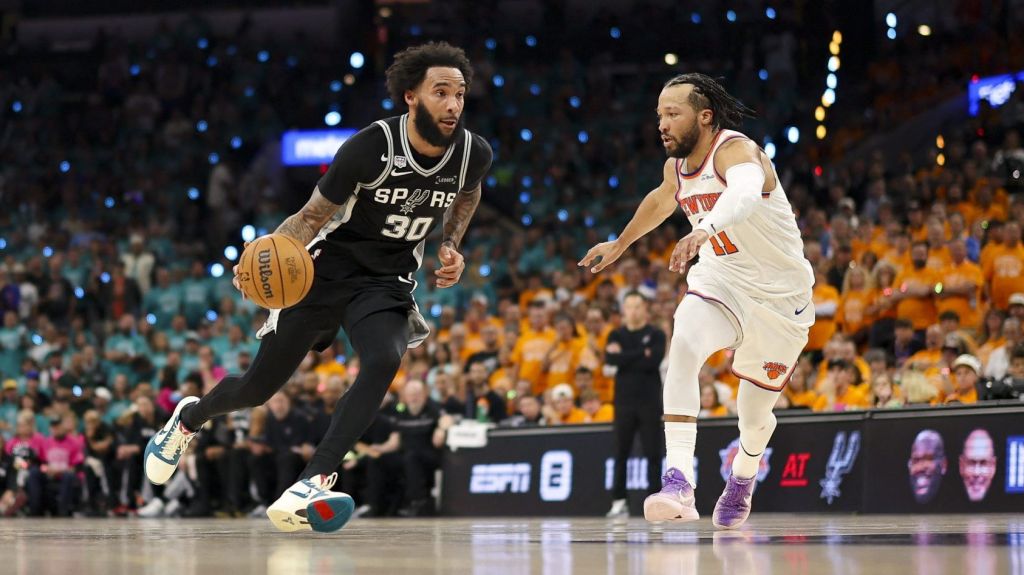
SAN ANTONIO — This year’s NBA Finals pits the league’s biggest market against one of its smallest.
The Knicks and Spurs matchup comes a year after a Finals series that featured two non-luxury tax teams for the first time in 22 years: the Thunder, the league’s smallest market, and the Pacers, which sits in the league’s lower-third of markets.
Whether the Knicks or the Spurs come out as this year’s victors, it will be the eighth time in as many years that the NBA crowns a new champion, continuing a historic run of parity. And it begs the question: does market size matter in the NBA anymore?
The league office doesn’t seem to think so.
“It’s wonderful, right?” deputy commissioner Mark Tatum told reporters on a conference call on Tuesday. “ When we did our last CBA deal, that’s what we wanted to [accomplish]. We set out to try to ensure that any team in our league, if well-managed, could win a championship, and we’re seeing that. We’re seeing that it’s not just a function of the market size that you’re in. Think about San Antonio, think about Oklahoma City, right? Two of our smallest markets battling.”
Executives across multiple teams and markets told Front Office Sports market size is still important in some ways and has become irrelevant in others.
Multiple executives said market size didn’t matter a year ago when considering the success of teams such as the Pacers, Spurs, and Thunder. Both the Spurs and Thunder built their teams through the draft while the Pacers made multiple trades that worked out in their favor. But the execs wonder if the league’s new lottery system could change that.
The Spurs’ young core is built off of three top-five picks in Victor Wembanyama, Dylan Harper and Stephon Castle, and one blockbuster trade for De’Aaron Fox. San Antonio could be the last superteam to be built that way, given that the NBA’s new rules prevent teams from having three consecutive top-five draft picks.
“The Spurs and Thunder got here by tanking,” one executive told FOS. “Now you can’t do that anymore.”
In his pre-Finals press conference, commissioner Adam Silver echoed Tatum’s comments about parity and its impact on market size.
“It doesn’t mean that we necessarily are looking to have a different champion every year, but we want to ensure that for the 30 teams in this league, regardless of the size of their market, they all have an opportunity to compete,” Silver said. “I think that’s what we’re seeing with these two teams. Obviously you have one of our largest markets and one of our smallest markets, but what they have in common is strong management, a winning culture, and of course great team basketball.”
And that’s where other team executives polled by FOS agree with the commissioner. The Knicks built their team through the free-agent signing of Jalen Brunson and blockbuster trades for Mikal Bridges, Josh Hart, OG Anunoby, and Karl-Anthony Towns. For most of this century, the Knicks were not the league’s blueprint for running a team. Now they’re among the model franchises.
“Market size is almost irrelevant,” one executive told FOS. “Organizational competence is what really matters and can overcome other obstacles.”
The Spurs have long had a strong reputation for their operations. Former general manager R.C. Buford, who oversaw the Tim Duncan dynasty, now serves as CEO of Spurs Sports & Entertainment, the team’s umbrella company.
Where market size still matters in the NBA, according to the executives, is among the game’s biggest stars. LeBron James, Kawhi Leonard (both Los Angeles), Stephen Curry (Golden State), and Kevin Durant (Houston) all play in Top 10 markets, with most of the game’s older stars in comparable cities.
The question is on display in real-time as the Bucks explore trades for Giannis Antetokounmpo. The Heat, Warriors, and Knicks have all been linked to Antetokounmpo, but interest from the Eastern Conference champions was higher before the team’s current playoff run. While the Cavaliers, Thunder, and Magic have also been considered as possibilities, the bigger market teams have been seen as more likely.
“Look at the teams linked to Giannis,” another executive said. “Market size definitely still matters. But just because you can get a Giannis doesn’t mean you can’t build your team in other better ways.
“Clearly any market size can win.”
Download the FOS App
The business of sports, in your pocket.



Scan the QR code to get the app now.