Want more from Front Office Sports
in your search results?
The NBA’s conference finals are set with two returnees from last year and two newcomers.
Back are the Knicks and Thunder, while the Cavaliers and Spurs are back in the league’s final four for the first time since the 2010s.
Thunder GM Sam Presti once said, “You can’t build a team the same way in every city.” But the two matchups are challenging that premise with similar approaches to roster construction: through the draft, or by trading for stars.
The 2025 Finals featured the first matchup between two non-tax paying teams in decades between the Thunder and Pacers.
That won’t happen again this year, as the two teams left standing in the East have the two highest payrolls in the league. The Cavaliers and Knicks mostly built their teams through star trades and free agency. Cleveland was the lone NBA team in the second apron this season, boasting an opening night payroll of roughly $229 million—but reduced it to $212 million after a series of cost-saving trades. The trades also saved the Cavaliers more than $50 million in luxury tax fees. The Knicks are slightly lower at $207 million.
Cleveland acquired its stars through trades in Donovan Mitchell and James Harden. They acquired All-Star center Jarrett Allen in the 2021 trade that sent Harden to Brooklyn, and drafted 2025 Defensive Player of the Year Evan Mobley. Cleveland’s cost-cutting at the deadline gave them the room to acquire Harden despite the restrictions of the second apron.
“It’s very rare to improve your team and save $100 million at the same time,” Cavs GM Koby Altman said after acquiring Harden.
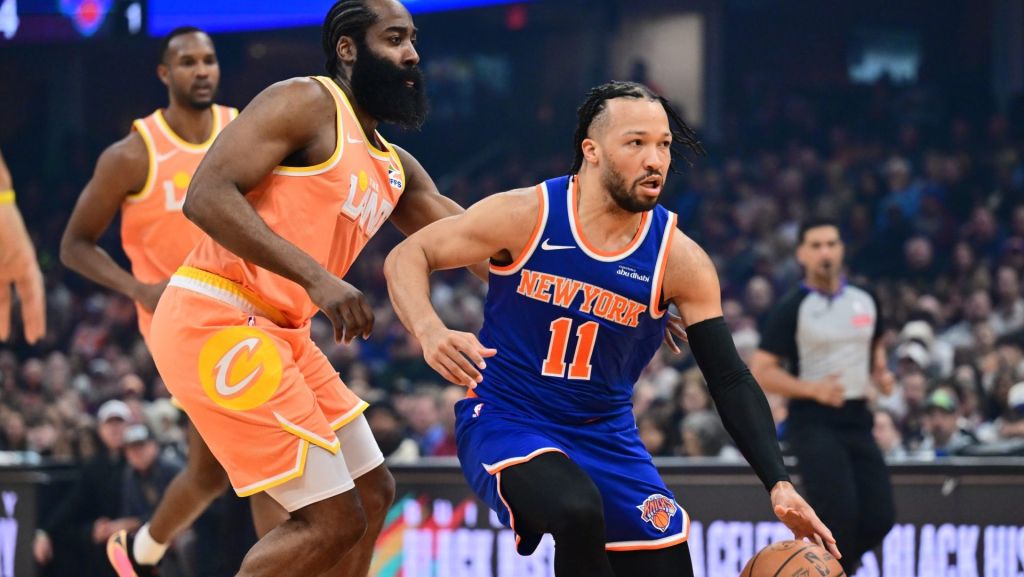
The Knicks are built similarly, having signed Jalen Brunson in free agency and traded for Karl-Anthony Towns, OG Anunoby, and Brunson’s Villanova teammates Josh Hart and Mikal Bridges. Mitchell Robinson and Deuce McBride are the Knicks’ most important homegrown players.
East Trades, West Drafts
Out West, both the Thunder and Spurs are winning with young cores mainly built through the draft. Oklahoma City acquired Shai Gilgeous-Alexander after his rookie season from the Clippers in the 2019 Paul George trade after his rookie season, but he became a star with the Thunder.
The key for both teams is that their core players’ max extensions haven’t kicked in yet.
On Sunday, the NBA named Gilgeous-Alexander its MVP for the second consecutive season. The two-time MVP made $38.8 million this season, which ranked just 34th in the league, according to ESPN’s Bobby Marks. A year ago, Gilgeous-Alexander signed a four-year, $285 million extension that will make him the NBA’s first $70 million player. But the 6-foot-6 guard’s new deal doesn’t start until 2027–28. (He delayed his extension to help the Thunder’s cap sheet.) And extensions for Jalen Williams and Chet Holmgren don’t kick in until next year.
“Assuming we’re a contending team this year, that would be three years as a non-taxpayer as a contender,” Presti told reporters in September. “People talk all the time about the fact that these—the windows are shorter and they’re saying there’s three years with each team more or less with the new rules. We just had three, or we’ve had two, we’re going on three.” But the Thunder can only avoid the tax for so long. The Thunder have committed more than $800 million to its three stars.
The Spurs will face a similar situation. While the Knicks and Cavaliers boast few homegrown players, the Spurs boast a trio in Victor Wembanyama, Dylan Harper, and Stephon Castle. Similar to the Thunder, the Spurs just made one star trade, acquiring De’Aaron Fox from the Kings a year ago. (Fox was far more established than Gilgeous-Alexander when he was traded.)
This summer, Victor Wembanyama is expected to sign a five-year rookie extension worth $252 million. The deal could top more than $320 million if Wembanyama hits certain thresholds.
He didn’t get a salary bump despite winning Defensive Player of the Year last month because he wasn’t eligible for All-NBA awards last season. Stephon Castle has two years left on his rookie contract, and will make just $10 million next season, but is extension eligible next summer. And last August, De’Aaron Fox agreed to a four-year extension worth $221 million that starts next season.
As the Thunder know, keeping the Spurs trio together won’t be cheap.
Download the FOS App
The business of sports, in your pocket.



Scan the QR code to get the app now.