Want more from Front Office Sports
in your search results?
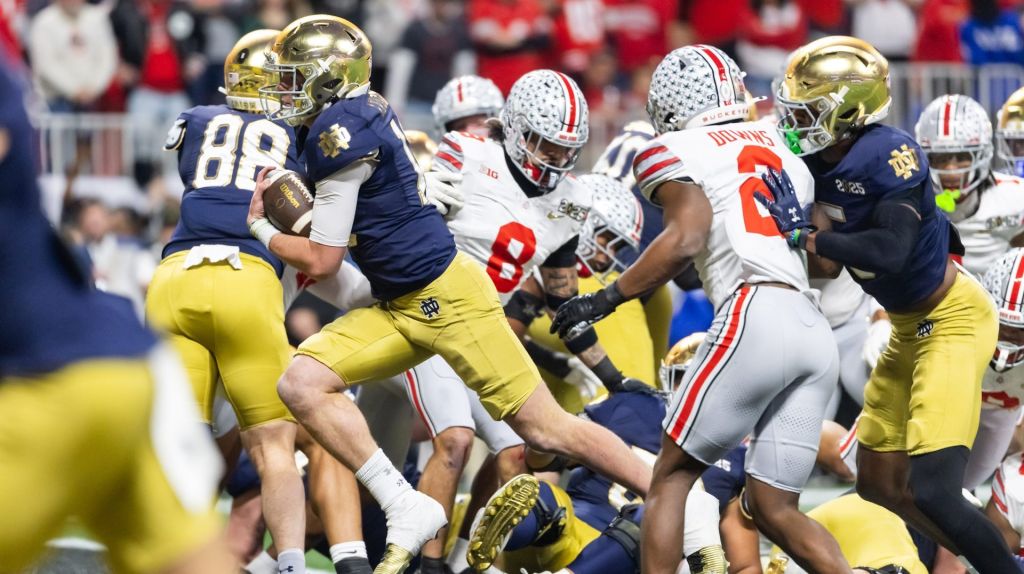
The $17 million and $18 million price tags for jersey patch deals announced this week by Ohio State and Notre Dame, respectively, surprised some sports advertising sellers—but only slightly.
Two sources who handle multimedia rights negotiations for colleges (but who did not broker either of the aforementioned deals) told Front Office Sports they had pinned Ohio State as the school that would fetch top dollar for its jersey patch sponsorship, though they anticipated a value “closer to $25 million.” Meanwhile, the $18 million Notre Dame brought in “was a little bit more than [we] would have projected,” one of the sources said, especially considering the Fighting Irish do not offer any branding opportunities in their football stadium.
Still, the sources FOS spoke with emphasized that the figures weren’t wildly unexpected and that only a handful of the schools yet to announce deals could command similar value—a view echoed by other industry executives.
“I think the market has now been set,” said Jason Miller, EVP of commercial revenue and head of properties for Excel Sports Management, an agency that has negotiated more than 25 jersey patch deals across professional sports. “A few deals have trickled in over the last few months, but everybody has really been waiting for a big shoe to drop. With Ohio State and Notre Dame this week, that’s now happened. I don’t expect there to be a deal that significantly outpaces those two schools.”
Several factors determine the value of a jersey patch.
First and foremost, sources said, is how much exposure a brand can expect to get across linear broadcasts and digital and social media by having its logo associated with a specific school. Next comes inventory—that is, how many schools are available to negotiate with. (Only Division I schools are currently eligible to sell uniform sponsorships, meaning there are less than 400 opportunities). Finally, “school intangibles” must be considered: things like general reputation, alumni base size, the breadth and success of athletic programs, typical sporting event attendance, and the social media reach of top athletes.
Experts suggested Texas, Michigan, Alabama, USC, and Penn State as the remaining schools with the biggest patch earning potential, with projected values topping out at $30 million.
Ultimately though, brands are the price-setters in this still-new market. Financial services companies are historically the biggest spenders on sports sponsorships: Notre Dame’s partnership is with SoFi; Ohio State’s is with Chase. A deal exceeding those would likely come from another big bank, and any such agreement would also likely include a “tremendous amount” of incremental assets beyond a jersey patch, according to longtime sports media consultant and Columbia professor Joe Favorito. Those, he said, could include in-venue signage or other campus-wide integrations.
While there will likely be a deluge of deal announcements between now and the start of the college football season on Aug. 29, industry sources don’t expect conversations to slow down after kickoff.
“We’ll continue to see deal activity throughout the college football season,” said Allison Fillmore, SVP of commercial partnerships at Learfield, the largest multimedia rights holder in college sports. “And we’ll definitely see an influx around the start of basketball season, too. Unlike the professional ranks, college jersey patches are really almost a year-round opportunity.”
That runway could get even longer. Jersey patches are currently only approved for non-championship competitions, but one industry source suggested to FOS that the NCAA may be considering a change to this position—which would be yet another boon for schools with perennially contending football and basketball programs.
Executives also cautioned against viewing this first wave of deals as a product of novelty alone. College sports’ massive audiences and uniquely loyal fan bases should keep jersey patches among the most sought-after sponsorship assets for years to come, they said.
As for where prices go from here? “I don’t think any of these things ever go down,” Favorito said. In the meantime, Monster Energy’s $20 million conference-wide deal with the Big 12 is looking like a steal.
Download the FOS App
The business of sports, in your pocket.



Scan the QR code to get the app now.