
Troy Aikman, Dolphins Have No Ongoing Consulting Agreement
Want more from Front Office Sports
in your search results?
USC’s new football locker room doesn’t announce itself as a locker room in the traditional sense.
The $225 million Bloom Football Performance Center opens to a hall of plush leather seating. There are more than 100 zero-gravity reclining chairs—one for each player on the squad—rigged with outlets to plug in phones and compression boots, and framed with hidden storage engineered down to the inch. There’s an in-house barbershop and a room with hot-cold therapy pools. And you won’t find gear—or gear smells—since pads and helmets are stored in a separate mudroom.
Everything a player needs—food, the weight room, sports medicine, the practice field—sits within steps. It’s a major upgrade for the Trojans, who until this year dressed in the basement of a sports center shared with the university’s other athletic programs, and had to cross a street to reach a single grass practice field. The new building more than doubles the old footprint, and the locker room was the point around which the rest of the design was arranged.
“This is the heartbeat of the building,” Jeff Fucci, USC’s senior associate AD, tells Front Office Sports. “Everything for a student-athlete really emanates from the doors of a locker room.”
From college football to the NFL to a fast-growing WNBA, teams are pouring money into the one room fans almost never see.
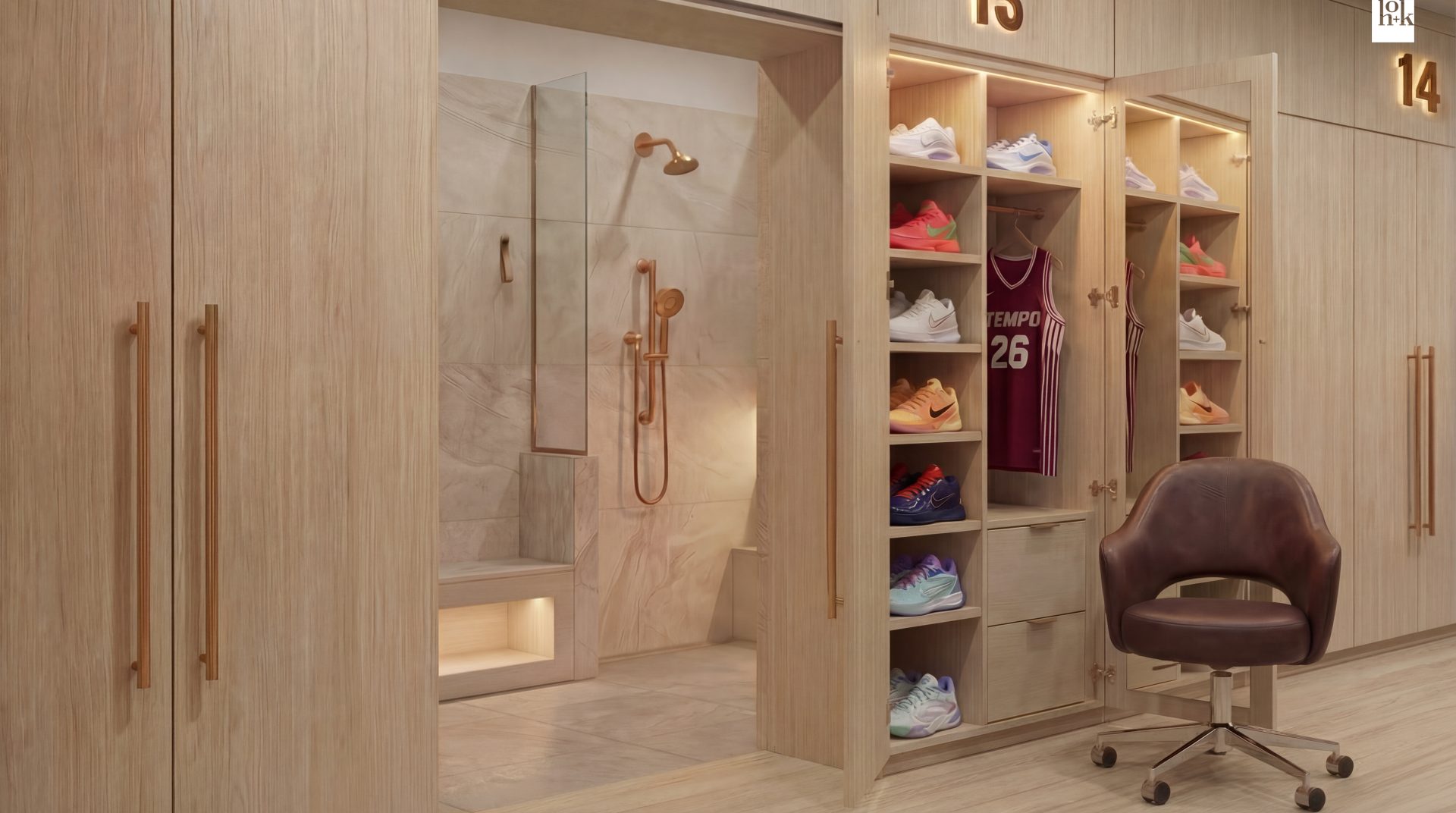
Notre Dame opened a $100 million football hall this summer. The Indiana Fever are building a $78 million training facility that reimagines the locker as an individual ”studio” with a vanity and ample storage, plus a spa-like recovery area nearby. The New York Liberty’s forthcoming $80 million facility, opening in 2027, likewise scraps open stalls in favor of private studios, one of many design choices informed by player feedback.
Budgets have climbed accordingly: Locker room overhauls that ran six figures a decade ago have spiked into the millions. The transformation—and race to have the most luxurious facility—is just beginning.
Lockers, Perfected
For all the amenities surrounding them, lockers themselves are still the centerpiece, and they’re almost always the largest line item, says Sherri Privitera, senior principal and director of women’s professional sports at design firm Populous. She tells FOS the price climbs fast once they’re wired for charging ports, lighting, and screens.
The manufacturers have watched that number balloon throughout the past decade, especially in college football.
Travis Hollman, whose company Hollman Inc. has built out more than half the U.S. locker market across both pro sports and general recreation, traces the current trajectory back to 2006, when a Texas billionaire helped his firm design what he calls the first modern locker for Oklahoma State.
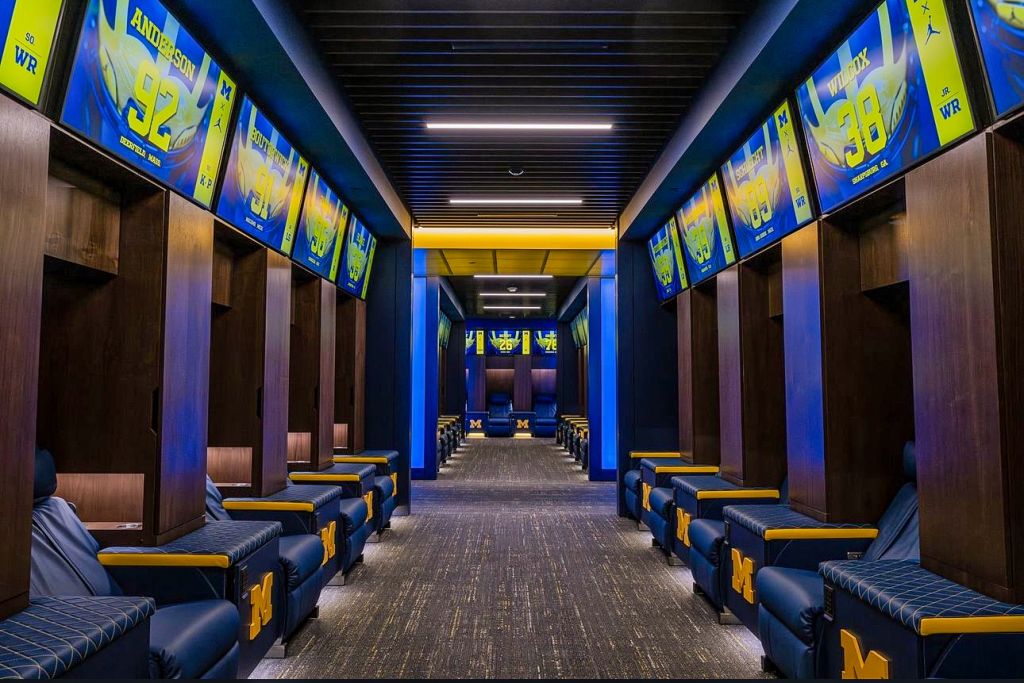
Until then, lockers were fairly standard-issue features, assembled on-site from wood or metal; Hollman introduced a high-end, custom-made alternative that arrived on campus pre-built and ready to install. Today, bespoke lockers are ubiquitous across the top tier of college athletics and major leagues, with some high-school football programs even splurging in recent years.
The biggest projects now run into seven figures: The locker package Hollman shipped to Notre Dame for its newly opened Keith and Janet Sherin Locker Room, he says, cost $1.7 million. It’s built with antimicrobial surfaces, germ-killing lighting, lockable compartments only coaches can access, and reclining nap chairs.
College football, he says, spends the most by a wide margin: While new lockers for an NFL team run about $700,000 to $800,000, a well-endowed Division I football program will pay twice that.
Part of that eye-popping number is simple scale. A college football roster can run to 120 players or more, roughly double an NFL team. Football also uses more equipment than any sport except hockey—pads, cleats, helmets, all of it needing to be dried and stored—which drives up the engineering inside each unit.
But it also speaks to teams’ priorities: While the pros often approach the space as a showpiece for tours, colleges treat it as a daily home for players, pouring money into the functionality Hollman says the pros tend to leave out. The more revenue a sport produces, the bigger the investment—football first, then basketball, then hockey or baseball depending on the region—and, thanks to Title IX, women’s college programs get comparable upgrades to their men’s counterparts.
For Hollman, Oregon is the next project. The university’s new 170,000-square-foot football facility will hold what he says is the most expensive locker setup his company has ever built—until, perhaps, whatever comes next.
Made for Recruiting
At USC, part of the case for spending on a luxury facility comes down to player retention. As the transfer portal has made roster continuity harder to count on, keeping players has become as urgent as signing them—and Fucci says the locker room was built with that in mind.
“Now more than ever, in this era of the transfer portal, the time student-athletes may spend at schools is more brief,” he says. “You really need to forge those bonds.”
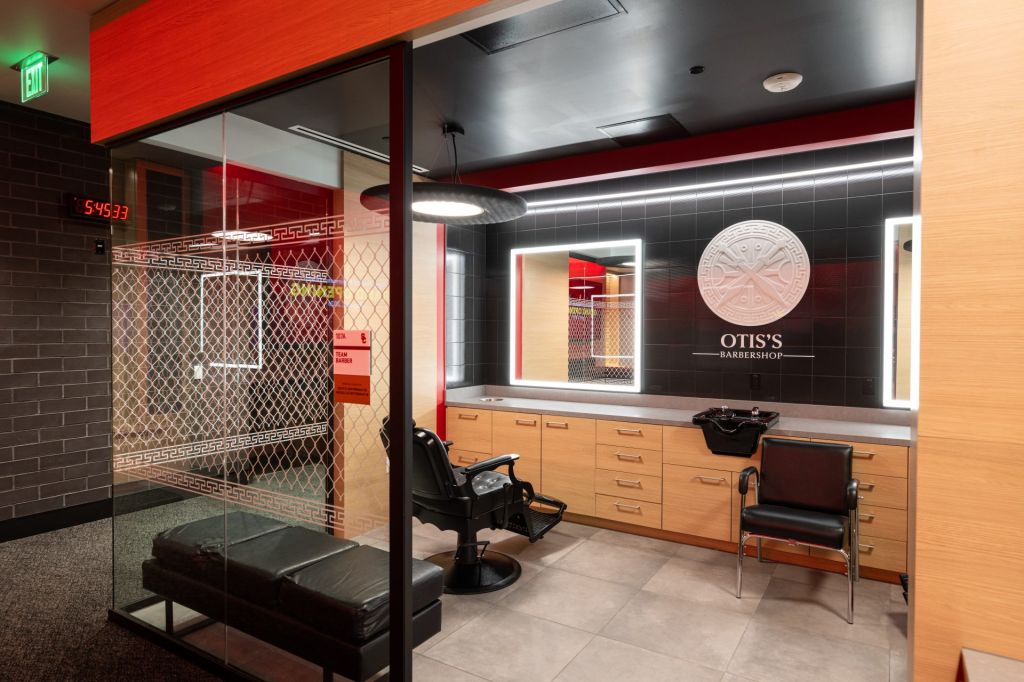
So, the room was built to bring players together. The lounge was pushed to the center of the design to pull players out of position-group cliques and into the same space. The barbershop exists because a player survey turned up Friday haircuts as a standing ritual; it’s designed as a place to sit around and talk while someone gets a fresh cut.
While a barbershop alone may not convince an athlete where to go to school, smaller factors have moved players before. Fifteen years ago, Hollman’s company put USB chargers in lockers for the first time and installed them at the University of Portland. The soccer coach called him afterward to report what they had gotten him: the second-best recruit in the country.
“It’s a joke, right?” Hollman says. “But back then, that was such a big deal.”
For Women, by Women
As huge as the investment in college sports is, nowhere is this shift toward tailored, high-end locker rooms more apparent than in women’s sports, particularly the WNBA.
For years, the league’s players made do with borrowed college gyms, shared NBA practice courts, and lockers that weren’t really theirs. Candace Parker, a two-time MVP, has said she went 16 years in the league before she had a locker with her name on it.
“I’ve had players from other teams that have come from sharing court space with the morning jazzercise class and having temporary lockers in certain places,” says Fever president Kelly Krauskopf, who has spent 30 years in the WNBA and NBA, and is overseeing the team’s new build. “As a whole, the league has come a long way, and rightly so.”
The WNBA is in the middle of what it expects to be its most-watched season in history, with attendance also up, plus a new labor deal that, for the first time, puts in place minimum standards for team facilities. The changes have both lined the league’s coffers and set a new bar, driving investment in these new, specialized spaces.
As facilities become more custom and luxurious, it’s created a kind of one-upmanship among teams over square footage, amenities, and project price tags.
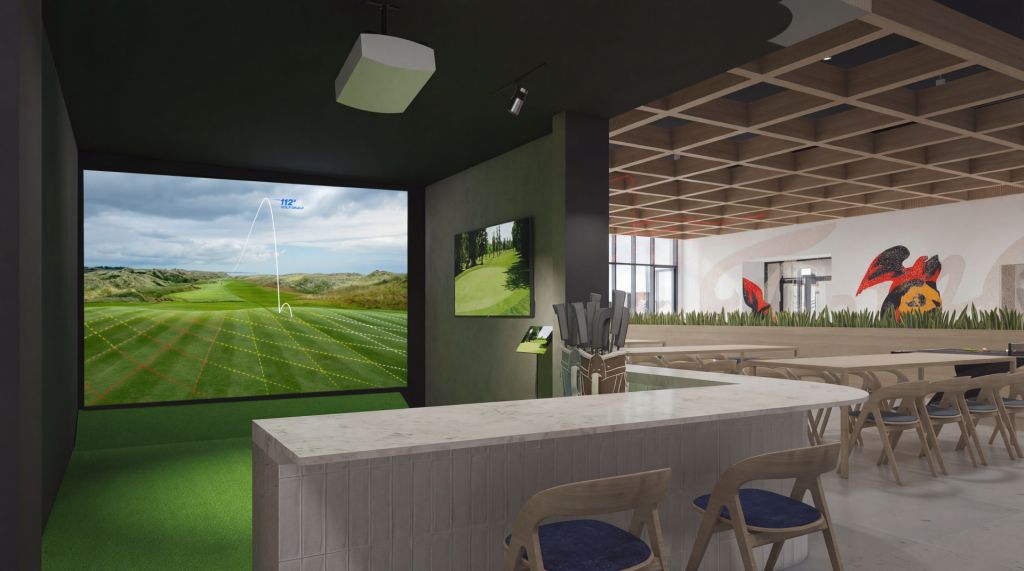
For Krauskopf, who watched college facilities lap women’s pro spaces for years, the competition is welcome. “It’s a little bit of an arms race, because you’re seeing everybody announcing they have the best new training center, or they have the largest, or they’re investing the most money,” she says. “And I love that, because that’s really where we should be. That’s a high standard for everyone.”
The Fever’s new facility, rising across the street from Gainbridge Fieldhouse, is her answer to a question the whole WNBA is now vying to address: What does it look like to build for these athletes rather than inherit spaces built for men?
In Indianapolis, the project is being led entirely by women—project manager, construction managers, architects—with an eye toward details Krauskopf says weren’t part of the previous, men’s-first template. There are wardrobes sized to hang tunnel outfits, a hushed recovery room with a water feature and ample natural light, a hair and nail salon, and—at one player’s request—speakers in the showers.
“Women just think differently. We move around the world differently,” she says, “and we wanted to be intentional around that.”
Building out the right space is a matter of performance, not just comfort, argues Privitera, whose firm designed the Fever’s facility. She designs locker rooms as athlete-only spaces, so no one has to worry about being walked in on. A player carrying that kind of unease into the building isn’t fully available for the work—and availability is what teams are paying for.
That lens has surfaced important tweaks that were always possible but never prioritized. In player interviews—which Privitera prefers to run individually, to encourage candor—one asked for floor-to-ceiling restroom partitions. Others noted they queued for the lone accessible shower because it had the only detachable head, since not everyone wants to wash their hair every day. Both were cheap, easy fixes.
“That’s what we’ve been trying to do; flip the script,” she says. “Why don’t we intentionally design for the need?”
Download the FOS App
The business of sports, in your pocket.



Scan the QR code to get the app now.