Want more from Front Office Sports
in your search results?
NASCAR is embracing drivers’ colorful language during its 10-race postseason, which began Labor Day weekend and runs through November 8. For every expletive dropped on driver radio communications, the Cup Series is donating $5 to a virtual swear jar. Fans can predict the top curses and final total for a chance to win all the money in the jar; over six races, the bounty is close to $6,000.
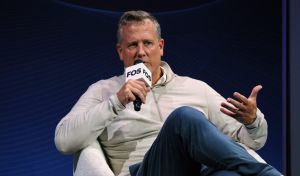
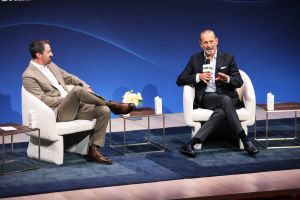
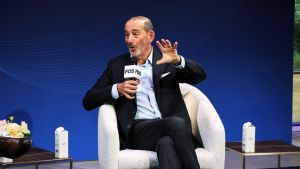
The swear jar is the latest component of NASCAR’s season-long “Hell Yeah” marketing campaign—and one of many increasingly “in-your-face” promotional plays CEO Steve O’Donnell touted at the Front Office Sports Tuned In summit in New York City on Tuesday.
“NASCAR has been a bit conservative in their advertising in the past, but Jess Smith, who heads up our marketing, put together this ‘Hell Yeah’ campaign and we’ve all really embraced it,” O’Donnell told FOS senior reporter Eric Fisher. “It’s the biggest promotion we’ve done.”
While fans seem to love the swear jar, O’Donnell noted it’s not quite as popular with team owners. Still, NASCAR is going to “continue to be aggressive in some of the things that we do, and get outside of the lane that we’ve been historically in,” he said.
Embracing Driver Authenticity
That appetite for aggression was on full display a few weeks ago—literally. When drivers Carson Hocevar and Ryan Blaney got into a physical altercation during the Bass Pro Shops Night Race at Bristol Motor Speedway on September 19, NASCAR leaned in and immediately shared clips of the clash on its social media channels. On YouTube alone, the video has nearly two million views.
“I don’t want to encourage fighting, but when it’s just two drivers, let them go at it,” O’Donnell said about the incident. “These guys are driving 180 miles per hour; they’re going to be ticked off sometimes, and we need to let that emotion play out to a point.”
He added that “allowing drivers to be authentic is a good thing,” which sponsors are realizing as they “come back into the sport.” Among these boomerang brands is FedEx; the freight carrier will serve as the title sponsor for the NASCAR Truck Series in 2027 after a nearly two-decade run as the primary sponsor of Joe Gibbs Racing between 2005 and 2024.
‘We’re All About America’
O’Donnell also repeatedly stressed NASCAR’s desire to reach a wider swath of Americans.
“We think about [our marketing] in terms of ‘everyone loves racing,’” he said. “We’re all about America; we’re all about having fun—loud, fast, families. Everybody loves that, no matter where you are. Even if we don’t have a race in Seattle, Washington, the goal is still to have a middle schooler in Seattle talking about NASCAR.”
NASCAR’s youngest drivers are poised to play an important part in this quest. O’Donnell pointed to Connor Zilisch, a 20-year-old Red Bull–sponsored driver, as an example of the next generation of talent eager to promote racing beyond the track.
“We have young drivers with all kinds of talent who are all in on the sport, who want to travel and promote the sport,” he explained. “We have not had that in 10 to 12 years. We’ve had a solid driver core, but their job was to win races and not necessarily grow the sport. For the first time in a long time, we’ve got drivers, teams, and tracks aligned on ‘let’s all bring this together and talk about how great this sport is and can be.’”
NASCAR is also enlisting social media influencers and expanding its YouTube presence as it looks to reach new audiences. This push extends to Hollywood, too: O’Donnell said the Cup Series is actively involved in the production of the Days of Thunder sequel starring Tom Cruise, including supplying more than 80 race cars for the film.
Since joining NASCAR in April, O’Donnell has been encouraged by the sport’s trajectory. “More people are sampling the sport and showing up at races,” he said to close out his time on the FOS Tuned In stage. “We’re on a good path.”
Download the FOS App
The business of sports, in your pocket.



Scan the QR code to get the app now.