Max Kellerman, LeSean McCoy Off DAZN Boxing Show As Mario Lopez Joins
Want more from Front Office Sports
in your search results?
In the mid-2000s, an Indian entrepreneur saw that the genteel sport of cricket was also a potential gold mine.
During his stint at Duke, Lalit Modi immersed himself in U.S. sports, noting how the major leagues generated huge revenue by selling themselves as entertainment. As he worked his way up the ladder within the Indian cricket administration, Modi realized that a new, three-hour, broadcast-friendly format of the game—Twenty20—was the perfect vehicle to monetize the sport.
With the backing of the all-powerful local governing body, the Board of Control for Cricket in India (BCCI), Modi created a domestic T20 league from scratch. He succeeded in selling the eight teams—which had no players, identities, or home grounds—to prominent local businessmen and rich celebrities for a combined $620 million in 2007.
The jaws of players, fans, and administrators hit the floor. Cricket had never seen that kind of cash.
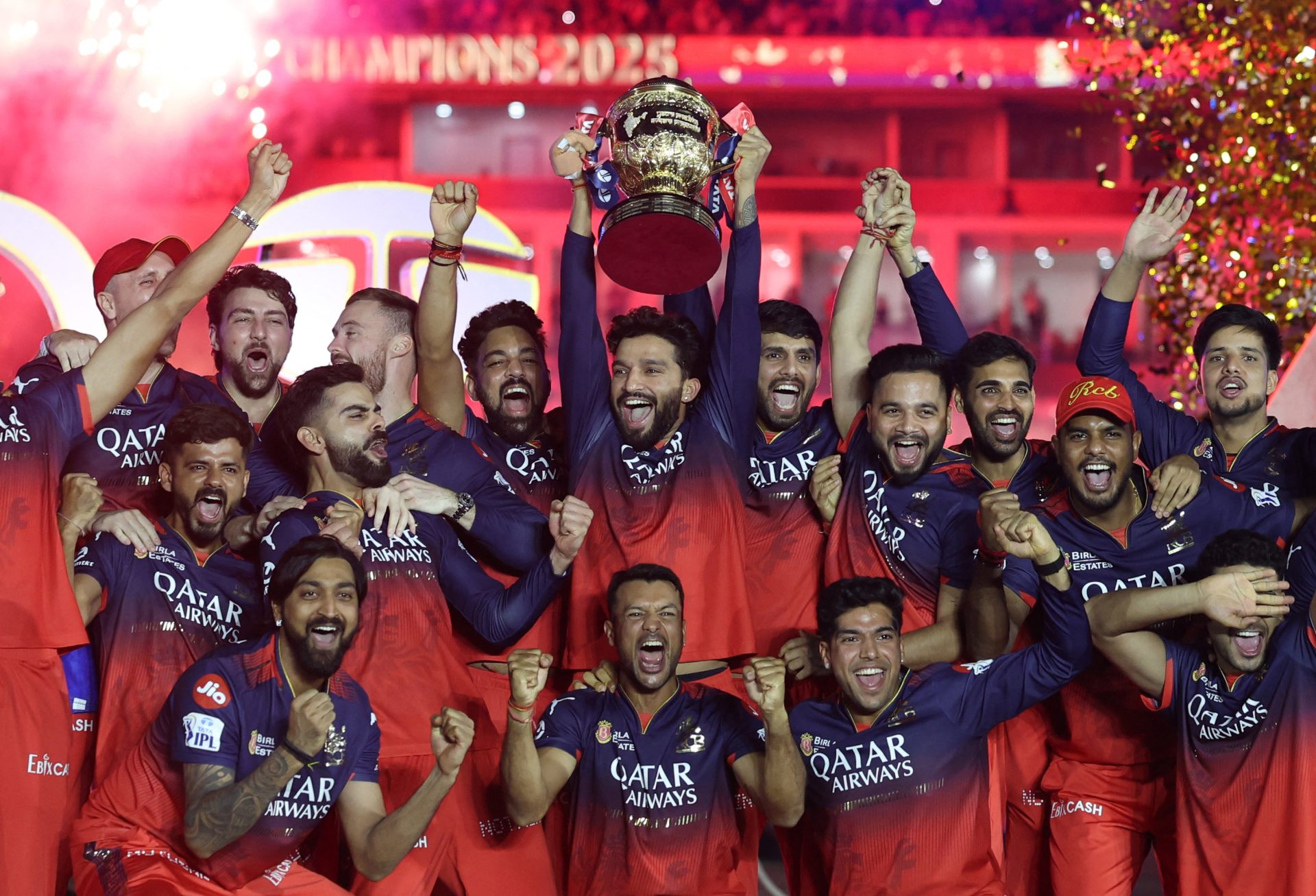
Nearly two decades out, the big bets on the Indian Premier League have paid off. One of the original franchises, Royal Challengers Bengaluru (RCB), was originally purchased for $112 million by United Spirits, the local subsidiary of global drinks manufacturer Diageo. This April, it sold RCB to the Aditya Birla Group, a multinational Indian conglomerate backed by Blackstone. The investor group also included David Blitzer, who has stakes in teams in the four major U.S. men’s pro sports leagues, as well as the English Premier League, MLS, and the WNBA. The price tag: $1.8 billion.
A deal for another of the original eight teams was also reached in May, this time for $1.65 billion. Rajasthan Royals were sold to Indian billionaire Lakshmi Mittal. (A previous sale, agreed in principle with Arizona-based entrepreneur Kal Somani, with additional investment from billionaire Rob Walton of Walmart, fell apart in April for reasons that have not been publicly disclosed.)
These big valuations put Indian cricket teams in the company of elite European soccer clubs and even mid-sized MLB franchises.
As U.S. institutional investors have woken up to sports as a massive asset class, major leagues have relaxed their rules around private-equity investment. Foreign capital has rushed into European soccer—even though that means coming to terms with new risks, like the ever-present possibility of relegation. It has also laid smaller bets on niche interests, such as rugby and pickleball.
But cricket is a new frontier. It is barely played—or even understood—in the U.S. Its locus of power is halfway around the world in Mumbai. Stakes in elite teams have become very expensive. Why is it so attractive?
Sport As Religion
Cricket—which “functions as a near-religious institution,” according to Arvind Navaratnam of investment-research firm Worldly Partners—is a wide-open playing ground for private equity.
The BCCI permits a single U.S. private-equity fund to buy up an entire team. Compare this to the NFL, where PE ownership is capped at 10%. Owning 100% of a franchise provides more opportunity and control—especially with an audience of about 1.4 billion people, which is still expanding with the rapid growth of India’s middle class.
That huge population has propelled an enormous expansion in the value of the IPL’s media rights. Broadcast revenue has risen from around $100 million annually to $500 million in the latter part of the 2010s. The current deal, which runs until 2027, is worth more than $1 billion. These numbers are still small fry relative to the NBA or MLB, but the IPL’s comparatively short, 10-week season means that on a per-match basis, the IPL has become one of the most expensive leagues to broadcast.
The sales also help to build a picture of what the franchises are worth. The BCCI sold two expansion teams in 2021 for $750 million (Lucknow Super Giants) and $940 million (Gujarat Titans). But RCB and Rajasthan Royals are the first to have fully traded on the open market. Their scarcity value and the investors’ belief in likely capital appreciation propelled them to sell for between 20 times and 25 times their annual revenue. The multiple far outstrips other major U.S. league teams or European soccer teams, and reflects confidence that the IPL is still maturing.
As the U.S. pushes in, the IPL is primed for growth in other ways, too. Navaratnam expects the new U.S owners to explore untapped digital engagement. “The IPL’s young, mobile-first fan base is well suited to the kind of direct-to-consumer monetization, through apps, fantasy, gaming and branded content, that U.S. sports have been doing for years,” he says.
And as big as the revenue story already is, the league’s measures to safeguard value and control costs are what make it especially attractive for American private equity.
Modi borrowed the U.S.’s preference for a closed league, with no relegation. This is important for institutional capital, which wants reliable revenue and asset values. Similarities between the IPL’s structure and other U.S. leagues could mitigate the novelty—and possible risk—of investing in a South Asian emerging market.
Player wages also account for an unusually small share of team revenue. In the NBA, the current collective bargaining agreement sets salaries and benefits at around 50% of total revenue, comparable to the NFL. The EPL is introducing new legislation to keep a similar ratio under 85%.
But in the IPL, it is currently around 20%. The BCCI also ensured that “player wages were set in three-year cycles through its auction system, which gives investors forward visibility on costs of the sort that does not exist in European football,” explains Andrew Umbers, a partner at consultancy Oakwell Sports Advisory. A complete absence of union power also means that wages are unlikely to rise fast enough for them to trouble investors.
Uncharted Territory
Although seemingly ideal on paper, IPL investment is not without risk.
The jump in the value of the current domestic broadcast deal means that media rights now account for almost three-quarters of IPL revenue. At the most recent negotiation, the price tag was pushed up by the desire of Viacom18 to capture streaming rights, which it intended to use to drive growth in its Jio digital platform. (Viacom18 actually paid more for the streaming rights than its main rival, Disney Star, paid for the TV rights.)
However, Viacom18 and Disney Star merged in 2024, which will reduce the level of competition in the next round of IPL rights. A recent report by Media Partners Asia, a Singapore-based consultancy, projects that the next media-rights deal will be agreed at the same value. The league is widely expected to expand the regular season from 14 matches to 18—which means these terms would mark a 13% decline in per-game revenue.
MPA also reported a deceleration in advertising revenue during the 2023–27 cycle, which it blamed on the Indian government’s decision to ban paid-for fantasy gaming and crypto advertising.
The quality of governance is another valid question. In 2013, the IPL’s reputation was badly stained by a match-fixing scandal. Intervention from India’s Supreme Court compelled the BCCI to separate governance of the league and the management of its commercial interests. Despite this push, India is an outlier among countries hosting top-tier sports leagues in that it lacks a specific sports-governance law. In theory, the IPL remains vulnerable to corruption or conflicts of interest.
Continued Dominance, Continued Returns
Despite the risks, Umbers argues the investment case for Blitzer and his local partners is still secure.
Each of the 10 teams is profitable at its current levels, and costs are more predictable and subject to more stringent controls than teams in comparable leagues. He’s also not worried about the oversight question because “the IPL now operates under intense scrutiny, a governance failure is extremely unlikely.”
Scarcity is also on their side, as a tight limit on the number of teams available to own helps to drive up their value.
Lalit Modi’s original vision gave the IPL an insurmountable advantage in establishing the world’s preeminent T20 league. When other cricket-playing countries wanted to set up their own IPL equivalents, they turned to IPL owners and their cash and expertise to make them sustainable. There is no prospect of the IPL slipping behind a rival competition.
The arrival of U.S. money is confirmation of the IPL’s place among the world’s premier sports leagues. And for American investors, the opportunity is only beginning.