Want more from Front Office Sports
in your search results?
Kevin Griffin has seen sports from a variety of perspectives. A former Ohio State football captain, with professional leadership positions with the Browns, Seahawks, D.C United, and most recently with Ohio State University, Griffin is taking those experiences to his new role as Oregon State’s athletic director.
A charter member of the Pac-12, Oregon State was left behind when all but one other school (Washington State) left for the Big Ten, ACC, or Big 12. Now the Beavers are one of nearly two dozen Pac-12 schools (nine full-time, 13 affiliate) and Griffin, hired in June 2026, is tasked with taking Oregon State into a new era, and help make decisions to bring the Pac-12 back to national prominence.
In an interview with Front Office Sports, Griffin discussed a multitude of topics, including his vision for Oregon State and the Pac-12, NIL (name, image, and likeness), revenue-sharing, and the expanded College Football Playoff.
This interview has been lightly edited for clarity and length.
Front Office Sports: What attracted you to Oregon State specifically?
Kevin Griffin: We have an incredible president named Jayathi Y. Murthy and her leadership and her vision for what she wants to do here at Oregon State was exactly what I felt like I could bring to a campus and a community. So really her and I aligned on what that looked like and the opportunity was critical. Then we also had some incredible coaches who were younger and first-year coaches, and some of them were very veteran and highly successful. The combination of a good coaching staff made it really attractive. So it just was alignment in all those areas.
FOS: Usually we see new athletic director hires and major coaching hires (football, men’s basketball) happen in tandem. What’s been the dynamic of inheriting a full varsity coaching staff?
KG: It’s been great. A number of those coaches were on the search committee, and so through that I got to know them and they got to know me. Then really kind of quickly establishing what their role is vice versa my role. How can I support them and how our executive staff that we’re continuing to build on would be supporting them and sharing the vision of how we restructure our department so that we’re more focused on servicing our coaches and our student athletes?
They’ve totally bought into it and embraced it, and so it’s been great. I have very frank conversations with their coaches. Sometimes, it’s very personal around their development and what’s going on with their teams, and then other times it’s just like, “Man, how are you doing?” Whether it’s how I can help you or your family. So it’s been great. There’s a mutual respect there, and I happen to have a background in a number of sports, so that certainly helps that I know what I’m talking about from a sports perspective. But most importantly, it comes down to like, are you a good people manager and give you folks space to do their jobs?
FOS: You come from a sports business background—marketing, corporate partnerships, revenue generation, etc. Do you sense that more colleges are leaning toward that type of athletic director versus a traditional administrative background?
KG: I think there was a hope to do that probably four or five years ago, and I say “hope to do that” from the presidents and other decision-makers. I don’t know if that’s really played itself out, but someone like me who understands both the professional sports world and how to run a business, but has also been grounded in working in college athletics for some time, it’s a combination that happens to work.
You have to understand how to build an organization. You have to understand how to run a business, and then you also have to understand the role that college athletics plays as part of the mission of the university. You can’t have one without the other. The most important thing that we do is to ensure that our student-athletes are safe and that their dreams come true. That’s first and foremost. That’s why we get up every day, and then you have to do all the other things on top of that.
FOS: Big-time college football is a part of your foundation as well. Your uncles played at Ohio State (Archie Griffin, Ray Griffin), you were a Buckeyes team captain yourself in 1998. Your most recent role before this one was with Ohio State as well. How do those experiences shape how you want to build Oregon State athletics?
KG: College is such a formidable time in a young person’s life. When done well, it can set people up the relationships that they have, the habits that they build, the type of young woman or young man that they become, and it’s the reason I left professional sports to work in college.
It’s what I loved about being a student-athlete at Ohio State, and so what I’ve always cherished most is the relationships with our student-athletes and helping them get off to a good start in their career, and letting them know that yes, while I sit here and think about our business and I work with our coaches and our staff to make sure that we have winning teams, what I’m really thinking about most and wanting to do is make sure that we’re we have the right infrastructure and support in place so that when they graduate from Oregon State University, they’re prepared for life and they have a job or whatever they plan to do, serve our country.
FOS: As far as working through Oregon State’s NIL infrastructure, how important was the $24 million Valley Foundation Gift and the enthusiasm from donors to surpass an $8 million fundraising yearly goal in just six months?
KG: Well, I haven’t been here that long. I think I’m coming up on my five-month anniversary. There’s a couple things. We are so appreciative of the Valley family and how they’re supporting us from a philanthropic standpoint. And by the way, they’ve been doing this for years. They’ve supported athletics in a variety of different ways, from capital projects to now the Valley Challenge and work across our campus and our institution.
That said, one of the things that I think is really important is that this is not the only way that we’re going to support our student athletes, revenue-sharing and NIL. It’s a foundation, but not the only way that we’re going to do that.
What I have found that needed to be done most is just get us organized and help Oregon State understand a more dynamic approach to supporting both our coaches from a planning standpoint, and then roster construction and management for the future. So, how do we get ahead of the roster for 12 to 18 months? And a lot of that comes down to how you’re resourcing your teams, whether that’s your assistant coaches and your head coaches, or in this case, the specific investments you’re going to make in your roster.
FOS: What’s the next tangible step in creating the environment that you’re looking for?
KG: We’ve established our cultural framework and the way that we’ve agreed to work together and our values and our mission, and the outcomes that we want to drive towards. Once we’ve done that, then it’s a matter of how we get organized to bring the resources in house. And we’ve done that, right? We’ve made some staffing changes. We’ll continue to modify our staff in a way that allows us to secure the resources that we need through the commercial avenues: ticket sales, sponsorships, third-party events, licensing, all the things that we need to do a better job at. Then make sure that we have plans in place to support the teams that we need support, and that’s everything from roster construction to our leadership institute for our student athletes, and supporting them as they go forward in their careers.
If there’s anything I want you to get out of this story more than anything is that our magic formula or our secret sauce right now is the culture in which we have. That’s a culture of commitment, a culture of unselflessness, and our coaches are absolutely amazing human beings.
FOS: Building off that, the recent re-signings of quarterback Braden Atkinson and wide receiver Jesse Legree for next year, what does that signify about Oregon State and what you’re trying to build?
KG: It’s hard to explain, man, because I just don’t think people will believe us. But it’s first of all, Corvallis is a special place, and this university is incredible. It’s one of those under-told stories or underreported stories in college athletics. This is a great place, but those student-athletes—and I won’t speak specifically to Braden and Jesse—you’re going to see more and more student-athletes, whether that’s the recruiting class that we just signed in men’s basketball, top 20 in the country, is retaining our best talent, both coaches and student-athletes.
They’re staying here because we can, number one, support them in a holistic approach. Of course, revenue share is a part of that. But when you’re in a place that’s like oozing with character and oozing with integrity, and they see the extra mile that you’re putting into the relationships to take care of them today and in the future, that goes a long, long way. These young people, more than anything today, need to know that you’re making a covenant, not a contract with them, and that matters. And so, my comments to any parent in the recruiting process, is we are here to be with this student-athlete not only for the four or five years that they’re here with us as Beavers, but for the rest of their lives.
And I got to tell you, money can sometimes be fool’s gold, but true relationships and commitment, like what we’re making and with the character that we have, it goes a long way. That’s not to say that these other schools out here don’t have great coaches as well. But we just maybe at this moment of time we have a little bit of a secret sauce and ingredient that’s working for us. And again, I want to make sure that doesn’t come across as if we’re comparing ourselves to anyone. It’s just working for us.
FOS: One goal you set in your introductory press conference was getting the football team on national television weekly. What’s the status of that goal today and moving forward?
KG: All of our Pac-12 games have been on national television. Every single one of our football games this year, with the exception of the UTEP game, has been on national television. So we’ve really appreciated the approach that our broadcast partners (CBS Sports, The CW, USA Sports) have had here with the Pac-12, and it’s certainly helped.
The amount of text messages or outreach I get from across the country, people on the East Coast who have heard about what we’re doing or watched part of our game, or on a Friday will send me a text like, “Hey, I’ll be watching.” That’s a nice additive to being part of the Pac-12. So that certainly helps, and I hope it helps not only with the brand of the university, but also I hope we’re reaching the households of potential student-athletes. Then we got to continue to tell our story during the broadcast so folks understand the quality of coaches that we have and what we’re doing here at Corvallis. That again, we think is pretty special.
FOS: The expanded Pac-12 launched on July 1, 2026. You started five days afterwards. Right now, it looks like your league will have the Group of 6 representative in the College Football Playoff (Boise State). What have you made of the reimagined conference in its first few months?
KG: I’ll give you a bit of a vanity comment on this. One thing I would hope that the rest of the country could get a chance to do is travel to some of these Pac-12 campuses. So whether it’s Boise or out to Colorado State, these campuses are just beautiful, man. And the way that the western part of our country is showing up is just spectacular. And it’s really cool to see the way that we’re all working together in the conference.
I’ve been really impressed with the collaboration across the board with the different schools. We’re all getting to know each other. I really like the competition we’ve had in football. I think you’re seeing it early in basketball. It’s going to be a great basketball league. I’d like to see some of the investment we’ve made in our women’s sports, like Colorado State’s women’s volleyball team, they’re in the top 25, and I think we’re in third place. So I’d like to see what we’re doing from that standpoint, but most importantly, we’re working really hard together to make sure that this conference stands out and that we do the right thing for our student-athletes.
FOS: There was probably a time during big conference realignment where many people doubted if the Pac-12 could rebuild. Now with nine full-time members and 13 affiliate members, what are your thoughts on the Pac-12’s place in the national landscape and how do you want to continue to build?
KG: I think it’s a really good question for all of my colleagues at our other institutions, the eight other members. At least for me, we’re really proud of the fact that you know we stand toe-to-toe with Boise State in football, and I think Boise State is probably the CFP team this year. We look at a team like Gonzaga in men’s basketball, they should have a deep run in the NCAA tournament. So we have schools and teams that are going to compete at the national level, and they’re going to carry the banner for us this first year.
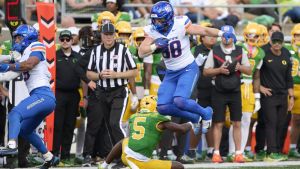
But the rest of us are right there too, right? If you look at our game against Boise State with our backup quarterback and a lot of backups in the game, we were right there all game, so it’s a very very competitive league. But we’re really fortunate right now to have in football Boise State, women’s volleyball Colorado State, and in men’s basketball Gonzaga teams that are really leading the country in what they do. In baseball Oregon State will be a top national contender. So in those sports, we’re holding our own.
FOS: On that note, the College Football Playoff is expanding. That does create more opportunities for Group of 6 teams to get into the field. What are your thoughts on expansion and how it affects the Pac-12?
KG: I’m not actually totally sure how I feel about it. It’s hard for me in my role to separate the conversation about the number of teams and not think about the economics of the Playoffs. That includes championship games. Obviously, we’re talking about football here and what that will mean not only us in the Pac-12 but you know other conferences as well. But as you can imagine, more of the dollars that are going to be generated from an expanded playoffs will sit with the Power Two conferences [the SEC and Big Ten] and not necessarily trickle their way down into the Group of 6, and so that creates a challenge.
We’re widening the gap between the Power Four and everyone else, and that’s problematic. In addition, the qualification of having to play 10 Power Four schools and some of the Group of 6 schools not qualifying as a Power Four school, that’s damaging, or it could be damaging. (Oregon State and Washington State count as P4 games in 2027 because previous games were scheduled while each were members of the Pac-12 when it was a part of the Power 5.) We’ll see how it plays itself out.
But right now, we’re gonna try to put the best team on the field that competes not only for that automatic qualifying role for a group of six, but also, who knows? What if we’re in the top 15 or No. 17, the way that Boise State is right now, as we end the season? Maybe there’s multiple Group of 6 teams that actually qualify in this 24-team Playoff.
Download the FOS App
The business of sports, in your pocket.



Scan the QR code to get the app now.