Want more from Front Office Sports
in your search results?
Over the past year, billionaire Cody Campbell has lobbied for college football to pool its most valuable broadcast rights. Campbell claims the idea will “save college sports” by making more money, which can then be used to fund women’s and Olympic sports.
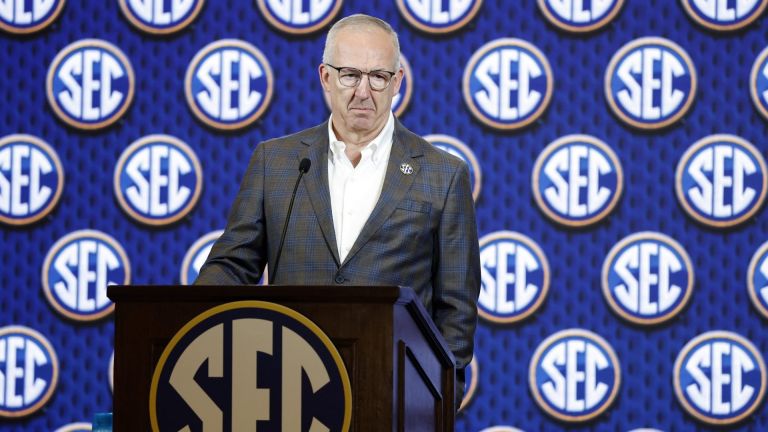
On Thursday, the SEC and Big Ten called the strategy “well-intentioned but misguided.” The conferences—who currently own the most lucrative college football TV rights—sent out a 10-page white paper to members of Congress explaining exactly why Campbell’s idea to amend the Sports Broadcasting Act of 1961 is a bad one.
Pooling college football media rights “would not save college sports but would actually introduce bureaucracy and legal chaos, and projections show it is likely to reduce revenue over the long term,” the white paper said.
The paper—sent by the SEC and Big Ten to offices of federal lawmakers who had requested more information on the concept—was prepared by FTI Consulting “on the basis of its review of certain of the information provided to it as well as publicly available information.” It’s the latest in a lobbying battle not just over a potential amendment of the Sports Broadcast Act, but also over broader legislation governing the future of college sports.
Campbell responded at length on X: “Our primary objective is to provide athletic programs, both big and small, the tools they need to achieve financial sustainability and preserve all of their programs, scholarships, and roster spots,” he wrote. “We want to grow the financial pie, and make it work for everybody—doing so in a way that doesn’t … punish or take revenue away from the ‘big boys.’”
Campbell made his billions through oil and gas companies in Texas; currently, he serves as co-CEO of Double Eagle Energy Holdings IV. He’s contributed heavily to the NIL (name, image, and likeness) efforts at Texas Tech and currently serves as the university board chairman.
The idea of centralizing college sports media rights isn’t new. The NCAA used to sell all sports media rights as one package, but the Supreme Court ruled in 1984 that doing so violated federal antitrust law. A group called the College Football Association formed to pool college football media rights for 64 schools, but the organization eventually folded and conferences began to sell their own rights. That setup continues today, minus pooled media rights deals for NCAA championships and College Football Playoff.
Campbell resurrected the idea of amending the SBA last here when he launched SCS and commissioned multiple commercials touting the idea during the 2025–26 football season. As Campbell has described it, a centralized body would take charge of selling pooled media rights, which would generate more total value than the current conference-specific deals. Those revenues would be distributed in a way that allows the biggest brands—like the SEC and Big Ten—to get a larger share of revenue than the rest, but still have enough left over to increase revenues for the other conferences and fund women’s and Olympic sports.
The idea has since become the subject of a lobbying battle, including the conferences, broadcasters, and industry consultants. Campbell’s organization, Saving College Sports, spent hundreds of thousands of dollars on lobbying in 2025, according to disclosures reviewed by Front Office Sports. At least two bills proposed in Congress last year—the SAFE Act and the College Athletics Reform Act—appeared to endorse the concept.
Campbell, who has a formal position advising President Donald Trump on college sports, said his concept “is also consistent” with Trump’s executive order from last year. “It seems [the SEC and Big Ten] have chosen to disregard the directives of the President and the will of the American people,” he said. Trump hasn’t weighed in on the SBA amendment concept publicly, however.
Now, the Big Ten and SEC are attempting to kill any momentum for amending the SBA.
Campbell’s proposal claims it would triple the media rights money in college sports, adding $6 billion in new “incremental” revenue.
The paper, however, argues:
- The current setup already provided for a 2.8x average annual value increase across all conference media rights deals.
- In 2036, the conferences could offer an average annual value of $10.5 billion, more than Saving College sports claims a pooled deal would generate.
- The current web of conference media rights deals make it logistically impossible to implement the concept anytime soon, given that media rights deals won’t be up until 2031 at the earliest.
- Pooled media rights would “erode” the current media and sponsorship value of schedules that cater to “local and national interest.”
- Creating a committee to oversee pooled media rights would bring unnecessary costs to conferences.
“College athletics doesn’t need government control and mandates,” the key points addendum to the white paper said. “Market forces, intense competition and continued innovation are the natural drivers of the value of media rights.”
But that doesn’t mean the Big Ten and SEC are against federal intervention in general. Along with the NCAA, Big 12, and ACC, they continue to lobby for a sweeping federal bill that would prevent athletes from being employees and restore enforcement power to the NCAA and conferences, rather than state legislatures and courts.
Download the FOS App
The business of sports, in your pocket.



Scan the QR code to get the app now.