Want more from Front Office Sports
in your search results?
Gender inequity isn’t new in NCAA basketball — or the rest of the sports industry, for that matter.
But the disparities between last year’s two Division I basketball tournament semi-bubbles were so stark, they drew outrage from federal lawmakers, professional athletes, brands, and media outlets — not to mention players and coaches themselves.
In the aftermath, an extensive report commissioned by the NCAA found inequity is “baked into the very fabric of the tournaments.” Conducted by Kaplan Hecker & Fink, it found that revenue distribution, contracts, and even the culture “prioritize Division I men’s basketball over everything else.”
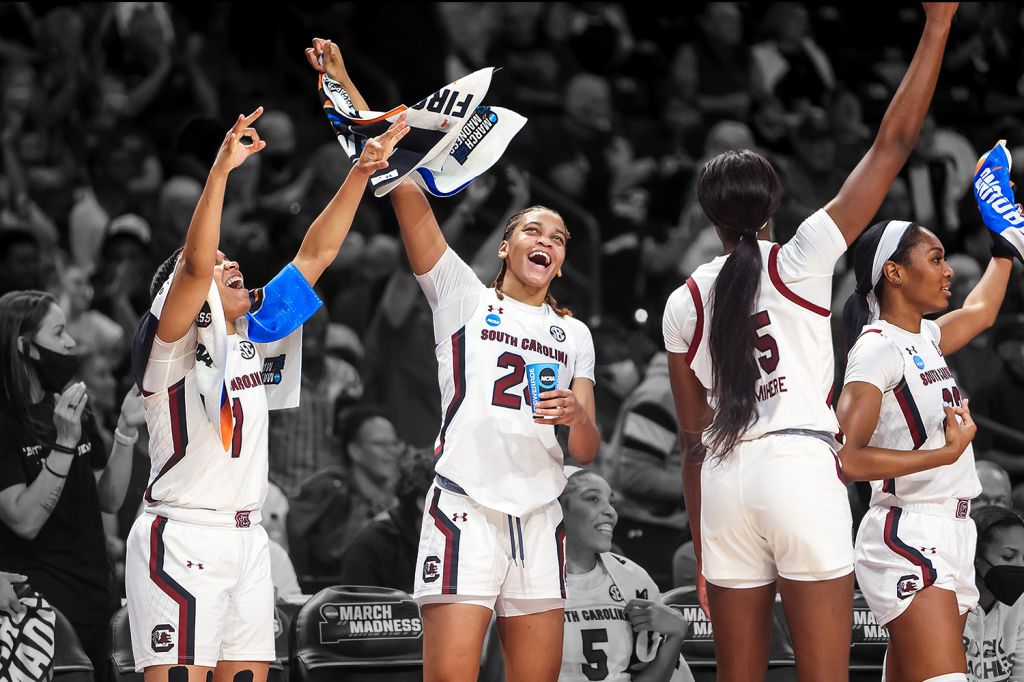
Despite this, women’s basketball has grown exponentially. Ratings have skyrocketed. ESPN sold out advertising and sponsorship inventory for the 2022 tournament faster than ever, ESPN coordinating producer Patricia Lowry told Front Office Sports. On-the-ground sponsorship activations have increased. Even the ESPN women’s bracket challenge participation has risen.
After last year, the NCAA was tasked with not just improving equity, but ensuring women’s basketball is treated like the valuable product it is — and gets the continued investment it deserves.
The changes the NCAA has made so far have been mostly topical, related to the tournament experience. But the NCAA hasn’t yet fixed many of the systemic problems that are holding back long-lasting equity and growth — ones that require a far larger commitment than equal swag bags and newly minted social media handles.
In a letter to NCAA President Mark Emmert this week, three House democrats wrote that the NCAA “has been notably slow to commit to or implement recommendations that will ensure structural, long-term changes.”
At The Tournament
Three NCAA and women’s basketball leaders explained to FOS the improvements they, along with many others, worked on — trying to right the organization’s historic wrongs that in many cases predated them. And the progress they’ve made is important.
The NCAA ameliorated women’s tournament planning processes by incorporating the men’s basketball committees, re-calibrating the budget, and adding more staffers.
The NCAA then gave the women’s tournament March Madness branding, reflected in everything from signage to social media handles, and a First Four. In swag bags, women’s teams get the same amount of gear. The app is now a hub of game and bracket content, rather than just a place to store Final Four tickets.
More positive changes are set for the Final Four in Minneapolis, including a new fan event — an open practice with teams — and equal recreational lounges, which women will have access to for the first time.
“From an athlete experience perspective, that stuff really matters in your feelings of worth,” Arizona State sports historian Victoria Jackson told FOS. But this is only the beginning of a long road to true reconciliation for the NCAA’s equity failures.
Media Rights
The NCAA has severely undervalued women’s basketball media rights, per the Kaplan report, and needs to renegotiate the contract that’s up in 2024 so it has more money to reinvest.
The report’s media rights expert, Ed Desser, estimated the women’s tournament alone could be worth between $81-$112 million annually in 2025. The current deal from 2011 is just a fraction of that: $500 million for the women’s tournament and 28 other championships — averaging $34 million per year.
The NCAA has to do its research, as the value of those rights could soar even higher, Iron Mountain Entertainment Services Chief Commercial Officer Beth Greve told FOS. Experts and stakeholders also agree women’s basketball should be split off.
NCAA VP for women’s basketball Lynn Holzman said NCAA officials are “preparing” to either re-negotiate with ESPN or bring the media rights to market — and consider bringing in their own outside media experts. But ultimately, the process is overseen by Emmert, who arguably already has a track record of underselling NCAA media properties.
Corporate Sponsorships
The NCAA’s corporate sponsorship programs “create and encourage sponsorship opportunities for men’s basketball above all other sports,” the Kaplan report said.
CBS/Turner only own broadcasting rights to the men’s tournament — but they own the rights to the entire NCAA corporate sponsorship program until 2032. That alone creates an incentive for pushing men’s basketball sponsorships. When partners buy in, they’re required to buy rights to the men’s tournament. Standalone sponsorships for women’s basketball can’t be purchased.
Brands are still finding ways to increase their investment in women’s basketball, though. Holzman noted that 11 sponsors will activate at the women’s Final Four — up from seven in 2019.
The NCAA could have admitted its mistake and paid CBS to get out of the contract, despite its longevity, Jackson said. “There are so many companies and individuals, like philanthropists, who want to pour money into women’s sports.” But it didn’t.
The Kaplan report suggested negotiating a new tier of sponsors for women’s basketball specifically, but the NCAA hasn’t done that, either. And the letter from House Democrats said the NCAA hasn’t yet hired a Chief Business Officer — another Kaplan report recommendation — who could help maximize the sport’s potential.
Final Fours
In 2013, Big East Commissioner Val Ackerman suggested in a white paper that hosting Final Fours in the same city would improve equity. The Kaplan report agreed, calling it “the best possible way to ensure that male and female players have similar, if not the same, experiences at the championships” — particularly given that the lopsided media/sponsorship agreements run until 2032.
But Women’s Basketball Coaches Association executive director Danielle Donehew said only 55% of women’s basketball coaches supported it, many concerned the men’s event would “dwarf” the women’s.
The basketball committees unanimously decided to push the idea off until at least 2031. Duke athletic director and Division I Women’s Basketball Committee Chair Nina King told FOS the committees want to see how existing improvements play out first.
Financial Incentive Structure
Every year, the NCAA allocates millions of dollars from its total revenue to Division I conferences and schools — this year, that amount surpasses $625 million.
Part of the calculation is based on eligibility, participation, and prowess in the men’s tournament. The basketball performance fund is a $169 million pot that’s distributed based on how far teams advance.
There’s no such distribution for the women’s tournament. Stakeholders from the WBCA to the Knight Commission, a college sports reform group, agree that must change — though the NCAA Division I Strategic Vision and Planning Committee is still mulling it over.
“There’s no reason that the revenue distribution inequity cannot be dealt with in a much quicker time frame,” Knight Commission CEO Amy Perko told FOS.
Moving Forward
50 years since the passage of Title IX, gender equity in sports still has mountains to climb — and systemic inequality doesn’t evaporate immediately.
The officials involved in women’s basketball appear clear-eyed about this — and as far as they’re concerned, nothing is off the table.
But the NCAA has always “undervalued, underinvested, undersold” women’s basketball, said Jackson, who has dedicated her career to studying these issues and was an accomplished NCAA athlete herself. “It’s not just making sure the athlete experience is equitable. You have to pour money into this to make up for setting the sport back.”
Download the FOS App
The business of sports, in your pocket.



Scan the QR code to get the app now.