Want more from Front Office Sports
in your search results?
Alabama athletic director Greg Byrne’s day-to-day is a balancing act: navigating the ever-evolving college athletics landscape while strategically setting his department up for long-term success.
College athletics look much different today than they did when he took over at Alabama in 2017 between increasing budget costs and spending limits due to NIL and the House v. NCAA class-action suit, the transfer portal, evaluating new revenue streams like private equity; and within his own department, having to replace the greatest college football coach of all time.
In an interview with Front Office Sports, Byrne discussed a multitude of topics that span all of major college athletics, as well as what’s happening at Alabama.
This interview has been lightly edited for clarity and length. Byrne declined to comment on the status of the Protect College Sports Act and the ongoing litigation between the SEC and LSU.
Front Office Sports: What is the single most pressing issue facing athletic directors today?
Greg Byrne: I don’t know if there is a single one. There’s a lot of different issues: trying to find a sustainable model as our market has changed dramatically, trying to slow down all the litigation we continue to face, very rarely is it ever recognized, our model is just very different. And anytime we bring it up, it doesn’t get a lot of attention. But historically, [college athletics] used to have two sports that would turn a profit. Now we have one sport that turns a profit: football, and that’s not the case at every institution.
I think there are a lot of football programs now that are losing money. The expectation level is to continue to provide support to our student-athletes academically, athletically, socially, medically, nutrition at a really high level; but then also and have coaches that coach them at a very high level, but then also have compensation that goes along with that. For some, it absolutely makes business sense, but for many others, it doesn’t.
And so you’re starting to see the discussion at a more high level about what’s the structure going forward to give you a chance to make this work. Conference governance has been one of those things that we’re starting to discuss more. So that’s a few of the things. There’s a lot more, but that’s the start.
FOS: How much of what decision making you’re doing as athletic director is with potential conference realignment in mind?
GB: We’re not talking a whole lot about conference realignment right now. When I say conference governance, we’re saying if the courts are striking down national rules—so the federal government basically—what can we do at the state level, which is the conference level? So we are discussing more about that to try to find a world where we can have rules that can be enforced, and for us not to get sued every time.
FOS: College Football Playoff expansion, where are you on that and does it feel like a 24-team playoff is inevitable?
GB: I sure feel like it’s headed towards 24 [teams]. I do think that we have to be very sensitive to making sure the regular season continues to have the value that it does. Now, one of the things I’m really happy about that [SEC commissioner] Greg Sankey has been leading the charge on is that if we expand to 24, everybody has to play 10 Power Four games during the season.
It is ridiculous that some are playing that many and some aren’t, and the teams that are playing 10 should be heavily rewarded for doing so. But I also think that 24 is a lot of teams.
FOS: What’s something that you think would surprise fans, or what’s something that’s going on that you think is misunderstood about this era of college athletics?
GB: The young people in our programs have a bunch of really good young men and young women who want an education, who want to compete at a very high level.
Are they wanting NIL opportunities? Absolutely, they are. But they’re still young people, and they still want direction. They still want to be coached hard. They still want to be growing in who they are, and there aren’t many things that’s better than college athletics to create that environment. And so, while there are frustrations, I’m reminded when I get to be around our young people, which I try to be a lot, they’re still young people.
FOS: What part of the current college business model is the least sustainable?
GB: The growth of what your NIL budgets have been over a very short period of time. People criticize coaching salaries, sometimes athletic director salaries. There certainly has been growth there, but nowhere near as dramatic and as quick a growth as the NIL space. There certainly isn’t the revenues to support them in that shorter period of time frame.
At Alabama, we have purposely not reduced the investments we make in our student athletes academically, athletically, socially, nutrition, medical, etc. We feel that while we will be competitive in the NIL space, and our recruiting has shown that, we also want young people that want those other development services as well. Those are the ones who are going to be most interested in maximizing their growth here, as a person and as an athlete.
FOS: In the context of not reducing the investment in student-athletes, what’s the challenge of balancing equal investment of all sports versus cutting back on certain sports to save or re-purpose money?
GB: It’s very challenging. Our coaches, our staff, we pour our heart and soul into the young people in our program, and I just think it’s critical that we continue to have an ethical and moral responsibility to support our young people, and if we lose sight of that, then shame on us.
That doesn’t mean every kid will have the perfect experience. That doesn’t happen. There will be challenges with it, but there still is a lot of good at what takes place here, and and and we can’t ever lose sight of making sure that we have the young people on the front of mind in the decisions that we’re making.
FOS: What does Alabama athletics have to develop over the next three to five years that maybe isn’t fully developed today?
GB: The biggest thing is continuing to be flexible in our world that we’re in. It’s been very difficult to do a lot of long-range planning because things have changed so much, so dramatically. And I don’t know if that is the most effective use of your current time. With that said, though, you still have to have a vision for the future of where you’re going. I think it’s very important that you don’t lose your foundation of who you are in this process.
I will put our lineup of coaches that we have, as far as coaching ability, recruiting with anybody in the country. I will also put up with who they are as people.
FOS: To that point, because you’ve hired several head coaches in this new era [football, baseball, women’s basketball]. When you hire a coach today, what qualities are more important or maybe more at the forefront of your mind than they were 5-10 years ago?
GB: Well, I think you have to have great coaches who understand their sport and who can coach and develop their sport at the highest levels. That hasn’t changed. Coaches can be very individual-centric, focused people, and if you don’t have ones that also understand that I’m part of an overall athletic department, that will create challenges and that will create culture issues.
On top of that, having the right people from a quality of person standpoint is really important, and I still do believe that’s a separator for a lot of families.
FOS: We’ve seen an uptick recently in sponsorships, jersey patches, etc. Is there any update that you could share on where Alabama is at with that?
GB: We’re watching the market continue to evolve. We’ve had some interest. Quite frankly, I think it will be beneficial to us to not be the first adopters from a financial standpoint, and so we will continue to monitor what that looks like and where we end up with it.
FOS: Along those same lines, obviously, private equity is starting to come into the college landscape. From your understanding, is there a scope in terms of ‘We give you X amount of dollars, we want to be involved in this?’ or is it ‘We’ll give you X amount of dollars to use at your discretion’?
GB: Everybody wants Alabama when it comes to that. I have not seen one model that makes any sense whatsoever for the long-term financial health of your department.
FOS: You were one of the first schools to convert your NIL collective into a full-time content website with paid fan subscriptions. Do you think that’s going to be the trend with universities moving forward?
GB: Yeah, I think it makes a lot of sense. We have a lot of people asking questions about it, and their schools are signing up for it. I do think we’ve been one of the leaders in it. We’ve been fortunate for that, and it’s been a group effort to move this along.
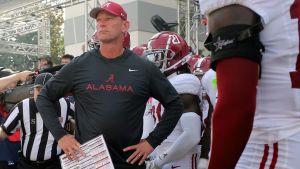
FOS: How has the football program evolved since Kalen DeBoer took over three years ago?
GB: I think Coach DeBoer continues to get even more comfortable in his role here at Alabama. You can see, right now, that almost everybody that’s here now from a student-athlete standpoint signed with Coach DeBoer; and that’s a natural evolution.
He has handled this transition in a very disruptive time in our industry. Let alone the disruption of going from Coach Saban to Coach DeBoer, whoever was going to replace Coach Saban, because of how important he has been and will continue to be to our university. So I’m really proud of the job that he’s doing navigating these waters. Have we stubbed our toe a time or two? We have. At the same time, we’ve also had a lot of real positive moments too. We just need to continue to learn and grow, so we put ourselves in the best position to have long-term success, and I feel very good about that direction with Coach DeBoer.
FOS: How do you view Alabama’s place in college football today in 2026, and what are realistic expectations for sustaining the success that was built prior to DeBoer?
GB: The bar is high in Alabama. That has not changed, nor will it ever change. Now, our industry is very different from what it’s ever been. Depth on your football team is much more challenging than it was a few years ago, so you have to have the right formula of high school recruiting, roster retention and transfer portal. Like this year, we’re heavier into the roster retention with a sprinkling of the transfer portal.
We haven’t been as heavy for this upcoming signing class. The year after, we’re planning on going heavier from a high school recruiting standpoint and roster retention. You have to be flexible and continue to evolve with where your roster is and what the marketplace looks like, and I think Coach DeBoer has done a really good job of creating an environment to allow us to be flexible in this world that we’re in right now. We will have to continue to be flexible in what that looks like going forward.
Download the FOS App
The business of sports, in your pocket.



Scan the QR code to get the app now.