Want more from Front Office Sports
in your search results?
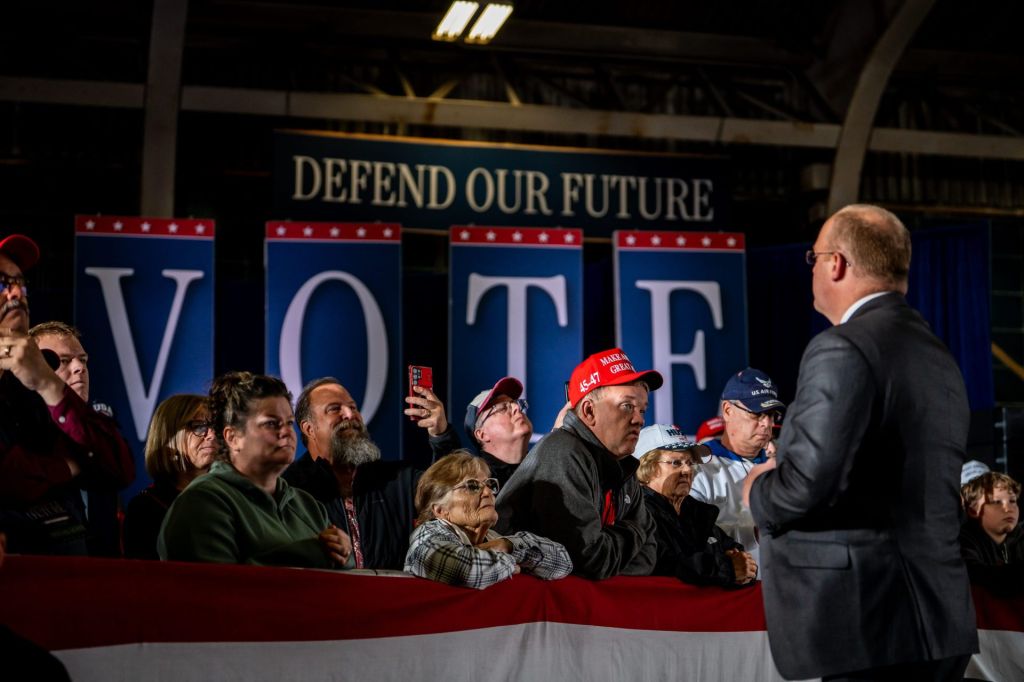
Both Kalshi and Polymarket are forecasting a likely Democratic sweep in Tuesday’s midterm elections. Experts say that regardless of the outcome, the prediction-market industry is set to face renewed bipartisan pressure in Washington, D.C., as lawmakers look to tighten oversight.
“I’m expecting a great deal of action after the midterm elections,” says Craig Holman, a government affairs lobbyist at D.C.-based consumer advocacy organization Public Citizen. “Both Democrats and Republicans are questioning the role of these prediction markets, especially when it comes to electioneering activities as well as different political events.”
Event contracts on politics and war, and the potential for insider trading on those markets, are of significant concern to lawmakers on both sides of the aisle, but sports is also a major flashpoint. The political backlash to prediction markets began earlier this year, and as of September, prediction-market legislation had been proposed in at least 15 states, according to the National Conference of State Legislatures. Many of the bills have bipartisan support, including at least one that’s focused on sports event contracts: the Prediction Markets are Gambling Act, which was introduced in March by Sens. Adam Schiff (D., Calif.) and John Curtis (R., Utah).
Utah’s attorney general last week filed felony criminal charges against Kalshi and its two cofounders, Tarek Mansour and Luana Lopes Lara, for allegedly offering what amounts to illegal gambling in the state. That prompted other companies, including DraftKings and FanDuel, to stop offering sports and political event contracts in Utah.
The Commodity Futures Trading Commission, the regulator that oversees prediction markets, has thus far backed the industry’s ability to offer sports, including in states where traditional sports betting remains illegal. It has sued 10 states, including Utah, Kentucky, and New Mexico, over efforts to prohibit sports event contracts.
Even if Democrats take control of both chambers of Congress, CFTC chairman Michael Selig is unlikely to lose his job.
“He’s not going to be removed,” says Aaron Klein, senior fellow in economic studies at the Brookings Institution. A Democratic-controlled Congress does not have the power to remove the CFTC chair, short of impeachment, Klein explains. “That would require some sort of massive embezzlement scandal, which would almost always result in resignation,” Klein says.
Melinda Roth, a professor of business, sports law, and corporate finance at New England Law, agrees that Selig is unlikely to be at risk if Democrats win, but tells FOS “we could see more pressure to add commissioners.”
Right now, Selig is the only commissioner at the CFTC, but the agency typically has five commissioners, no more than three of whom can be from the same political party, according to its website.
However, Klein says there’s no guarantee a Democratic-controlled Congress could compel the appointment of additional commissioners, because they are appointed by the president. “Trump has made it clear the era of independent financial regulation is over,” he says. “The purpose of having bipartisan commissioners was to create independence. I don’t see that happening.”
‘Ripe for Reform’
Sen. Richard Blumenthal (D., Conn.), tells FOS that trying to add commissioners is “not something that is front of mind.”
“There’s so much else that’s going to take precedence,” he says. “Prediction markets are ripe for reform. There need to be safeguards and guardrails so they can be regulated just as other forms of gambling are.”
Removing Selig or appointing additional commissioners aren’t the only ways Congress could reshape the prediction-market industry. Lawmakers have other tools at their disposal, including exerting pressure through the CFTC’s funding. Because the agency relies on Congressional appropriations to fund its operations, lawmakers could attach what are known as riders to spending bills to restrict how the CFTC can use its money.
As examples, Klein says Congress “could preclude the CFTC from using any of their money on litigation or future rulemakings.”
Following the election, there could also be Congressional hearings and investigations to put pressure on the industry (there have already been some subcommittee hearings specifically focused on sports event contracts, including in May and July). While it might be a long shot to compel testimony from Donald Trump Jr.—who is an investor in Polymarket and a strategic advisor to Kalshi—Klein says lawmakers could call in people from companies like Kalshi and Polymarket to ask about their business practices and their relationships with regulators.
“The hard power of legislation is often overestimated, while the soft power of hearings and inquiries is often underestimated,” Klein tells FOS. “Those could shine a lot of light that could put the CFTC on weak footing.”
His point about the power of legislation being overestimated is tied to the fact that the president has veto power, meaning that even if a bipartisan bill got all the way to Trump’s desk, he could simply choose not to sign it.
“That’s a very significant obstacle,” says Blumenthal, who in March alongside Sen. Andy Kim (D., N.J.) introduced the Prediction Markets Security and Integrity Act (their bill would establish safeguards to protect against insider trading and market manipulation and ban markets on war, death, and military action).
While it may be a tall order to get the president to sign a bill restricting an industry his administration has strongly supported, the fact that both Democratic and Republican lawmakers are showing a desire to rein in the industry is not meaningless. Rep. Adrian Smith (R., Neb.) and Rep. Blake Moore (R., Utah) are other examples of Republicans who have introduced bills aimed at increasing industry oversight, and Sen. Ted Cruz (R., Texas) has plans to propose legislation that would ban prediction-market platforms from offering sports event contracts unless they have received authorization by a state or tribal government.
“There’s a bipartisan groundswell,” Klein tells FOS. “And the day after the midterms, the next election starts.”
Download the FOS App
The business of sports, in your pocket.



Scan the QR code to get the app now.