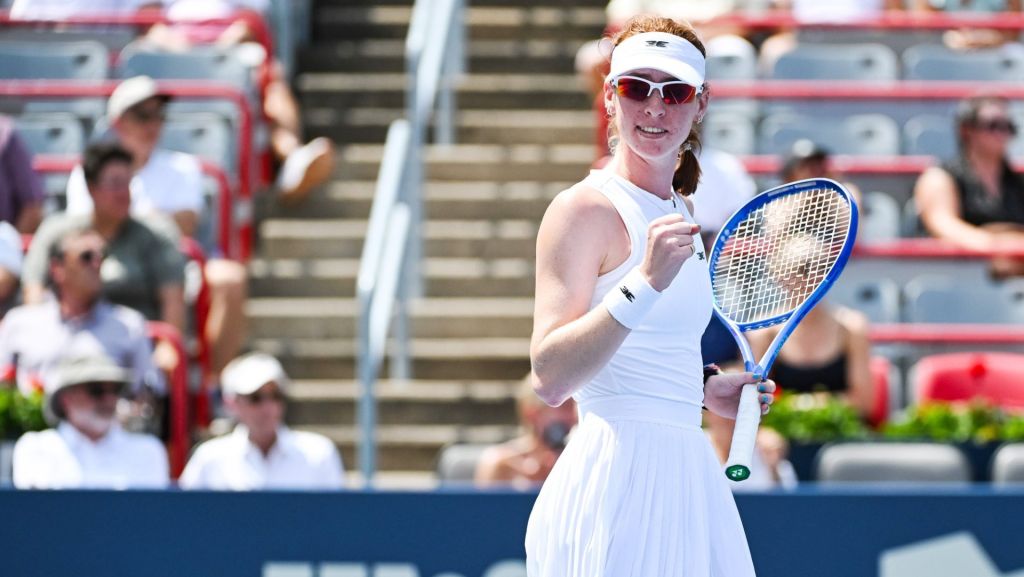
The details of the NCAA’s landmark settlement with tennis players Reese Brantmeier and Maya Joint over prize money limits are not yet clear, but it may have already prompted changes to the NCAA’s rules.
The NCAA Division I cabinet will review three proposed changes related to pre-college enrollment athletics eligibility, including a change that would allow prospects to “accept prize money in their respective sports without impacting eligibility.”
The current rules only allow athletes to accept prize money that covers their “actual and necessary expenses.” Tennis players are the exception to the rule, but may only claim a maximum of $10,000.
This rule led Brantmeier, a UNC women’s tennis star, to sue the NCAA in 2024 after she had won $50,000 at the 2021 US Open. Joint, a former University of Texas player, joined Brantmeier’s lawsuit late last year after she won $140,000 for advancing to the second round of the 2024 US Open. Joint is now a professional player ranked No. 31 in the world.
Joint and Brantmeier aren’t the only players who have had a run in with the prize money restriction.
Columbia University men’s tennis star Michael Zheng won about $150,000 at the 2026 Australian Open. It wasn’t immediately clear whether Zheng, a two-time NCAA men’s tennis champion, could claim his winnings, and a spokesperson for Columbia told FOS in January that they were “working with the NCAA to see exactly what is permissible.”
Zheng told FOS at the BNP Paribas Open last month that he was able to claim that money. He said there was little risk for him to violate the NCAA rules because a penalty would result in his ineligibility for next year, when he’s already graduated and turned pro.
Though the terms of the NCAA’s settlement with Brantmeier and Joint are not yet known, sports lawyer Darren Heitner tells Front Office Sports he believes the timing of the NCAA’s proposed rule changes means they’re related to the settlement.
The sides agreed to a settlement on Feb. 26 and were granted 60 days to submit further materials on the settlement to court—putting the deadline on April 28. Attorneys for Brantmeier and Joint said they are unable to provide an update until after that deadline has passed. The NCAA’s committee will begin reviewing the three proposals later this month and, if approved, will take effect in the 2026–27 academic year.
The NCAA did not immediately respond to a request for comment.