Want more from Front Office Sports
in your search results?
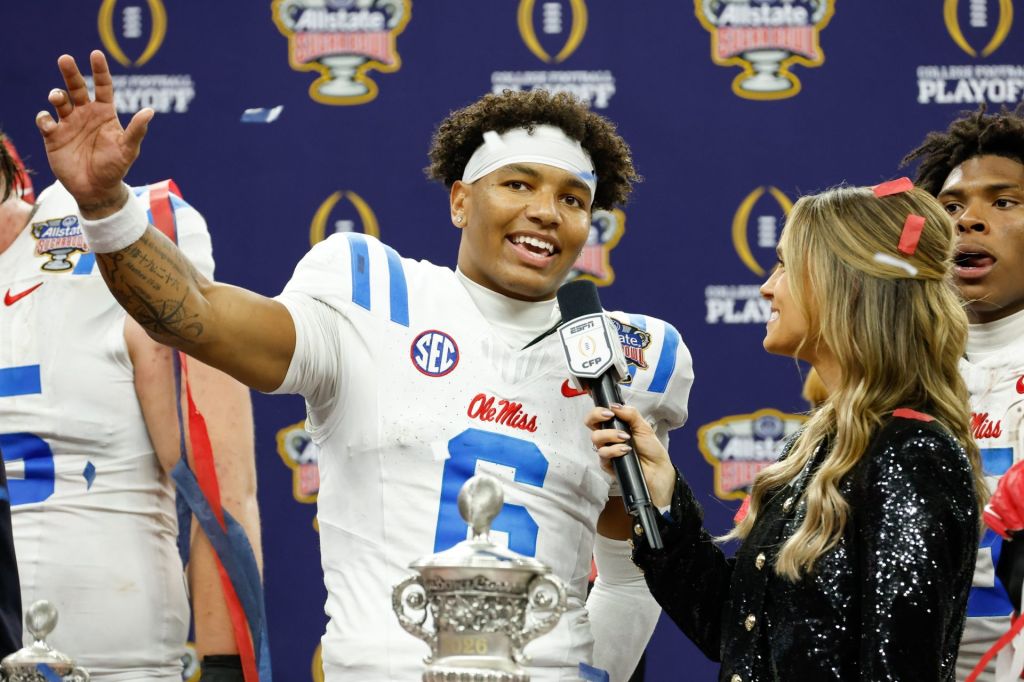
The NCAA is appealing the ruling in the Trinidad Chambliss case that will allow the Rebels quarterback to play next year.
The appeal, filed Thursday to the Mississippi state supreme court, seeks to overturn the preliminary injunction Mississippi state court judge Robert Whitwell granted Chambliss on Feb. 12.
Chambliss sued the NCAA arguing it committed a breach of contract and acted in bad faith by denying his request for a waiver to gain one more year of eligibility after he was unable to play college football during his first two years at Ferris State. During a two-hour long reading of his decision, Whitwell said he believed the NCAA had, in fact, acted in bad faith, and “fell short in its mission to foster the well-being” of college athletes.
The NCAA is now arguing in a 658-page brief that the ruling should receive an expedited review before the 2026-27 season, and that it should ultimately be overturned. The governing body argued the injunction would cause “irreparable harm” to the NCAA, as well as Division I athletes and teams competing against Ole Miss next season.
“If courts can intervene in NCAA eligibility decisions to provide special treatment to favored athletes, then the NCAA’s ability to ensure fair athletic competition in which all participants play by the same rules will depend upon the whims of trial courts throughout the country,” the NCAA wrote. It added the ruling would cause “irreparable harm” to current NCAA athletes because “such an outcome is unfair to DI schools who follow the rules and must compete against UM in the 2026-2027 DI football season or who may be displaced from postseason competition by UM.”
In a statement to Front Office Sports, one of Chambliss’s attorneys, Tom Mars, said: “Everyone remembers when the NCAA famously appealed to the Supreme Court in the Alston case and got their teeth knocked out by Justice Kavanaugh. I expect the NCAA to be spitting chiclets in this appeal as well.”
The appeal is the latest twist in a nationwide battle over the legality of NCAA eligibility rules that began in 2024 with former Vanderbilt quarterback Diego Pavia’s lawsuit against the NCAA. Sixty-one eligibility lawsuits have been filed against the NCAA since then. The NCAA has succeeded in getting preliminary injunctions denied in 31 of these cases. However, players have been granted preliminary injunctions in 13 cases (with eight of those in state courts.)
Many of these lawsuits have challenged the NCAA’s rules on the grounds that they violate federal antitrust law; but the NCAA has won most of these cases. Recently, players tried filing breach of contract cases in state court instead—Chambliss is one of the players who, at least previously, succeeded in that strategy.
Download the FOS App
The business of sports, in your pocket.



Scan the QR code to get the app now.