Want more from Front Office Sports
in your search results?
Nine days after LSU women’s basketball announced it had signed a 17-year-old Russian player, the program’s anticipated starting center—who is from Ukraine—left the team.
Kate Koval, a junior from Kyiv, was heading into her second season with the Tigers after playing her first year at Notre Dame. Her father, Oleksandr, is a drone operator in Ukraine’s war against Russia. His 6-foot-5 daughter played all 35 games for LSU last year and started 17.
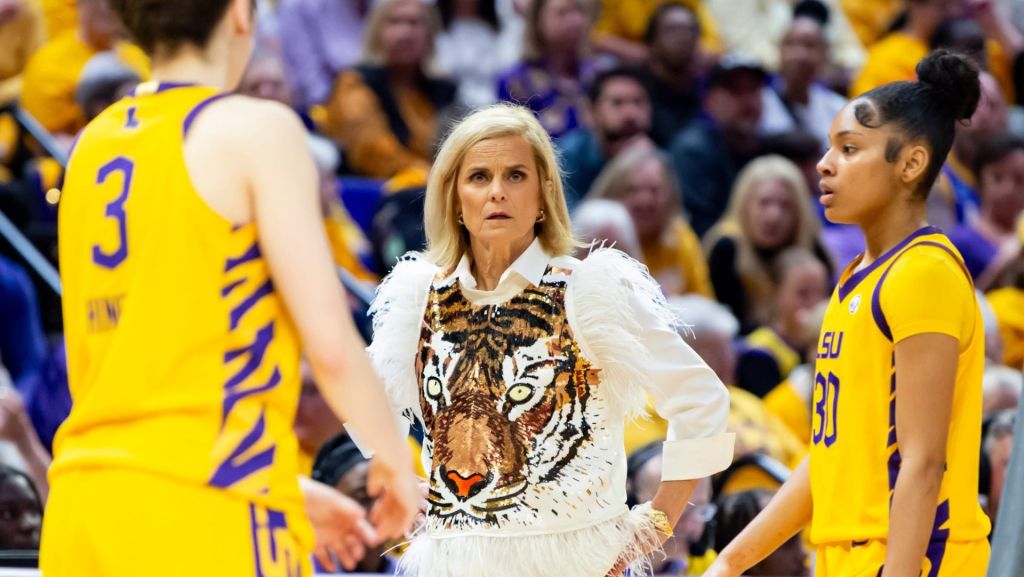
Coach Kim Mulkey announced on Monday that Koval came to her the day before to quit the team “for personal reasons.” A spokesperson for LSU tells Front Office Sports that Koval also has expressed her intention to withdraw as a student at the school.
Koval’s next steps are tricky, given the transfer portal is long closed, and classes have already started at many schools. She may need to transfer in April in order to find a new team.
According to the NCAA, midyear basketball transfers can’t compete for another school if they were enrolled somewhere else during the first semester, even if they never played a game. LSU’s classes started on Monday.
“We will respect her privacy on her decision, but we had a long talk about it, and it was a hard decision for her,” Mulkey said. “I know it is hard because she loves LSU. Kate is a great person. She has to do what she feels is right for her, and we fully support her in that.”
Mulkey didn’t explicitly say Koval left because she didn’t want to share a locker room with Russian pro Anna Minaeva, whose signing was announced on August 14. Last week, Mulkey said in an interview with The Advocate that she met with Koval about Minaeva, and when the coach suggested perhaps the two players could even help end the war, Koval told her: “I doubt that,” in Mulkey’s telling.
“Know that what I have to do in this business, I cannot make a decision to not recruit somebody that can help our program because of a conflict between two countries,” Mulkey told The Advocate she told Koval.
The center has spoken in the past about the war’s impact on her and her family.
“I was just blaming myself,” Koval told The Athletic while she was still at Notre Dame, where she played one season before transferring to LSU ahead of last year. “Why am I here and my family is over there? Why am I safe and my family has to go through all that?”
LSU’s spokesperson said the withdrawal process can take a while, and couldn’t say if Koval was technically withdrawn yet.
She would need to pursue some kind of waiver from the NCAA if she wanted to compete for another school this year.
Koval said last year that she was living with her brother, who was attending LSU as a graduate student. Another brother played junior hockey last season in Amarillo, Texas.
The Russia–Ukraine conflict has bubbled up in other sports, although it’s not clear if athletes from the two countries have ever played on the same Division I women’s basketball team. Ukrainian tennis star Elina Svitolina has refused to shake hands with Russian players for years, while Oleksandra Oliynykova said at the French Open this summer that Russian players on tour “don’t want to communicate and “have these horrible beliefs.”
Russia has been banned from the Olympics and many other international competitions since invading Ukraine, but a lifting of that ban looks likely ahead of the 2028 Games.
Download the FOS App
The business of sports, in your pocket.



Scan the QR code to get the app now.