Want more from Front Office Sports
in your search results?
WASHINGTON — The biggest news of the day on Friday at the White House was a report that Russia was assisting Iran in its counterattacks against the U.S. and Israel. But when President Donald Trump was asked about it, he said: “That’s an easy problem compared to what we’re doing here.”
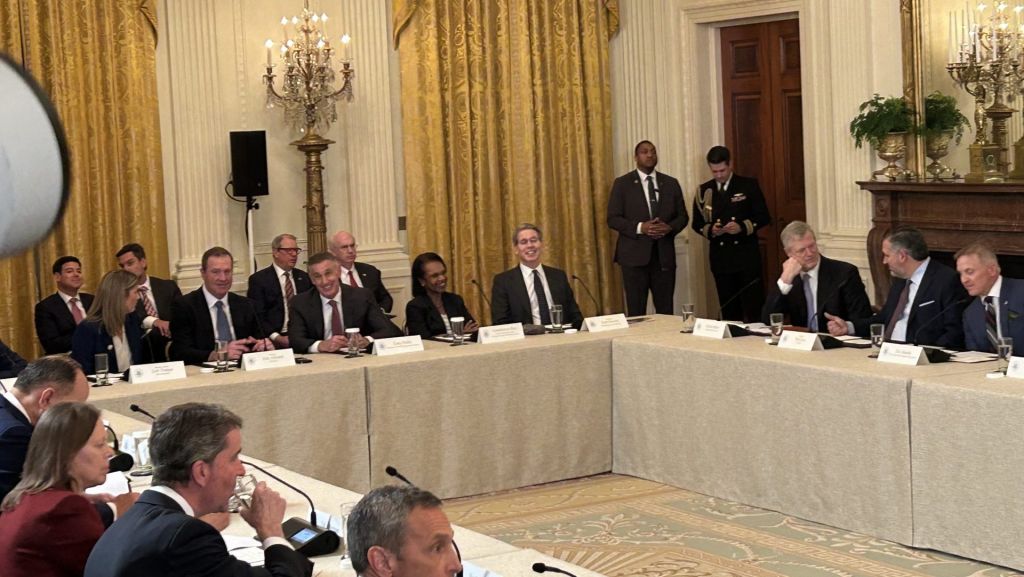
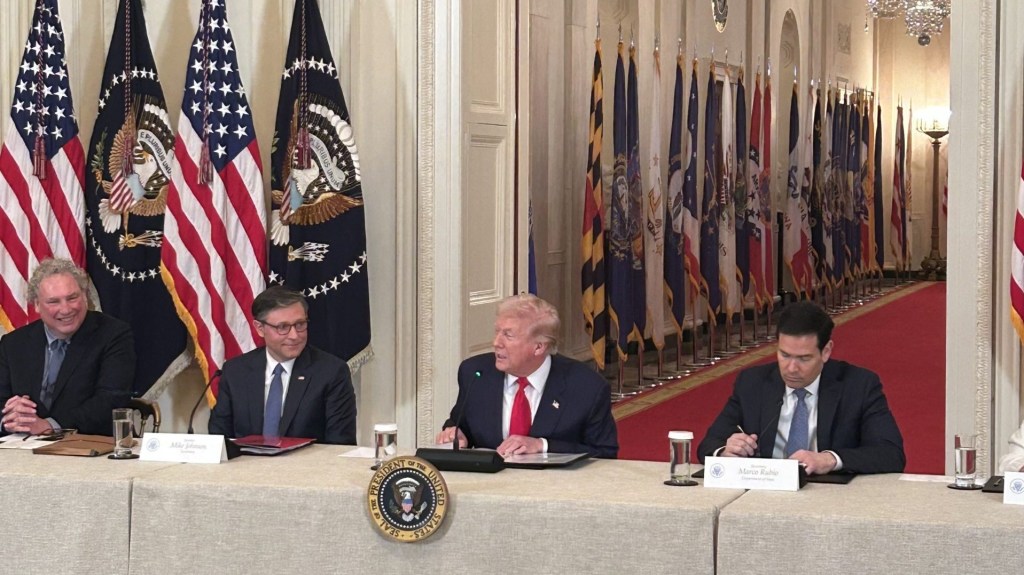
Here was in the East Room at the White House, where Trump had just spent more than 90 minutes presiding over a roundtable called “Saving College Sports.” The group comprised about 50 attendees from not only college sports and higher education, but also pro sports, private equity, media, Capitol Hill, and Trump’s Cabinet.
The President indicated he was partial to returning to “that wonderful system I thought we had,” where players didn’t earn compensation beyond scholarships and the NCAA had the power to enforce rules. He said he doesn’t want to return to a time “where student athletes were never allowed to receive any compensation,” though he added in the same breath: “not the worst idea, but I think a lot of people would overrule me on that.”
At the end of the event, Trump declared the intention to author a second executive order within the next week, though he didn’t say what would be in it. (His first one, named “Saving College Sports” just like Friday’s roundtable, did little by way of actual enforcement.) “I’ll have an executive order that will solve every problem in this room—every conceivable problem within one week,” Trump said.
A Packed Room
Throughout the past week, the event remained in flux as with a shifting list of potential attendees and an Iran-focused news cycle. The White House did not publicly confirm the event until it appeared in Trump’s daily schedule briefing on Thursday night. A White House official shared a finalized attendee list just minutes before the event itself began.
On Friday afternoon, the group sat around a sprawling rectangular table. Speaker of the House Mike Johnson (R., La.) and Secretary of State Marco Rubio flanked Trump. Big Ten commissioner Tony Petitti sat next to former Secretary of State Condoleezza Rice. NCAA President Charlie Baker shared a few laughs with Sen. Ted Cruz (R., Texas). Chief of Staff Susie Wiles sat alongside former Alabama football coach Nick Saban and former Ohio State football coach Urban Meyer, US Olympic & Paralympic Committee CEO Sarah Hirshland and NBA Commissioner Adam Silver.
Noticeably absent were both Democrats besides Rep. Lori Trahan of Massachusetts, as well as current college athletes. (The Yankees’ Levine acknowledged their absence and vowed to include them in future conversations.) More than half the attendees did not get an opportunity to speak.
Despite the news cycle hanging over the White House, Trump was highly engaged in the college sports debate.
After reading prepared remarks, he cued several people to speak, including Rubio, Levine, Johnson, Baker, Saban, DeSantis, and SEC Commissioner Greg Sankey. The themes were similar: preserve education, provide an antitrust exemption to allow for rules in college sports, and stop players from transferring and challenging eligibility rules.
He asked the roundtable whether they found a good framework in the SCORE Act, a pro–NCAA bill which has so far not reached the House floor for a vote, but which Johnson said Friday finally has enough support to pass. The bill would offer antitrust protections to the NCAA, a no-employee clause for athletes, and would pre-empt state laws in favor of a national standard. All were in favor but Democrat Trahan.
Attendees also discussed mechanisms to amass more revenue for college sports. “We’re not solving the economic crisis,” American commissioner Tim Pernetti said. He raised potentially amending the Sports Broadcasting Act of 1961 to allow college football media rights to be pooled and sold together to generate more money for the entire system—an approach endorsed by Campbell.
Trump himself didn’t provide an opinion on the concept. (After the roundtable concluded, however, Republican Sen. Eric Schmitt of Missouri, who was in attendance, and Democratic Sen. Maria Cantwell of Washington announced the introduction of a bipartisan discussion draft that would codify the idea.)
Although Trump discussed ballooning athletic department deficits and the harm they may pose to Olympic sports—specifically mentioning Rutgers—he did not discuss the role coach salaries or the coaching carousel may have played in the chaos. To the President, the compensation issue was with the players; millionaires Meyer and Saban bolstered his position.
‘‘I’ll Get It Done’
Several times throughout the event, Trump railed against what he described as a “radical left judge from California,” whom he blamed for the current chaos. It was unclear if he was referring to Northern District of California judge Claudia Wilken and the House v. NCAA settlement she approved or another ruling by a different judge.
When Trump asked why no one had appealed the decision, Sankey piped in to ask if he was actually referring to the Supreme Court decision in NCAA v. Alston. The justices ruled 9–0 that the NCAA was subject to strict antitrust scrutiny. “So the Supreme Court was responsible for this?” Gee, that surprises me,” Trump said, lifting his hands in the air.
Trump also said he had signed an executive order to give an exclusive television window to the Army-Navy football game; though he has previously announced his intention to do so, no such order has been presented to the public.
Trump demonstrated a fierce resolve to not just stabilize the industry, but also potentially turn back the clock to what he saw as the glory days of college sports—-when players got scholarships but didn’t get paid, and the NCAA had strict control. He announced his intention to author the additional executive order toward the end of the roundtable.
Two roundtable participants—Yankees president Randy Levine, and Texas Tech board chairman and Trump advisor Cody Campbell—will be among the people involved in authoring the executive action, a source told Front Office Sports after the meeting concluded.
“I’d like to write an executive order based on some of the very great talent in this room,” he said. “And we will be sued and we’ll go before a court and maybe, maybe we’ll have a judge that’s realistic, reasonable and wants to do a favor for the country, because that’s the only way this is going to be solved.” He did give Johnson permission, however, to continue advancing the SCORE Act.
One thing Trump didn’t allow: members of the White House press pool to ask questions about topics outside the future of college sports. At the end of the brief press availability, Fox senior White House correspondent Peter Doocy asked, why convene a roundtable about college sports now?
“It doesn’t sound very important compared to what’s happening in Iran and other places,” Trump said. “But it is very important to me. And if I can get it done, I’ll get it done.”
Download the FOS App
The business of sports, in your pocket.



Scan the QR code to get the app now.