Want more from Front Office Sports
in your search results?
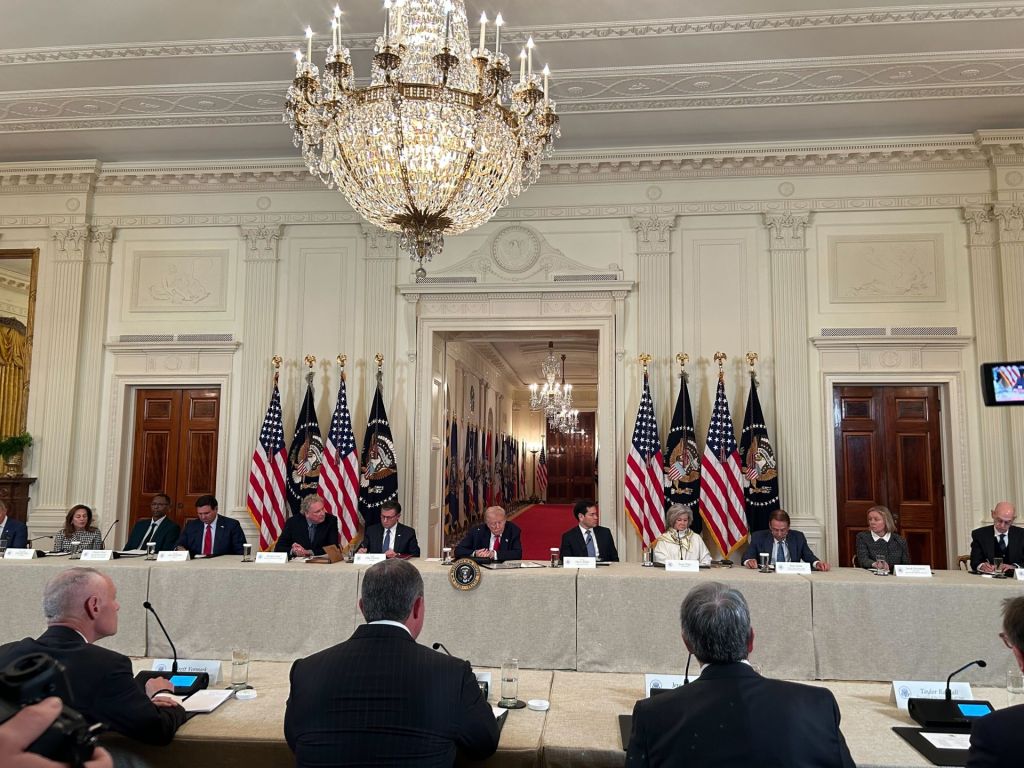
WASHINGTON — At a roundtable at the White House titled “Saving College Sports” Friday, President Donald Trump announced that he would write and sign a second executive order regarding college sports within one week.
“The executive order is going to let colleges survive and players survive,” Trump said at the conclusion of the two-hour-long event in the White House East Room.
Trump tasked New York Yankees president Randy Levine, who served as a vice chair of the event, with putting together a smaller group to make recommendations on the contents of the executive action itself. At the same time, he told House speaker Mike Johnson (R., La.) that he could continue with his efforts to bring the beleaguered SCORE Act—the subject of much of the event’s discussion—to the floor of the House of Representatives for a vote. Johnson said he believes he currently has the votes to get the bill through the House.
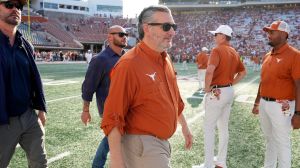
The roundtable brought more than two dozen business executives, professional sports leaders including NBA Commissioner Adam Silver, university and athletic department administrators, power conference commissioners, former athletes and coaches including Urban Meyer and Nick Saban, and NCAA President Charlie Baker to the East Room of the White House. Florida governor Ron DeSantis and Levine served as vice chairs of the event alongside Secretary of State Marco Rubio. Other notable faces included Sen. Ted Cruz (R., Texas), Sen. Eric Schmitt (R., Missouri), Rep. Steve Scalise (R., La.), former Secretary of State Condoleezza Rice, Secretary of Commerce Howard Lutnick, Secretary of Education Linda McMahon, and others. The lone Democrat: Rep. Lori Trahan (D., Mass.), who has been outspoken on college sports issues and introduced legislation of her own.
Notably, the event did not include any current college athletes; Levine said the group would be working with athletes in the future to ensure they were part of ongoing proposals.
Trump had originally convened the meeting to discuss what administrators see as several existential crises in college sports—and the inability to implement solutions. Trump appeared deeply engaged throughout the meeting, asking questions and making comments about various proposals.
“It doesn’t sound very important compared to what’s happening in Iran and other places,” he said of the roundtable, “but it’s very important to me.”
Attendees identified and discussed several pain points: An unrestricted transfer portal and a lack of regulation on NIL (name, image, and likeness) deals have created a system of “unrestricted free agency.” (The House v. NCAA settlement, which allowed revenue-sharing with players but implemented new NIL restrictions, was billed as a solution; it instead raised the floor for athlete compensation.) Meanwhile, schools have begun cutting Olympic sports to fund the new recruiting arms race, jeopardizing the Olympic pipeline. In addition, more than 60 lawsuits have been filed challenging NCAA eligibility rules.
Trump did not say what specifically would be in his new executive order, but hinted that it might align with elements of the SCORE Act, which has been stalled in the House of Representatives. The SCORE Act would offer antitrust protections, preemption of state laws, and a clause preventing college athletes from being employees—all things that would give the NCAA and power conferences the power back in college sports.
It’s unclear if an executive order can legally accomplish these goals. But Trump appeared to welcome legal challenges in the hopes that a judge might deem his order legal, and therefore provide cover for the NCAA and power conferences to enforce restrictions without Congress’s help. “We will be sued, and we will go before a court,” he said.
Trump also provided a clue to the potential contents of his order when he asked if it would be possible to go back to “the wonderful system I thought we had,” by offering some compensation to athletes but ultimately restoring transfer rules, NIL restrictions, and eligibility rules.
Trump also didn’t elaborate on how this executive order would be different from the one he signed last summer. “Saving College Sports” directed multiple agencies to consider solutions to preserve the Olympic pipeline, give the NCAA the power to enforce rules, and study whether athletes are better off without employee status. Although that order technically outlawed pay-for-play NIL deals and required schools to offer equitable opportunities for women’s sports, it did little by way of actual change. On Friday, Trump described the previous executive order as a test run, and said this second order would be “more comprehensive.”
“This is really the future,” Trump said. “I think beyond college sports, this is the future of colleges.”
Download the FOS App
The business of sports, in your pocket.



Scan the QR code to get the app now.