Want more from Front Office Sports
in your search results?
The MLB expansion drumbeat is getting much louder, but there are still many more questions than answers in the league’s potential move to add two teams.
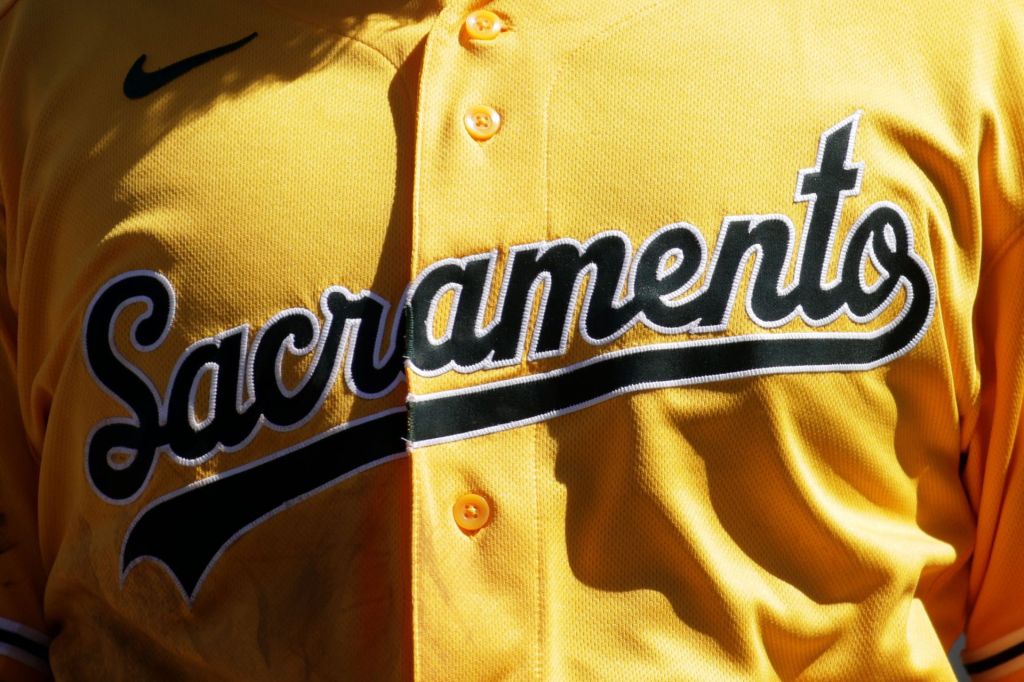
As expected, Sacramento leaders formally unveiled an expansion bid Thursday, with officials there seeking to build materially on the three-year interim stay of the A’s in the California capital that is now in a second season.
While the A’s are ultimately headed to Las Vegas in a new stadium set to open in 2028, Sacramento intends to build their own new ballpark at or near the site of Sutter Health Park, the current home of the A’s and Triple-A River Cats. There is not a lead investor in place for the Sacramento bid, and the A’s currently have the worst attendance in MLB playing in that minor-league facility.
Local boosters, however, contend they have amassed $800 million in land and private investment, with access to another $1 billion in public money, including tax-increment financing and receipts from hotel taxes. A new bid organization, The Sacramento Pitch, has been formed, containing a series of local politicians, business leaders, and prominent baseball figures including former MLB player and manager Dusty Baker.
Sacramento, the No. 20 U.S. media market, is the country’s second-largest locale without a MLB club, trailing only No. 15 Orlando.
“When MLB moves forward on expansion, Sacramento will be impossible to ignore,” said Mark Friedman, founder and chair of Fulcrum Property and chair of The Sacramento Pitch. “We have the market, the site, the capital, and the community. Sacramento is ready to compete—and ready to win.”
State of Play
Sacramento, however, certainly has no shortage of rivals among MLB expansion candidates. Other markets that have either put forward formal or informal overtures to the league include Salt Lake City, Nashville, Portland, Orlando, Raleigh, Vancouver, Montreal, and Mexico City.
“One of the things we’ve begun to think about is expansion. There are a lot of markets in the United States, in North America, quite frankly, Canada and Mexico, that would like to have Major League Baseball,” league commissioner Rob Manfred said Wednesday night on The Pat McAfee Show.
There is a bigger notion to the expansion play, too, as Manfred intends to use the creation of two new franchises as an opening to pursue more geographic-based realignment across MLB—one that would do away with the traditional National and American leagues and the current six-division format. One western team and one eastern team among the expansion entrants would be part of that plan.
“This opens up a whole lot of opportunities in terms of geographic realignment, which promotes rivalries and reduces travel in what is a tough season,” Manfred said. “If you can cut that travel down, it’s great for the players.”
The commissioner said last fall at the Front Office Sports Tuned In summit that he would like to have two new markets selected before he finishes his tenure in early 2029. Those teams would likely not be on the field before then, though.
MLB last expanded with the arrival of the Diamondbacks and Rays in 1998.
Bigger Issues
While expansion is set to be a defining part of Manfred’s final era as commissioner, there are several other steps that must happen before any site choices are made. Among the outstanding prerequisites:
- Settling the long-running Rays stadium saga once and for all. While there is rising momentum for a ballpark deal in Tampa, planned renovations at Raymond James Stadium, home of the neighboring Buccaneers, could complicate the baseball effort. If the Rays ultimately fail to complete a ballpark agreement, one of the expansion candidate cities could become relocation targets.
- Completing a labor agreement with the MLB Players Association. With the current collective bargaining agreement expiring Dec. 1, the sport’s future economic framework is unknown. The union presented its initial proposal to management on Wednesday, but found a grim reception to that. Owners are expected to seek a salary cap, something that players have resisted for decades, and set up what could be a fractious set of negotiations. Realignment is also subject to collective bargaining.
- Establishing an expansion fee for the incoming franchises. The previous expectation for that had been around $2.2 billion each, but the recent $3.9 billion sale of the Padres that smashed all prior records in the sport will likely prompt a reconsideration of the ask from the current team owners, and require more capital from bidders.
“When people want your product, it’s kind of incumbent on you to try to figure out a way if you can deliver that product,” Manfred said.
Download the FOS App
The business of sports, in your pocket.



Scan the QR code to get the app now.