Want more from Front Office Sports
in your search results?
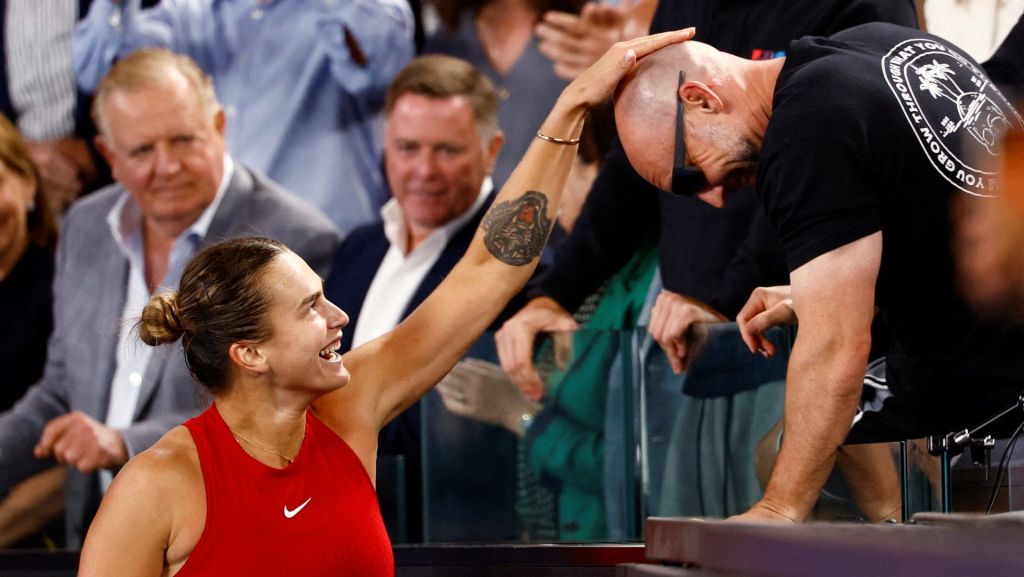
Aryna Sabalenka has earned more than $50 million in her tennis career. She has the No. 2 spot on the all-time WTA career earnings list, behind only Serena Williams. But according to her performance coach Jason Stacy, the world No. 1 women’s tennis star and the rest of her team have only recently been able to spend freely given the costly nature of the sport.
In an emotional interview with Front Office Sports, Stacy said he and head tennis coach Anton Dubrov were sharing hotel rooms and scrounging for cheap flights even when Sabalenka, 28, had turned into a consistent top 10 player in the early 2020s.
“She was paying for all of our flights, all of our food every day, all of our hotel, plus our salaries, everything,” Stacy said. “It’s a lot of money, and there were no sponsorship deals at the time. Income was purely from what she won on the tour. That was it. And that was up and down.”
Stacy joined Sabalenka’s team in 2018, before she cracked the top 10, while Dubrov followed in 2020. The coaches agreed to be paid a relatively low base salary that came with a percentage split of each tournament’s winnings.
“Before she really broke through, we wanted her to understand that we’re here for the team and for her, not for ourselves,” Stacy said. “As part of proving that, we set up our agreement where we can have a lower salary, but with percentages so it’s performance-based.”
Stacy, who has been coaching for two decades and has worked with individual players and tennis federations, said there is no standard payment structure for tennis coaches.
Sabalenka had earned nearly $2 million in 2018, but much of her earnings went toward tennis-related expenses. (Earlier this year, French Open runner-up Maja Chwalińska shared how she struggled to pay for her hotel room at the tournament despite nearly $1 million in career earnings.)
As Sabalenka has become one of the most dominant players on the tour in recent years, and has held the world No. 1 spot since October 2024, she’s earned at least $8.2 million in tournament prize money every year since 2023.
Despite nearly 100 weeks on top of the rankings, Sabalenka’s No. 1 spot is quite vulnerable entering the US Open. She only holds about a 350-point lead over No. 2 Elena Rybakina, and the Belarusian hasn’t won a tournament since conquering the Sunshine Double in March.
“You have the target on your back. Everyone wants to beat you,” Sabalenka said last week at the Cincinnati Open. “But I feel like it’s the same if you’re No. 1, No. 2, No. 10. It doesn’t really matter what the ranking is anyway. When you go out there on the court, everyone wants to beat you.”
Stacy admitted that it’s commonplace for players to face “setbacks” throughout their careers, and what’s important is continuing to believe that it will turn around.
“We’ve put together a lot of pieces of the puzzle that for the most part over the last several years, it’s been working very, very well,” Stacy said. “But when you’re doing those things and you’re pushing yourself, you’re still going to have moments where, you know, we get off track a little bit … But when you trust that process, it allows you to go: ‘You know what, it’s fine. I’m going to keep fighting because it’s the right thing for me to do.’”
Still, Sabalenka’s success on the court has translated into additional sponsorship deals, particularly from brands not explicitly associated with tennis including Emirates, Gucci, and Stella Artois, most of which have come in the last year.
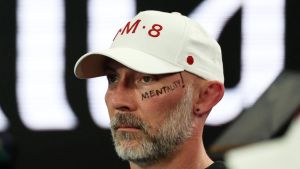
Some deals have even directly benefited Stacy. In June 2025, Sabalenka was announced as a global ambassador and shareholder for health supplement brand IM8. That deal has also benefited Stacy, who is often seen wearing the brand’s merchandise at games.
“The cameras are on me talking all the time. I’m not the head coach, I’m not the player. But there’s companies that are interested in hearing the behind the scenes,” Stacy said.
Stacy, who chronicled in his book The Pressure Code that he went through homelessness as a teenager, said the team has stayed “mindful” about their expenses as Sabalenka’s profile—and earnings—has grown over the last few years. He’s aware that an athlete’s success is finite given numerous factors that can upend a career.
However, Sabalenka has already built enough of a cushion that has allowed the team to still enjoy the rewards of their success.
He recalled a recent time when he found himself reflecting on his journey as the trio was traveling to a tournament on a private jet.
“I remember sitting there for a moment going: ‘What the heck. Look where we are. This is crazy,’” Stacy said, tearfully. He said it’s important for him to regularly look back at where they came from, a life that looked different up until fairly recently.
But Sabalenka admitted last week at the Cincinnati Open that she tries not to reflect too much on her journey because she doesn’t want to spiral down an emotional rabbit hole.
“To be honest, I don’t want to stop and look back because every time I stop and try to, I get completely crazy and emotional,” she said. “Because it took a lot of work, a lot of tough moments, a lot of things to go through. It’s been a hell of a journey. I try not to do that, I try to focus on staying present.”
But she knows she will eventually want relive those trying time: “I feel like I’ll be able to reflect at the end of my career to look and go, ‘Wow, that was amazing.’”
Download the FOS App
The business of sports, in your pocket.



Scan the QR code to get the app now.