Want more from Front Office Sports
in your search results?
This is arguably the most important week in Rays franchise history, with the MLB club’s stadium future once again hanging in the balance.
The city of Tampa is scheduled to vote on Thursday on its contribution toward a planned $2.36 billion ballpark, with Hillsborough County Commission set to follow with a separate vote the next day. Together, the two jurisdictions are set to contribute up to $876 million for the facility—down from a previously targeted figure of $976 million—but the politics around each vote are still highly delicate.
In recent weeks, Tampa Mayor Jane Castor has clashed with the city council over the issue and restructured its potential taxpayer contribution to the project, while two county commissioners have raised new concerns about the structure of the stadium deal. Through these and other developments, the public-sector burden has shifted considerably to the county compared to the original deal framework, with that jurisdiction now set to contribute $796 million and the city another $80 million. The Rays are responsible for the remaining cost, as well as any overruns.
Before the two votes, though, more political wrangling and last-minute negotiations are expected. Even getting the stadium vote on Thursday’s city council agenda required surviving a narrow 4–3 vote.
“The work isn’t done, Our teams continue working tirelessly to get the details ironed out,” before the votes, Castor said.
Looking Ahead
Time is tight for the Rays, as the club is intending to break ground later this year toward a planned opening in early 2029 of the new facility, to be located at Hillsborough College’s Dale Mabry Campus and near Tampa International Airport.
The planned stadium is set to be surrounded by a large mixed-use development, inspired in part by The Battery in Atlanta.
“It seems like that was very thoughtfully done,” Florida Gov. Ron DeSantis said Monday. “I’ve seen some of the renderings that have come out, some of this stuff. You know, it’s exciting. It’s exciting to see.”
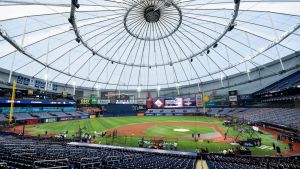
The Rays have been seeking a new ballpark for much of the past two decades, with the long-running saga contributing heavily to Stu Sternberg’s sale of the club last year to a group led by Jacksonville developer Patrick Zalupski. Sternberg previously walked away from a deal to build a new ballpark near the club’s current home, Tropicana Field in St. Petersburg, but the proposed new stadium is much more centrally located in the Tampa metro area.
“We listened, and the result of our collaboration is a deal that improved each week for the public, is fair for all involved, and supports our goals,” Rays CEO Ken Babby said in a statement regarding the latest talks with the city and county.
“The commitment by the Tampa Bay Rays to this lifetime opportunity is absolute, with record private investment and guarantees that will secure the future of Major League Baseball for our region and leave no doubt that Tampa Bay is a world-class destination by any measure,” Babby said.
Though the Rays have MLB’s fourth-smallest luxury tax payroll at $114.1 million, the club has the American League’s best record, and is in strong position to return to the playoffs for the first time since 2023.
Download the FOS App
The business of sports, in your pocket.



Scan the QR code to get the app now.