Want more from Front Office Sports
in your search results?
NEW YORK — The biggest thing in tennis is getting a whole lot bigger.
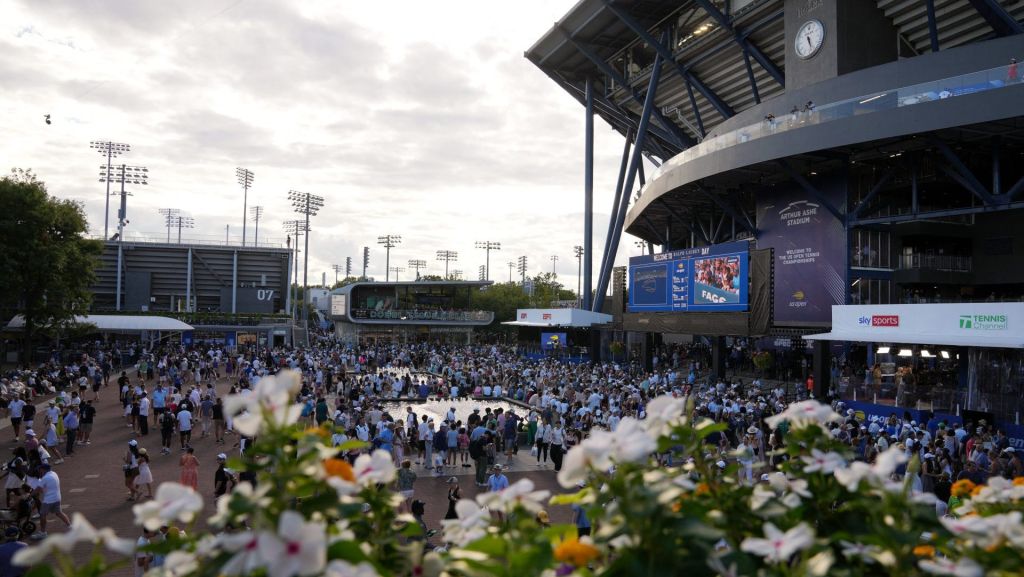
The U.S. Tennis Association is about midway through a three-year, $800 million renovation of the Billie Jean King National Tennis Center in New York. The makeover will upgrade the setting of the US Open—already the sport’s most lucrative tournament with a $108 million prize pool, and one of its most-attended events.
Privately financed by the USTA and first unveiled last year, the facility upgrade plan includes: An extension and redesign of the courtside seating bowl at Arthur Ashe Stadium, the complex’s centerpiece, to create 2,000 additional lower-level seats; a 40% enlargement of the stadium’s promenade-level concourse; and the creation of two new luxury-suite levels, plus several new club, restaurant, and premium hospitality spaces.
The project will also add a state-of-the-art, $250 million player-performance center—a sizable upgrade in amenities for competing athletes.
As this year’s US Open heads toward yet another attendance record, surpassing last year’s 1.14 million, and continues to show the stress of its ever-expanding popularity, the grounds have something of a transitory feel.
Some areas, like the enlarged seating bowl at Arthur Ashe Stadium, are essentially done, and the entire lower level also has all new seats. Many components of the renovation work however, are not yet complete, and have had temporary finishes for this year’s US Open. Hospitality areas are much more limited than before, and scant compared to what’s planned for 2027 and beyond.
Another sprint of construction is set to begin later this month, and will extend through the winter and into next year, in part taking advantage of the Arthur Ashe Stadium roof.
Once the entire project is complete in time for the 2027 US Open, though, the stadium will be brought fully into the 21st century after its initial development 29 years ago.
“Ultimately, when people come out to the Open next year, it should feel like a brand-new building,” USTA COO Danny Zausner tells Front Office Sports. “The shell, from the outside, will be what people know it as, but otherwise, we’re talking about a transformed stadium.”
Fancy Schmancy
Perhaps the most striking thing about the entire renovation project is the further separation of luxury-level customers from the rest of the US Open fans, who are the foremost driver of the tournament’s annual attendance records.
The reworking of the Arthur Ashe Stadium seating bowl doesn’t materially enlarge the overall capacity of the facility, which would increase fan access and potentially lower average ticket prices. Rather, the project essentially shifts some of the upper-level seating closer to the court, which allows for greater intimacy, but also carries higher costs for fans.
A sizable portion of the rest of the fan-facing renovation work, meanwhile, involves upgraded hospitality and experiential options for high-end customers, including several bunker lounges that will feature access to chef’s tables, multicourse meals, and speakeasy bars. Those ultra-luxury areas are designed to compete more directly with similar offerings at many other modern stadiums and arenas, including in New York, that push far beyond the traditional trappings of an ordinary suite.
New York magazine recently took sharp aim at the USTA on this class-divide front, complaining of what it called a “shmancification” of the tournament into merely a playground for rich elites to see and be seen, regardless of their interest in tennis: “In remaking Ashe, the USTA is doing the same thing as every branch of the hospitality industry by catering to those for whom money is no object with the most luxurious, most exclusive, most over-the-top experiences imaginable.”
Zausner, however, pushes back on the notion that regular fans are getting pushed or priced out of the tournament. Instead, he argues that the renovation will upgrade the overall event experience for every attendee. He also points to a 20% reduction in upper-level seating that’s combined with a 40% increase in open space along the stadium’s promenade tier, a combination specifically designed to relieve some of the bottlenecks that have become endemic to the US Open.
“We’re continuing to try to offer something for everybody, regardless of whether they have a grounds pass, are sitting in the front row, or anything in between,” Zausner tells FOS. “What the experience upstairs [at the stadium beginning next year] is going to be like is going to be as premium as the premium-level spaces at plenty of other arenas and stadiums in this country. Everybody is stepping up a notch and going forward. Nobody’s going back.
“I appreciate that the 2,500 people in the club program are the sexy story that people are talking about, and the prices there, but that makes about 8% of the stadium capacity. The other 92% are also going to get a far superior experience than what they’ve had, and that’s the big sell for us,” he says.
Cascade of Changes
Located just to the west of Arthur Ashe Stadium and adjacent to the practice courts, the forthcoming player-performance space will create an extensive facility reshuffle. Current player locker rooms will become administrative spaces. The current offices will be used for part of the bunker suite plan. Player lounges and dining areas, meanwhile, will be repurposed for other hospitality spaces.
“It is going to be quite complicated,” Zausner says. “We’re in a media center right now, for example, that’s going to become a restaurant. Every space here [on the ground level of Arthur Ashe Stadium] is going to become something else. While this past year was complicated from a structural standpoint, what’s happening now, the finishes that are being put in, is no less complicated.”
In the meantime, Sunday’s men’s singles final will conclude a tournament that will raise expectations for next year’s event in the remade complex.
“Fan Week this year was wildly successful, really beyond anyone’s expectations,” Zausner said of the tournament qualifying period that also now includes a high-profile mixed-doubles competition. “You combine that with sold-out days throughout the main draw, and it will be another strong performance. We feel like we’re in a really good place.”
Download the FOS App
The business of sports, in your pocket.



Scan the QR code to get the app now.