Want more from Front Office Sports
in your search results?
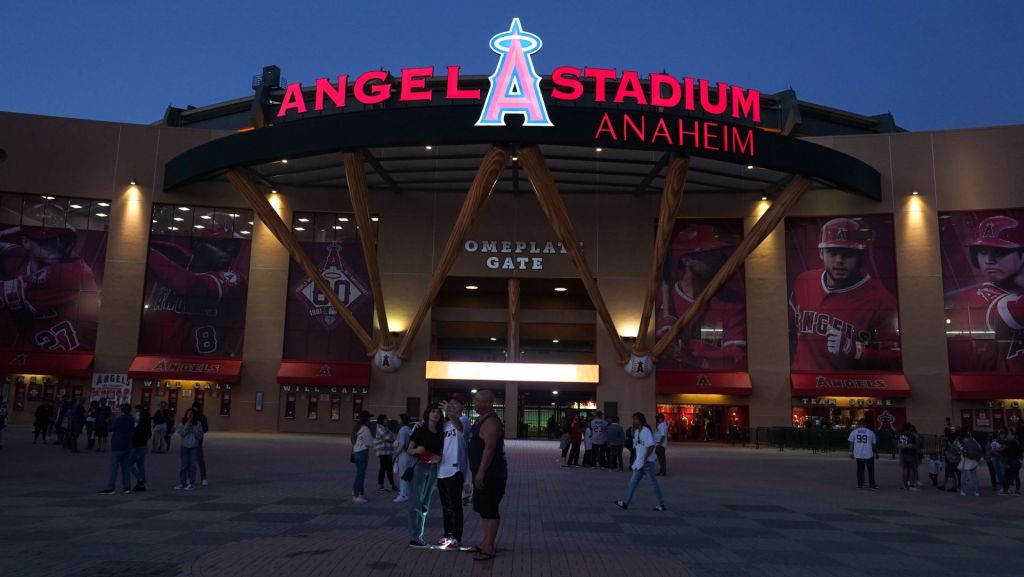
There is not a definitive plan in place for incoming Angels owner Stan Kroenke to build a new ballpark for the MLB club, but one could very well be on the way.
Kroenke’s $4 billion agreement to buy the club and Angels Broadcast Television (ABTV) from Arte Moreno, setting a league record for a team control transfer, immediately raised expectations that a new ballpark would soon be developed in Anaheim.
To that end, Forbes reported earlier this week a plan for a $2.5 billion stadium project was already being put together, but the outlet then retracted that statement, citing a Kroenke Sports & Entertainment spokesman who indicated that “the Angels were not ready to move forward on the project at this time, but might in the future.” Along similar lines, KSE told Front Office Sports that no final decisions have been made yet about the future of Angel Stadium.
Even with that shift, though, the factors supporting a replacement of Angel Stadium continue to grow, and will almost certainly escalate further after Kroenke closes the purchase in early 2027. Among the relevant issues:
- The facility, which first opened in 1966, is the fourth-oldest in MLB. The three that are older—Boston’s Fenway Park, Chicago’s Wrigley Field, and Dodger Stadium in Los Angeles—have each received significant upgrades in recent years and are widely beloved by fans. Nostalgia helped fuel the push to upgrade each of those other ballparks, but no such reverence exists for Angel Stadium.
- An extensive renovation in the late 1990s added the park’s now-famous outfield rock formation, but Angel Stadium faces rising infrastructure issues, which isn’t surprising given its advancing age. The ballpark also regularly ranks lower among players and fans, and it even had an issue earlier this year with a discovery of rodent droppings at a concession stand.
- The publicly owned Angel Stadium is surrounded by about 130 acres of surface parking lots. That parcel, an expansive chunk of land in an otherwise densely populated area, is currently controlled by the city of Anaheim and is prime for redevelopment that would extend the accelerating real estate wave across sports. The nearby Honda Center, home of the NHL Ducks, is already seeing such a mixed-use development effort unfold with the OCVibe project. Angel Stadium further enjoys proximity to three freeways and a train station.
- Prior efforts by Moreno to buy the stadium and redevelop the surrounding land collapsed four years ago amid a corruption investigation of then–Anaheim Mayor Harry Sidhu. Current Anaheim Mayor Ashleigh Aitken, who has already characterized the sale and forthcoming exit of Moreno as “like it’s my birthday” and said the stadium site has “a lot of potential,” appears eager to make a new deal of some sort. “I am encouraged by Stan Kroenke’s track record with the Rams and his commitment to investing in and uplifting neighborhoods,” Aitken said.
- Kroenke has an extensive real estate pedigree across his sports portfolio. SoFi Stadium in Inglewood, California, is the centerpiece of the growing Hollywood Park development. KSE is also planning expansive real estate projects around Ball Arena in downtown Denver, at a new Rams headquarters and training facility in Woodland Hills, California, and with a remade arena in San Diego.
Local Politics
The Angels have a lease in place for Angel Stadium that runs to 2032, and can be extended to 2038.
Any forthcoming deal at the Angel Stadium property, including a new ballpark, would be bound by the California Surplus Land Act, which requires public bodies in the state to prioritize affordable housing development and open space when selling or leasing land.
There is now a big incentive in place, however, that would allow Kroenke and the city of Anaheim a waiver from that requirement. California Gov. Gavin Newsom recently signed into law the “Home Run for Anaheim Act,” a measure that would relieve those affordable housing requirements if the team reverts to its prior geographic signifier of Anaheim. Moreno led the 2016 shift for the franchise to become known as the Los Angeles Angels, but that move has been widely unpopular.
“New ownership means new possibilities, and Anaheim is ready for them,” said state assemblyman Avelino Valencia, who authored the “Home Run for Anaheim Act.”
Download the FOS App
The business of sports, in your pocket.



Scan the QR code to get the app now.