Want more from Front Office Sports
in your search results?
On Sunday afternoon, a league title and the very future of two teams swung on a critical replay review.
Players and coaches from the losing team were furious, and the team itself formally demanded the league release full video and audio of the replay deliberations.
Less than 48 hours later, the league did exactly that—live on national television.
That’s just standard procedure in the English Premier League, which airs a weekly Match Officials Mic’d Up program giving fans a look under the hood of its most important calls.
The NFL would do well to do the same. Not only would it shore up arguably its biggest vulnerability—trust in officiating—it would be an absolute gold mine for American sports’ kings of content.
Take the aforementioned VAR decision heard around the world. On Sunday, Arsenal was beating West Ham 1–0 when the Hammers scored off a corner kick to tie the game.
The goal would have had seismic consequences: It would have taken Arsenal out of the driver’s seat in the Premier League title race, while also possibly saving West Ham from relegation—a move that could cost the club tens or even hundreds of millions of dollars.
After a lengthy review by the replay staff, though, referee Chris Kavanagh went to the on-field monitor and quickly decided the obvious: West Ham forward Pablo fouled Arsenal goalie David Raya, pulling his arm down and impeding him from making a save. No goal. Arsenal won the game—and likely the league—five minutes later.
The heavy stakes made the audio released Tuesday all the more fascinating. It also shows what the NFL and other U.S. pro sports could potentially gain by following suit.
On the very first slow-motion replay, video assistant referee Darren England lets out an enormous sigh when he realizes what he sees: the Pablo foul that went uncalled. Though the replay staff delays—England at one point instructs someone to “keep delaying”—the officials are in agreement that Pablo fouled Raya, and it took Kavanagh mere seconds of review at the monitor to concur.
“For me, there is a foul,” England says before loudly huffing and then plainly describing the “potential foul with the arm.”
Arsenal fans have seized on England’s remarkable sighing—at least three times—but it shows that he and the rest of the replay crew are enormously reluctant to make a decision that will flip the outcome of a game. It’s an extraordinarily valuable degree of transparency for a sport that, like American football, has been weighed down by an officiating crisis in recent years.
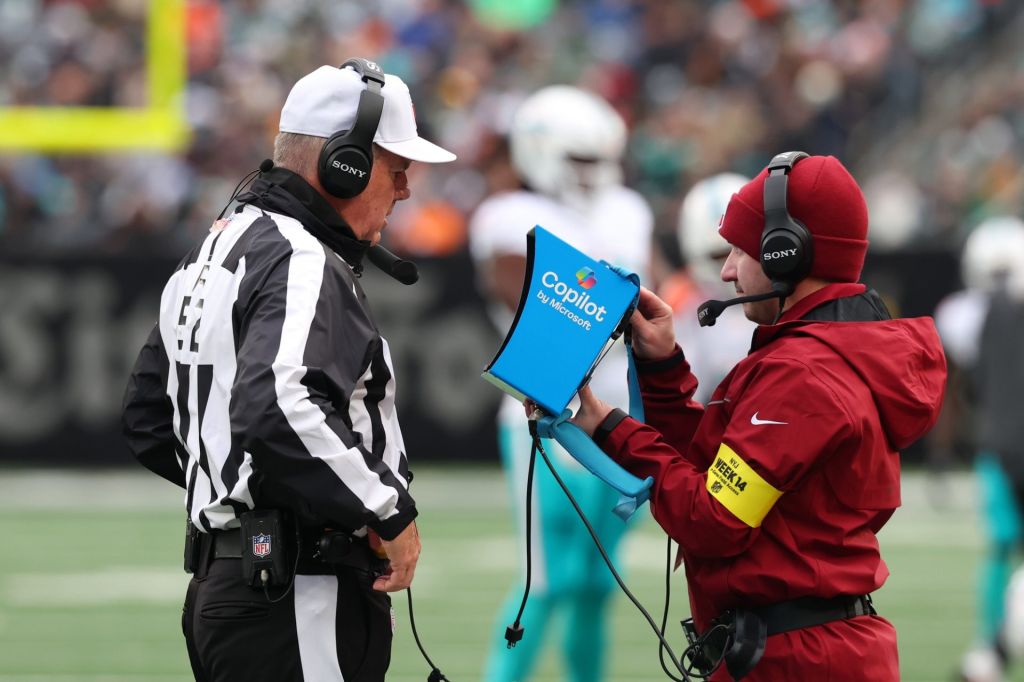
Plus, the NFL’s video replay system is more opaque than nearly any other sport’s.
Last fall, there were two incidents that showed just how little is understood about how the league makes critical decisions that swings games. After a critical touchdown was waved off in a Lions–Chiefs game in October, referee Craig Wrolstad told the pool reporter that his crew—not anyone in New York—made the decision to penalize the Lions on the play. But days later, Lions coach Dan Campbell said that he was told staff in New York actually made the call.
Those staffers in New York are a point of contention, too. A “high-level team executive” told ProFootballTalk last year that he wasn’t even aware of the extent of the league’s replay staff until the NFL’s Walt Anderson inadvertently revealed it. As Mike Florio wrote after the Anderson interview: “No one knows who’s making the decision, when a formal review occurs. And no one knows who’s making the decision when an expedited review occurs that a full-blown review isn’t needed.”
Release the ref tapes! Fans would have a clearer understanding of how decisions are made, tamping down on conspiracy theories, and the clips of refs reaching and then defending their decisions would be absolute catnip for the content mill between games. Howard Webb, who is in charge of England’s soccer referees, regularly goes on television to break down the week’s most controversial calls at a monitor, as he did for this weekend’s Arsenal–West Ham call.
Fans are desperate for any shred of transparency around officiating; take the rapturous reception for baseball’s ABS system. And giving a peek into how replay officials operate is not unheard of in the United States, either. The ACC aired replay deliberations last football season, and they did it live during games, not even the day after like the Premier League. Critical late calls were overturned late in the Virginia–Florida State and Clemson–Georgia Tech games, and viewers and media critics were overjoyed to get a look under the hood. The program went so well that the Big 12 is adding replay center audio to game broadcasts this fall, making it the second major conference to do so.
The NFL has avoided its absolute worst-case officiating scenario, reaching a seven-year collective bargaining agreement with referees. But now that the fear of replacement refs has been avoided, there is an obvious move the league can make to improve trust.
The league and NFL Referees Association did not answer questions about whether the new CBA contained provisions around potentially televising replay audio.
Download the FOS App
The business of sports, in your pocket.



Scan the QR code to get the app now.