Emails Reveal Powerful Network Behind Protect College Sports Act
Want more from Front Office Sports
in your search results?
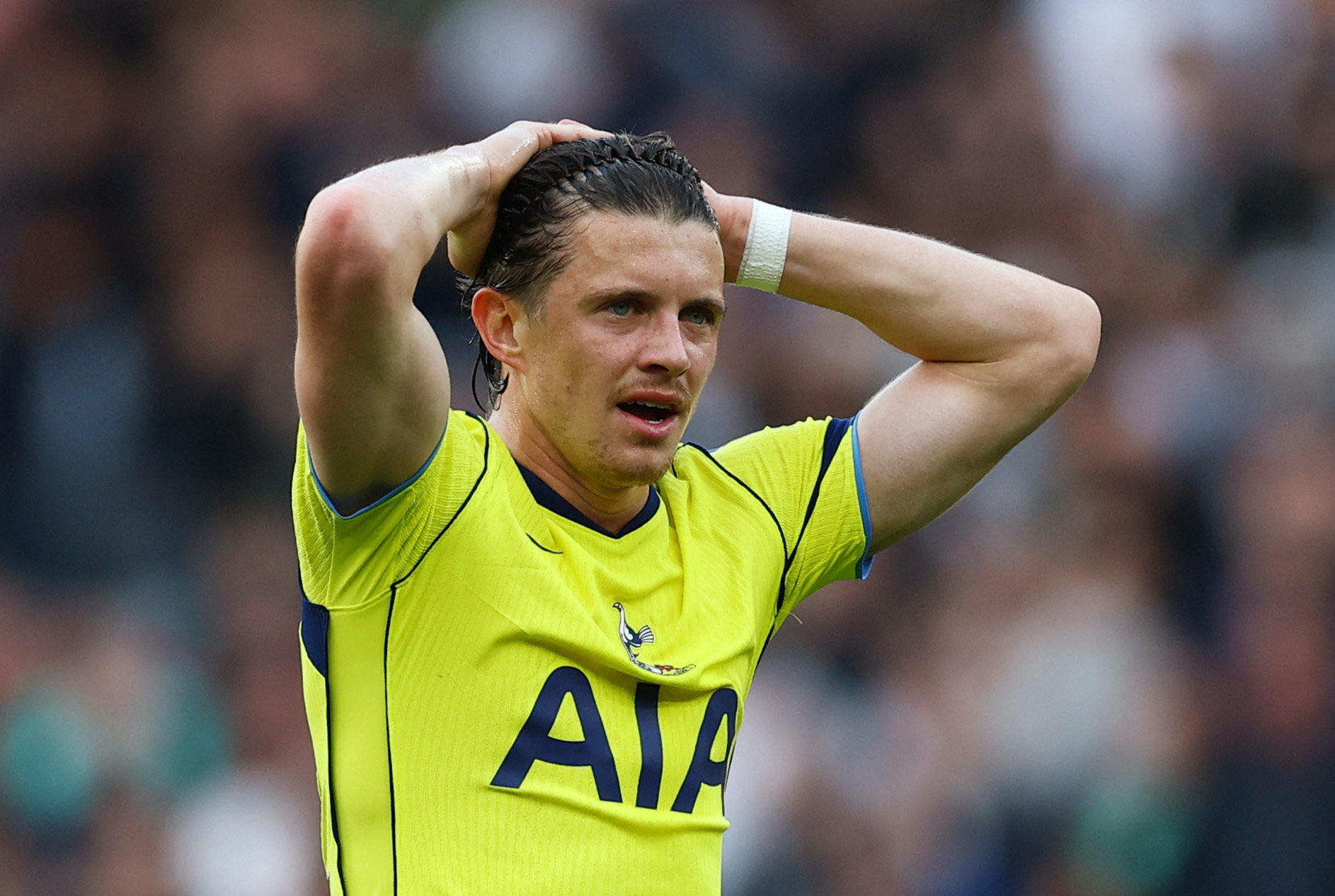
Tottenham Hotspur is staring down the abyss.
With three games remaining, Spurs are in 17th place in the Premier League, just one point clear of West Ham and the relegation zone. A 2–1 win over Aston Villa on Sunday pushed the void slightly further away—but Spurs, one of the richest and most famous sports teams in the world, is still on the brink of getting sent to the minor leagues.
It’s a spectacular fall from grace. Tottenham is one of England’s “Big Six” clubs (a term that has fallen out of favor, ironically, because Spurs have been so bad in recent years).
The club generates the ninth-most revenue in world soccer at $766 million (£565 million). It was playing in the Champions League in March after winning the Europa League last year. Its stadium cost $1.2 billion to build, regularly hosts NFL games, and is generally thought of as one of the best in the world.
The Washington Commanders are playing at Tottenham Hotspur Stadium next fall. By then, the venue, which usually hosts the likes of Arsenal and Manchester United, could be hosting Championship teams like Lincoln, Stoke, and Blackburn.
“Spurs being relegated would be unprecedented,” Kieran Maguire, associate professor in football finance at the University of Liverpool, tells Front Office Sports. “We’ve never seen anything like it at this scale––a club that was supposed to compete in the European Super League. From a footballing perspective, this is as big as it gets.”
The financial losses, too, would be unprecedented—an estimated $548 million (£405 million) hole overnight, and more after that.
Maguire estimates Spurs’ total revenue across media, match day, and partnerships would be slashed to $473 million (£348 million). Prize money would also plummet. Despite their struggles on the pitch, Spurs earned an estimated $100 million (£74 million) by reaching the round of 16 in the Champions League. Even finishing 18th place in the Premier League—the first of the three relegation spots—would be worth around $163 million (£120 million). In contrast, most Championship clubs are typically awarded only $14.9 million (£11 million) per season.
Spurs’ single greatest loss, however, would be broadcasting––missing out on the Premier League’s $16.3 billion global rights. NBC alone pays $2.7 billion for its U.S. coverage through 2028. In comparison, the English Football League (EFL), which houses the Championship, sold its entire international TV rights for $188 million (£148 million) in 2024. “The Premier League generates over half of its broadcast revenue from overseas,” says Maguire. “In the EFL, it’s around 10% total, meaning the U.S. is a minor market, even with greater exposure now thanks to Wrexham.”
Relegated teams receive parachute payments from the Premier League, a sum directly tied to the competition’s broadcast rights, to help soften the blow of relegation. This is expected to be $61 million (£45 million) for the trio demoted to the Championship this season. That would barely make a dent in Spurs’ $1.2 billion (£875.2 million) debt, on which it owes $40.7 million (£30 million) in annual interest payments alone. “There’s a cliff edge between the Premier League and the next tier down,” says Maguire.
Domino Effect
Spurs could experience up to a ten-fold drop in its commercial deals, estimates Michael Jackson, group CEO of Elite Sports Marketing, a sponsorship agency that works with several Premier League and Championship teams.
Depending on relegation clauses—which allow sponsors to bail if a team is relegated—this could include everything from its kit supply contract with Nike, worth $116 million (£86 million) last season, to its shirt sleeve sponsor (cryptocurrency exchange Kraken), to its banking partner (HSBC), to even its men’s hair treatment partner (Elithair). The club is reported to have already lost one contract worth millions of dollars.
Its annual $54.4 million (£40 million) deal with Hong Kong life insurance company AIA is the biggest question. It’s the 10th-largest front-of-jersey sponsorship in all of soccer this season. It dwarfs the size of those in the Championship––which average only around $1.37 million (£1 million) a year, Jackson says.
He believes it’s unlikely that Spurs’ original deal with AIA, signed in 2019, in the aftermath of its Champions League final defeat, would have a relegation clause. “These are often contained in the contracts of the Premier League’s bottom eight teams,” he says. “To go from a Champions League final, at a time when Spurs had star players like Harry Kane and Son Heung-min, to the prospect of relegation, would have been unfathomable––it wouldn’t have even been considered.”
Still, it’s unlikely Spurs would insist upon AIA paying another $54.4 million if it’s in the Championship, Jackson says, especially given that the brand is set to become its training kit partner when the current front-of-jersey deal expires in 2027. Instead, the gulf in value between the Premier League and the Championship would mean Spurs’ current partnerships likely would be renegotiated. Future deals would also be impacted if the club is relegated––a permanent stain on its Premier League record. “You go down, you start back on lower money,” says Jackson. (AIA and Nike did not respond to an FOS request for comment; Kraken declined to comment.)
Match-day income, which totaled $171 million (£126.5 million) last season—the seventh highest in Europe—would also take a significant hit. Ticket prices for Championship games pale in comparison to Premier League games across the board, but Tottenham’s single-game tickets command upward of $136 (£100) for the most in-demand matches, among the most expensive in England. The club has already said it will freeze season-ticket prices for next year, but if it wants to routinely sell out its 62,850-seat stadium, it will likely have to cut the prices of its single-game tickets.
Premium seating and corporate packages would also be in far less demand, a key reason why Maguire estimates match-day income would fall by nearly 40% in the Championship to $108 million (£79 million). “It’s doubtful Tottenham would be able to sell all its hospitality boxes for a Tuesday night home game against Preston North End,” says Maguire.
‘A Complete Rebuild’
These compounding losses would arrive just months after Spurs announced record pretax losses of $160 million (£120.6 million) for the 2024–25 season. And that included its highest-ever revenues, boosted by winning the Europa League. Its cash reserves are also under strain––from $264 million (£200 million) in 2023 to just $26.9 million (£20.4 million) last year, driven by the third-highest non-wage operating costs of all European teams, $354 million (£260 million), according to Maguire.
Relegation would therefore mean job losses, says Maguire. He cites Aston Villa’s case in 2016, the then-biggest Premier League club to be demoted to the Championship, which cut around 400 roles. “You don’t need as big a communications or marketing department in the Championship; there’s less demand,” he adds. “[Soccer players] will always find somewhere to play––relegation hits the rank and file harder.”
Spurs’ $348 million (£256 million) wage bill, the Premier League’s seventh highest and approximately six times that of leading Championship teams, would also need to shrink. Remarkably, most of its players’ contracts reportedly contain around 50% wage cuts should the club be relegated. “I’ve seen contracts for players of other Big Six clubs and never seen that before,” says Maguire.
But even if player salaries are halved, many player sales would follow, and not just to offset huge losses. “Most players will want to leave,” says Jackson. “Many will still be in demand from rival clubs and few would be willing to stay on reduced wages, let alone play in the second tier.”
An expected exodus would mean Tottenham would have to spend big, even in the Championship. It means it could struggle to balance the books and reduce costs in line with depleting revenues, deteriorating its operating position even further. “Spurs will need to spend to replace all its players leaving,” adds Jackson. “It would require a complete rebuild, even amid financial constraints.”
A Tottenham relegation would be so seismic that the effects would go beyond the club.
Stefano Endrizzi, founding partner of U.S. investment banking firm MergersCorp M&A International, which handles the sale of soccer clubs, says Spurs’ demise will likely affect soccer valuations longer-term. “If a club the size of Tottenham can be relegated, it can indirectly affect the value of those that survive,” he says.
Endrizzi says Premier League clubs could experience a three- to four-fold decrease in valuation following relegation. It underscores the relative volatility of European soccer compared to American sports, where major league franchises––immune from relegation––have price tags that stretch into the billions.
Yo-Yo Clubs
No club the size of Spurs has ever been relegated from the top flight. Not Manchester United from the old First Division in 1974. Nor Villa in 2016. Not even Juventus from Serie A in 2006, following the Calciopoli scandal.
Relegation would be catastrophic for Spurs. But a sustained period outside the Premier League would make it worse. After all, there’s no guarantee it would return to the top flight for the 2027–28 season. Demoted teams face a fight to get back up. Ironically, perennial Premier League strugglers with more recent Championship experience––”yo-yo” clubs, such as Burnley––are often more equipped to immediately bounce back than those with the resources of Tottenham, which was last relegated in 1977.
The fear is what happened to Leeds United. In the years before Leeds went down, it was a Premier League giant. After consistent top-five finishes and a Champions League semifinal, it plummeted, finishing 15th, then 19th in 2004. It took 16 years to return to the top flight––including three torturous seasons in England’s third tier. Even today, it’s not fully out of the relegation fight.
But Tottenham is a much better-managed club, at least financially. The largest bulk of its billion-dollar debt isn’t repayable until the 2040s (“so it will at least have a decade to return to the Premier League,” quips Maguire). And even with events on the pitch, its stadium should still continue to host elite events off it––a revenue stream of $44 million (£32.5 million) last season, more than any Championship club’s match-day revenue.
“Given it’s still a massive club, Spurs can take the hit for a year,” says Jackson. “Any longer, and it becomes a major issue: How do you sustain a club of that magnitude in the Championship?”
If Tottenham does go down, it will be one of soccer’s biggest stories. “If it happens, it’s going to be every team’s cup final next season,” says Maguire. “Everyone will want Spurs’ scalp.”
Tottenham Hotspur declined to answer questions for this story.
Download the FOS App
The business of sports, in your pocket.



Scan the QR code to get the app now.