


Max Kellerman, LeSean McCoy Off DAZN Boxing Show As Mario Lopez Joins
Want more from Front Office Sports
in your search results?
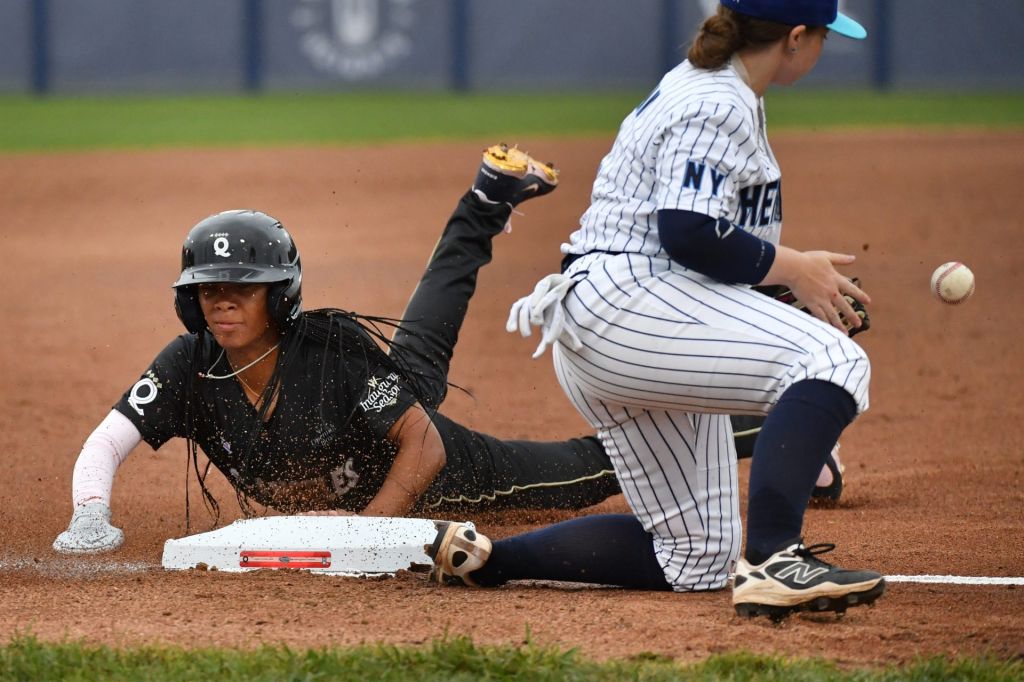
Professional women’s baseball is back in the U.S. for the first time in decades.
When the first pitch was thrown on August 1, the four-team Women’s Professional Baseball League was hailed as a historic return for women’s baseball. Aside from a brief attempt to capitalize on the movie A League of Their Own in the 1990s, there had not been a professional women’s baseball league in the U.S. since the 1950s.
Behind the scenes, though, the WPBL has been mired in litigation, boardroom drama, and questions over whether its majority owner ever invested money in the league.
Its own CEO, Canadian lawyer Keith Stein, admits that there’s a “power struggle” between members of the board. Over the summer, board member Mina Kim started a legal battle against the league, demanding financial transparency and alleging that Stein may have misspent the league’s money amid what her lawyer called “mounting red flags” in a pre-trial brief.
Front Office Sports spoke with several people familiar with the operations of the WPBL, who asked to speak anonymously out of concerns over retaliation. Stein spoke extensively with FOS in his first public comments since Kim came forward with her allegations.
Stein’s WPBL co-founder and the league’s commissioner, Justine Siegal, declined to comment. “I don’t handle the business side of the league,” she wrote in a text message.
Interviews and public records show a startup with murky governance, inconsistent records, and a lack of clarity internally from Stein about league operations.
And a critical question—how much money Stein actually put into the league—remains in dispute as Kim’s case winds its way through the Delaware Court of Chancery, a common venue for corporate disputes.
Stein told FOS he owns roughly 65% of the league, and Siegal’s stake is smaller than 6%. (The ownership structure of the league has not been previously reported.)
Stein said he contributed about $225,000 to getting the league off the ground in 2025. But Kim, the league’s largest investor, told FOS in a statement she has “never seen any evidence that Keith has personally contributed any money into WPBL’s corporate or trust accounts.”
“Investors have asked directly for that information, and to date, none has been provided,” Kim said.
Stein denies Kim’s allegations of financial mismanagement and says he funded the league at its outset. The WPBL’s attorneys have argued that Kim is acting out of a “personal vendetta” and her requests for information are excessive.
Mixed Messages About Who Funded the League
The WPBL was first announced in October 2024, co-founded by women’s baseball advocate Siegal and Stein, co-owner of the Canadian Baseball League’s Toronto Maple Leafs. Stein was also the co-founder of the Pro Padel League. In interviews with FOS, Stein said the WPBL was his idea.
The league ultimately raised about $3 million in a seed round this winter, led by a $500,000 investment from Kim, an early investor in the Orangetheory Fitness chain. (The size of Kim’s investment has not been previously reported.)
Sources told FOS that before the seed funding round, people close to the league believed that Stein had invested into the WPBL, only to later find no record of his investment. The first outside investor, retired sales executive Rhonda Eiffe, declined to comment.
Kim’s legal filing details a June 10 board meeting in which Stein said “he owed his fellow directors no obligation of disclosure.”
This week, Stein told FOS that he did put money into getting the WPBL off the ground before any other investors came on, but his spending happened before the league had an official bank account set up. He said much of this money was spent on staff salaries.

Stein said that before Eiffe’s investment, he was the league’s “sole investor” and covered all costs. He said he doesn’t know how much he spent on “infrequent” payments in 2024, which came from his personal bank account. From January through September of 2025, Stein says he spent roughly $225,000 on league business out of his corporate bank account.
“Until June of 2025, I was the only funder, and my bank account was used as the de facto account of the corporation,” Stein said, which he claimed is “not unusual” for a startup. Stein said efforts began to open a bank account for the league in May or June of 2025, but weren’t completed until December of that year. “It’s actually not so easy to open up a bank account these days,” Stein said.
When asked why his investments do not appear on the cap table, Stein said: “I had more than enough equity, I didn’t need more.” Asked why he didn’t make his investments more widely known, Stein said there was “nobody else around at the time” aside from himself, Siegal, and his lieutenant Jeremy Berman.
Stein said he doesn’t take a salary from the league, covers all of his business travel expenses, and has “definitely not” been repaid for the money he says he invested.
A Mysterious $59,000 Wire
Kim’s filing lays out a number of “unexplained” transfers of league funds between bank accounts, including Stein’s own account and a trust account belonging to Dentons, the law firm where Stein is an attorney.
Stein called the legal filing’s characterization of the multiple wires a “complete distortion” that showed a “knowledge deficit” in startup operations. Kim said in her statement that she has invested in “over 35 early-stage ventures” and advised “several startups.”
One of the wires detailed in the filing is a $59,000 transfer from the league to an entity owned by Stein. Kim’s filing says that the league initially described this transfer as a reimbursement before later reclassifying it as a “a loan for which no documentation exists.”
Stein said this money was actually a portion of Eiffe’s investment, which he initially thought was a reimbursement for himself, but recently learned had been classified as a loan.
Eiffe’s $75,000 investment in June 2025 first went into the Dentons trust account, Stein said, but “the only way for those funds to be deployed was to go through my account.”
“I was funding and funding, and that money was provided to my account as reimbursement so that those funds could be used, not just my funds,” Stein said.
The CEO said that the reason why only $59,000 of Eiffe’s investment was transferred rather than the full amount was because it was meant to cover two costs for its August tryouts in Washington, D.C.—an insurance payment to National Park and hotel fees—which combined ended up being $63,000.
Close Ties To Stein
The league is tightly bound up with Stein’s personal and professional life.
The Toronto address of a Dentons office is also listed as the league’s official address on the WPBL website, and one Dentons lawyer in addition to Stein sits on the league’s six-member board. Trademarks for the league and its four teams were registered with the U.S. Patent and Trademark Office under Stein’s name to a personal home address in Canada; the attorneys filing those trademarks are from Dentons.
Stein told FOS he was “surprised” the trademarks were filed under his name, but said he has a “binding agreement” with the league that all trademarks will be transferred once they are approved.
Stein appointed his Dentons colleague, Andreas Kloppenborg, and his former brother-in-law, Mark Prosterman, to the WPBL’s board of directors. Kim’s filing says a conflict of interest arises from Stein, Kloppenborg, and league counsel all working at the same law firm. The filing also says Stein did not tell the board that he had a family connection to Prosterman.
Stein said it is “commonplace with startups” for the founder to “appoint people to the board that he trusts and he’s comfortable with.”
Stein called Kloppenborg a “trusted advisor” that he put on the board because of his background in pro sports leagues in Canada. As for Prosterman, Stein said he “would not have considered it relevant” to disclose that Prosterman was his brother-in-law more than a decade ago, saying, “I’m not sure I even think of him in those terms.” Stein said he saw Prosterman, who works in software sales, as a “very capable director who invested a very significant amount in the league.”
Kim v. Stein
Kim was brought to the league by former board chair Assia Grazioli-Venier of Muse Capital; the other members of the board were all put in place by Stein.
In April 2025, Grazioli-Venier was announced as chair of the board of the WPBL, tasked with leading a “global search” for a CEO, and Muse Capital had an advisory deal with the WPBL. Grazioli-Venier brought instant pro sports credibility as a co-owner of the NWSL’s Washington Spirit and a former board member of Italian soccer giant Juventus.
A year later, Stein cut ties with both Muse and Grazioli-Venier, telling FOS that Muse failed to bring on sponsors and that Grazioli-Venier had to go once he terminated the Muse deal. He also said that Grazioli-Venier and Kim put forward a motion earlier this year to find a new CEO, but were voted down.
In a statement, Grazioli-Venier told FOS that Stein’s account was unfair, and that her work was “instrumental in ensuring this League has gotten the coverage and prominence it richly merits” in addition to bringing on a wellness company as a founding sponsor.
“Regrettably, our leadership and contribution was not valued by certain representatives of the League, and Muse no longer serves on the Board or in any advisory capacity,” said Grazioli-Venier, who remains a shareholder.

The WPBL board feud has gotten ugly as Kim demands transparency and Stein denies wrongdoing.
“In all my experience and tenure, I have never had to go to court just to get basic financial information—until now,” Kim said.
In recent interviews with FOS, Stein called Kim a “disgruntled investor” and said her legal action has become a “witch hunt.” He said that she “wants more influence I think than a board member is entitled to have” and noted that she is the only member of the board who has not attended a game in Springfield, Ill., this season.
“I was at spring training this year and got to see firsthand, and was genuinely excited by, what our coaches and players have built,” Kim said in a statement. “Unfortunately, for the last five months, including this season, my time has been focused on getting this league the answers it needs.
“No one should read that as a lack of commitment to the players—it’s the opposite. I want this league to have the governance and transparency it needs so these players have a stable place to play for years to come, not just this season.”
Kim’s filing also alleges that Stein gave some investments preferred treatment—not unusual for a startup funding round—but then didn’t disclose that to the other investors.
Stein tells FOS he added these preferred agreements to the company’s records by last fall. But a person close to the league says that’s false, and that the agreements didn’t appear on the company books until June—following Kim’s first formal demand for records.
Other sources have alleged issues with Stein’s management. Three people close to the league told FOS that Stein offered at least two people future ownership of a franchise. (The league currently owns all the teams.) Stein confirmed he offered one person a team in writing, but said the claim that he verbally offered anyone a second team has “no basis in reality.”
Earlier this summer, athletes scheduled a meeting with the league intending to speak with Stein about their concerns ahead of the season. He never joined; only Stein’s right-hand man, Berman, joined the video call late, but kept his camera off. Berman has a single-digit stake in the league, according to Stein.
Where Does the WPBL Go From Here?
The WPBL appears to be paying its vendors and employees, and Stein claims the league is in a safe financial position and up to date on its bills.
Two players told FOS they have been paid in full and on time, as did two employees. Players make between $300 and $500 per game.
“We have a healthy seven-figure number in our bank account, and we will have a healthy seven-figure number in our bank account at the end of the season, and for the foreseeable future,” Stein said. “We are not passing a hat around or anything like that. I think we’re in very good shape.”
Stein said the WPBL plans to do another round of financing in the future, though he doesn’t feel rushed to do that for “several months.” He said the league had an $18 million pre-money valuation for the seed funding round, which came out to almost $3.3 million when it closed in February. The CEO said he’s “confident” that the league will be valued “much higher” for its next round of financing.
Stein also said the league has made $1.3 million in ticket revenue. The league claimed to have sold more than 55,000 tickets across its 30 regular season games, though the stands have looked sparse on many broadcasts.
Fan engagement still appears strong, as teams and players like Kelsie Whitmore and Denae Benites boast healthy social media followings. An ESPN spokesperson declined to share streaming numbers for the WPBL on ESPN+.
“To me these players are the Babe Ruths of their time,” Stein said. “We’ve done something extraordinary. … It’s too early for a victory dance, but we should be celebrating a whole lot more, I think, and feeling a lot more positive.”
The next week will be critical. In Springfield, the Los Angeles Queens and San Francisco Firebells will compete in the inaugural best-of-five championship, with L.A. up 2–0 in the series following a Thursday night win. In Delaware, the battle between Stein and Kim over the future of the WPBL may be coming to a head.
On Thursday, the court ruled to move the trial to papers, which means a decision about whether the league must turn over documents to Kim could be imminent. But Stein said he has the ability to remove her from the board at the end of the month.
Download the FOS App
The business of sports, in your pocket.



Scan the QR code to get the app now.