Want more from Front Office Sports
in your search results?
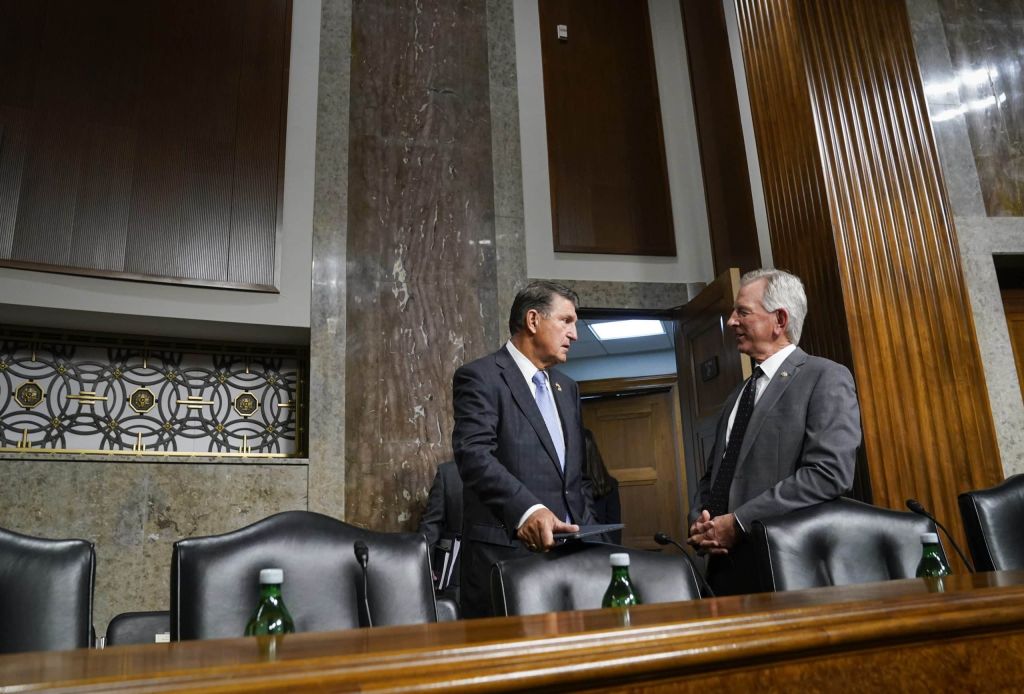
On Tuesday, Sens. Tommy Tuberville (R-Ala.) and Joe Manchin (D-W.V.) introduced a bipartisan bill in the Senate related to name, image, and likeness, the transfer portal, and other college sports issues called the “Protecting Athletes, Schools and Sports Act.”
While three other senators published a draft of bipartisan legislation last week, this is the first officially bipartisan NIL bill introduced in the Senate. It’s the latest piece of NIL legislation expected to be introduced in Congress this week before the August recess, as multiple others are pending. The legislation has been in progress for a year.
“Our bipartisan legislation strikes a balance between protecting the rights of student-athletes and maintaining the integrity of college sports,” Manchin said in a statement. “I urge my colleagues on both sides of the aisle to consider this commonsense legislation as a way to level the playing field in college athletics.”
The bill includes two major pro-NCAA comments which were not mentioned in Tuberville and Manchins’ original press release, with Front Office Sports reviewed in addition to the text of the bill itself.
The bill gives the NCAA what would effectively be “an antitrust exemption in disguise,” according to Kennyhertz Perry sports attorney Mit Winter. Boise State law professor Sam Ehrlich agreed with Winter’s interpretation.
“Section Nine says the NCAA shall establish rules to govern and provide oversight of schools,” Winter explained. “Those rules could include things well beyond NIL, like transfer rules and compensation limits in general. So all of those types of rules, and others, would potentially be immune from antitrust law under this bill.”
The NCAA has been begging for an antitrust exemption, because that would shield it from litigation and give it the power to protect its amateurism model, and deem athletes amateurs once and for all.
Another clause of the bill could prohibit schools sharing revenue with college athletes in the future, Winter and Ehrlich agreed. ESPN first noted the language.
As for NIL, the bill would create not only a uniform NIL standard preempting state laws, but also require a uniform NIL contract (something NCAA President Charlie Baker has asked for).
It allows the NCAA to prohibit certain types of deals — like recruiting inducements or deals with “unsavory” industries like gambling or weapon companies. It “empowers” the NCAA to enforce these rules, and legally empowers the Federal Trading Commission. The FTC will also serve as a clearinghouse for NIL agent registration, collective registration and specific deals, though schools would have to receive specific deal information from athletes. There will also be an anonymized NIL database.
A unique aspect of the bill: collectives or boosters must be “affiliated with a college.” It has language suggesting that “third parties,” including collectives, must be “formally associated with an institution of higher education through a written contract” if they want to promote the school or provide athletes certain benefits. Third parties that are affiliated with the school, like collectives, must offer “equal representation” and “equal services” to men’s and women’s sports athletes.
Perhaps to address recruiting inducement, the bill would change NCAA transfer rules. Instead of a one-time ability to transfer at any point, athletes would have to complete three years of eligibility before transferring “without penalty,” though there are a couple exceptions.
The bill also provides sizable requirements for athlete medical care. All four-year institutions will be required to offer insurance to uninsured athletes for eight years after they graduate. Athletic departments making more than $20 million per year must cover two years of out-of-pocket medical expenses related to injuries after athletes’ playing days end; departments making $50 million must offer four years. There will also be a medical expense fund created through revenues from the College Football Playoff and NCAA championships. Manchin and Tuberville included requirements for scholarships to be honored as well.
It does not, however, address whether or not athletes could be considered employees — nor does it grant the NCAA a blanket antitrust exemption, which many officials have asked for.
In a statement, Baker said the governing body was “encouraged” by the legislation. While not quite an official endorsement, the SEC and Big 12 both provided favorable statements about the bill.
Last Thursday, Sens. Cory Booker (D-N.J.), Richard Blumenthal (D-Conn.) and Jerry Moran (R-Kan.) published a draft of their bill, which includes many similarities to Tuberville and Manchins’. It would create a uniform standard for NIL rules and put only certain limits on what types of companies athletes could partner with. It would also outlaw deals being used as recruiting inducements.
It differs from the Tuberville and Manchin bill in establishing a third-party entity to oversee NIL agent certification, collect data on deals, and set certain rules. The NCAA would be given latitude to set and enforce certain rules related to NIL.
Like Tuberville and Manchin, the legislation would establish a federal standard for medical coverage of athletes’ on-field injuries and establish lifetime scholarship offerings.
Sen. Ted Cruz (R-Texas) is also working on a bill, a draft of which was obtained by On3 last week. In addition to addressing NIL, the bill would reportedly give the NCAA what would be almost a blanket antitrust exemption and deem athletes amateurs.
This group of NIL bills is a result of expansive lobbying efforts by the NCAA and Power 5 conferences to sway federal lawmakers to pass favorable legislation that gives the NCAA and conferences more power, and ensures the amateurism model will stay intact.
Each quarter, the six entities spend hundreds of thousands on lobbying firms. Conference, school, and NCAA officials have spent an increased amount of time in Washington. Every chance they get, commissioners and Baker (himself the former governor of Massachusetts) use almost every public speaking opportunity to repeat their legislative wishlist.
The Power 5 conferences have also retained at least one Washington-based PR firm, called Firehouse Strategies, which provided a statement to FOS last week on the matter. “We are pleased to see the momentum that continues building in both the Senate and the House to address this issue,” the statement read in part. “Our conferences welcome additional efforts in the future.
Editor’s Note: This story has been updated to include quotes and analysis from legal experts.
Download the FOS App
The business of sports, in your pocket.



Scan the QR code to get the app now.