Want more from Front Office Sports
in your search results?
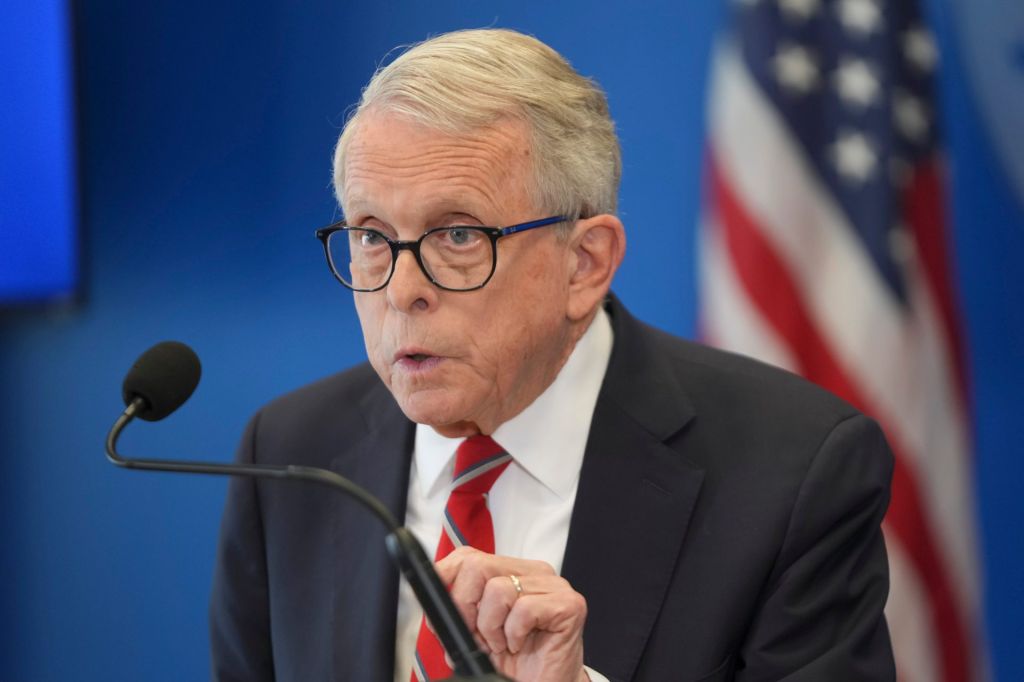
Ohio Gov. Mike DeWine isn’t the first governor to weigh in on the eligibility battle being waged in college sports. But he is the first to issue an executive order on the subject.
On Tuesday, DeWine signed a three-page executive order stating that players who started college in 2022 and have exhausted four years of eligibility should be awarded a fifth year.
“No State institution of higher education or private college or university in Ohio shall uphold any rule, requirement, standard, or other limitation that prevents a student-athlete of that institution or college in the Class of 2022 from fully participating in intercollegiate athletics in the 2026-27 academic year,” the order states. The only caveats: Players must still be 24 or younger (in keeping with the NCAA’s age-based policy), must be academically eligible, and cannot have signed professional contracts.
The executive order comes as multiple cases at the state and federal level have challenged the implementation of the NCAA’s age-based eligibility policy, which went into effect this summer. The new rule allows players five years to complete up to five seasons of eligibility, beginning on their 19th birthday or when they start college, whichever comes first. But the NCAA decided that the rule doesn’t retroactively apply to the freshman class of 2022. Over the past several months, hundreds of players in that 2022 class have filed lawsuits to win back a fifth year.
The order also comes as the U.S. House of Representatives gears up to consider the Protect College Sports Act, which would codify the NCAA’s new policy into federal law. The new law would not, however, cancel out previous eligibility cases filed before it was signed.
Now, Gov. DeWine has tried to create some consistency—at least for players at Ohio schools.
The immediate effects of the executive order are unclear, however.
The EO “doesn’t require those schools to roster the players, but provides them cover if they choose to,” sports attorney Darren Heitner tells FOS. However, the EO itself may not have the power to “supercede” NCAA rules.
“This EO only has legal teeth if the schools think that it has legal teeth,” Boise State sports law professor Sam Ehrlich tells FOS. “From there, things get complicated. I think there are several legal theories that the NCAA could use to attack this if needed.”
Nebraska attorney general Mike Hilgers also questioned the order’s enforceability. “I can’t imagine such an order being enforceable across the league, let alone in Nebraska,” he said. “Either way, our office is reviewing this very closely as it appears contrary to every rule currently in place.”
The NCAA has already taken this position. On Tuesday night, NCAA president Charlie Baker said in a memo to schools that the organization intends to continue enforcing eligibility rules “consistently,” including in Ohio.
“The Governor of Ohio cannot legislate NCAA eligibility rules,” Baker wrote. “One elected official seeking to make their own rules for their own schools’ advantage is a terrible way to run athletic competitions and precisely why Congress must pass the PCSA [Protect College Sports Act] as soon as possible.”
But the document could help sway Ohio’s supreme court toward the players’ position when it reviews Borovicanin v. NCAA, the first case filed on this issue, which counts dozens of men’s and women’s basketball players as plaintiffs. (Players initially won eligibility, but their injunction was overturned on appeal.)
“It’s a fairly strong statement of policy,” Seton Hall law professor Bob Boland tells FOS. However, he noted the EO includes a potentially complicating provision: “Nothing in this Order is intended to decide, or to direct any court considering any matter pending before any court, or to require any institution to act contrary to an order of a court of competent jurisdiction.”
Ultimately, though, the order could have a ripple effect nationwide, legal experts said. The EO could also be emulated by other state governors who may want their state universities to have the competitive advantage offered by these players looking for eligibility. Though one executive order in one state may not technically have teeth, the NCAA may have a harder time fighting multiple state governors.
Download the FOS App
The business of sports, in your pocket.



Scan the QR code to get the app now.