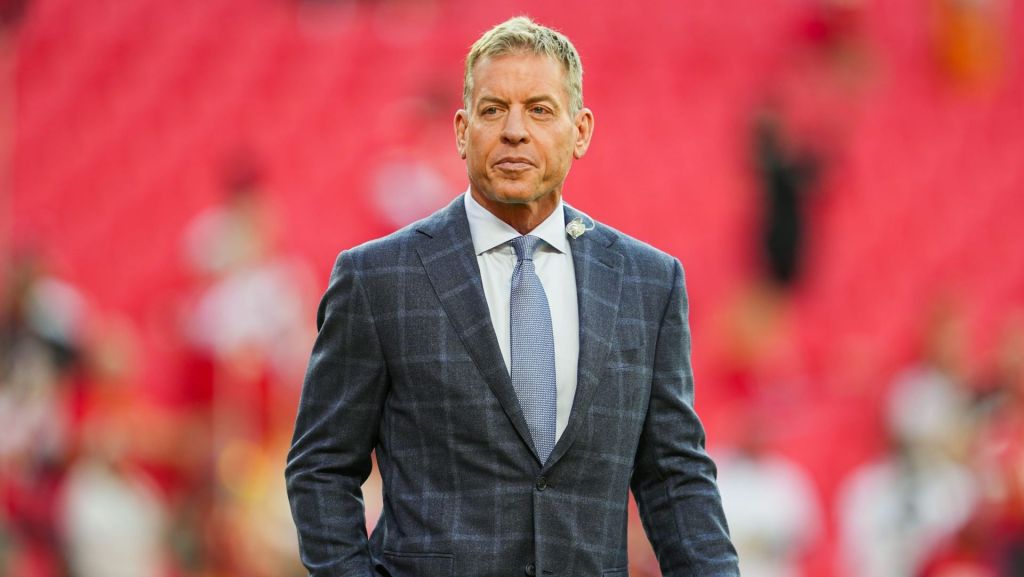
Troy Aikman, Dolphins Have No Ongoing Consulting Agreement
Want more from Front Office Sports
in your search results?
The opening of the NIL floodgates in college sports three years ago birthed an entire cottage industry of third-party NIL services companies that have raced to amass contracts with big school clients.
In just the past month, one of those companies has collapsed and another is under fire. How did we get here?
In July 2021, the NCAA began allowing college athletes to get paid for use of their name, image, and likeness; that led to an open market in which star quarterbacks and basketball players freely transfer from school to school for promises of cash payments.
Add to that the result of the House v. NCAA settlement in June, which allows schools to share up to $20.5 million of revenue per year directly with players—separate from personal NIL deals. While the $20.5 million in revenue-sharing is a hard cap, there is no limit to how much money players can make from NIL deals.
One result of the House settlement was a new entity designed to police both the revenue-sharing and NIL deals: the newly formed College Sports Commission, which oversees the NIL Go clearinghouse, a platform created by Deloitte to judge the market fairness of NIL deals and curb high-priced pay-for-play deals. NIL Go has already been criticized for being slow to approve deals submitted by athletes—so slow that some collectives have started to make payments to players without waiting for the NIL Go green light. But Big 12 commissioner Brett Yormark said Tuesday about the platform’s slowness, “That’s not a glitch, that’s a feature.”
Early in the NIL era, schools relied heavily on third-party collectives of rich boosters to help facilitate those huge payments to players. But as the House settlement looked set to pass, many Power 4 programs—not all—moved away from their collectives in preparation for a new landscape where revenue-sharing would, presumably, become the centerpiece of building championship rosters, and NIL payments would be a cherry on top of that cap.
It hasn’t played out that way so far. Top players are still being lured mainly by ever-ballooning NIL payments, independently of a school’s stated revenue-sharing plan. But the move away from collectives by some schools has prompted an ensuing move toward third-party platforms or marketplaces that connect athletes with NIL deal offers.
“Collectives, for the most part, should only exist in markets where the school is at the [revenue-sharing] cap—they’ve exceeded how much they can pay directly,” NIL marketplace Opendorse cofounder Blake Lawrence tells Front Office Sports. “That’s where a collective actually makes sense.”
Opendorse is one of the leading NIL payments marketplaces, used by 100 Division I programs, and works with each school’s athletic department or an affiliated NIL collective. On June 30, just before new rules went into place, collectives funneled close to $20 million to college athletes through Opendorse, the largest day in the company’s history.
The company picked up some new business earlier this month after Student Athlete NIL (SANIL), a third-party collective operator, abruptly shut down, and its clients were searching for logistical help.
SANIL at one point worked with more than 40 schools, and was growing so quickly that in February another NIL operator, Blueprint Sports, announced it would acquire SANIL in a deal aimed at “establishing a $100M+ NIL powerhouse agency,” according to a press release at the time. That deal was never finalized, and SANIL is no more.
Blueprint has had its own string of bad news. In 2024, the company said it supported more than 25 universities or collectives, but that number is down to 10. Arkansas ended its contract with the company, and Oregon State’s contract has come under scrutiny over how much of a cut Blueprint takes from the NIL deals it helps facilitate. (With Oregon State, Blueprint guaranteed an initial $750,000 in NIL funds, then takes 75% of profits up to $1.15 million, and 50% of profits beyond that, according to The Oregonian.)
Blueprint has still been fielding calls from athletic directors despite the negative headlines, and the agency—which also counts Penn State, NC State, and Maryland as clients—has four to five more D-I deals close to being signed, a source told FOS.
In an interview with FOS, Blueprint Sports CEO Rob Sine predicted that whether big schools will continue using collectives will be a “dealer’s choice” based on individual needs.
“Schools are going to be able to decide: Do we need to have a collective or do we not? But what we do need to have is we need to have an NIL operation that we are completely integrated and aware of, and work with on a daily basis,” Sine says. “Some athletic directors may want a collective, some may not. But almost all of them are going to say, ‘We’re going to need an additional NIL effort powered by …,’ and that’s where we come in to be able to help with everything from fan monetization to breaking recruiting news to events that we can create.”
Some major Power 4 programs, including Georgia, Ohio State, and Texas, have signed deals this year with Learfield—an established college sports marketing company that made its name specializing in multimedia rights—to create new NIL divisions within their athletic departments. For example, the NIL-dedicated Buckeye Sports Group falls under Learfield’s Ohio State Sports Properties operation. Learfield has been around in several forms since 1972, but adapted to focus on NIL business in 2021.
In the NIL era, serious athletic departments are farming out a suddenly crucial operation to outside companies—in many cases brand-new companies with very short track records.
“There’s no barrier to entry when it comes to NIL,” Learfield EVP of NIL growth and development Solly Fulp tells FOS. “And there’s a lot of new people coming into our space that are prioritizing the transaction over what is truly in the best interest of the student-athlete.”
Fulp says Learfield’s preestablished presence at the schools it’s working with creates more accountability. “While others might come in and create high expectations, and if they don’t deliver, they pull their tent and leave, we can’t do that,” he says.
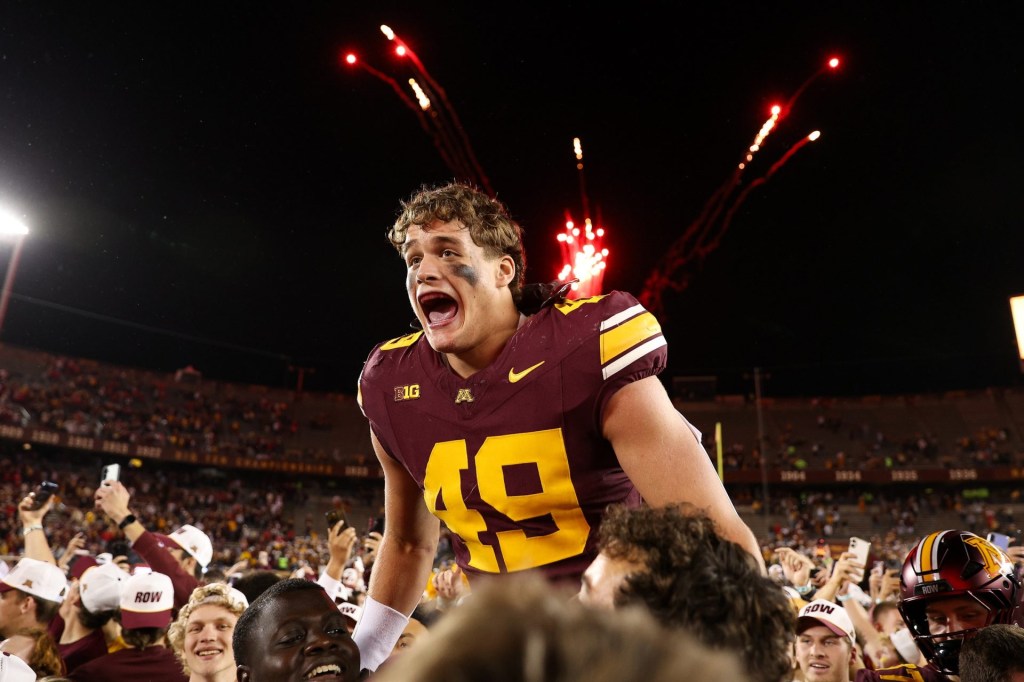
Brett Schreiner, the senior manager of NIL business development at Minnesota, a Learfield client, says having a clear operation is key to limiting the confusion for stakeholders interested in striking NIL deals. “Sometimes they’ll reach out to the collective. Sometimes they’ll reach out to a coach. Sometimes they’ll reach out to the student-athlete,” Schreiner says. “And there’s no question that they don’t know how this all works.”
As college football coaching buyouts have already surpassed $100 million this season, maximizing NIL dollars to create the most competitive rosters possible is crucial.
Sine believes $25 million football rosters (revenue-sharing plus NIL money) will be the baseline for top programs, with the biggest spenders going even higher. Nebraska coach Matt Rhule recently said the “world of $30 and $40 million rosters … isn’t going away.” Fulp says companies like Learfield “feel the pressures of the school on recruitment and retention of these student-athletes, and how important commercial opportunities play into that.”
The revenue-sharing cap is expected to increase incrementally from this year’s $20.5 million sum, and NIL rules are expected to evolve as the College Sports Commission continues to sharpen its governance strategy.
Even more changes may be on the way. The idea of a true hard salary cap in college football and basketball, which would require complicated collective bargaining between athletic departments and athletes, has gained some steam in recent months.
Everyone in and around college athletics anxiously awaits clear rules of the road. Until then, the chaos continues.
Download the FOS App
The business of sports, in your pocket.



Scan the QR code to get the app now.