Sunday, October 4, 2026
  • -
    days
  • -
    hours
  • -
    minutes
  • -
    seconds

‘More Bark Than Bite’: What Trump’s Executive Order Means for College Sports

Thursday’s order on college sports pay provides a window into Trump’s thinking. But its actual policy impacts are likely minimal, sources say.

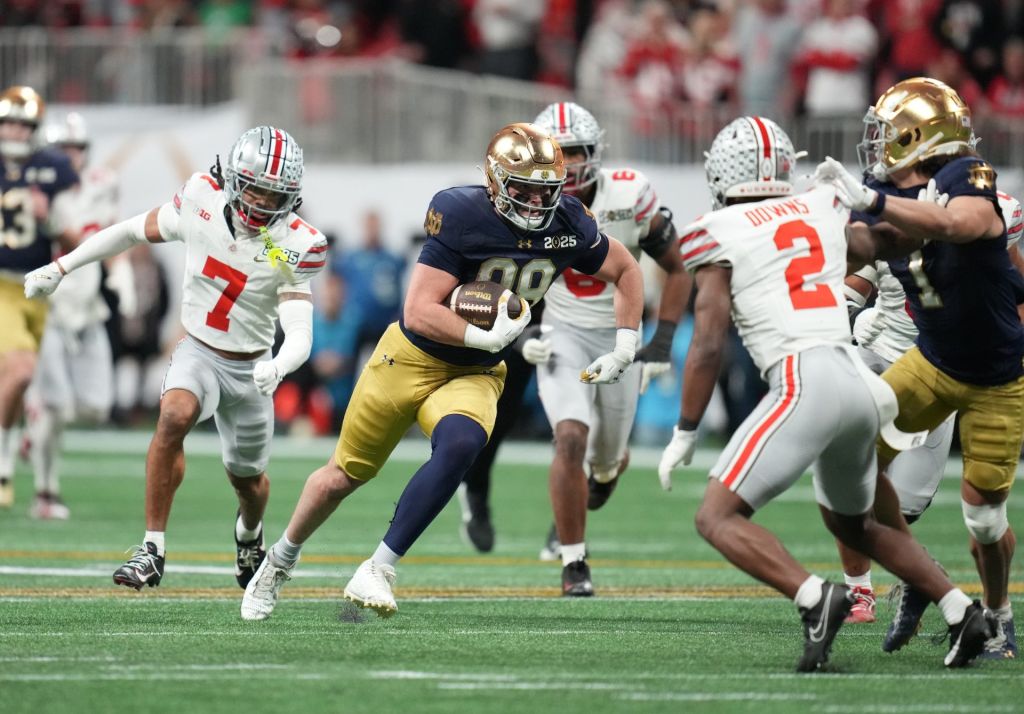
Jan 20, 2025; Atlanta, GA, USA; Notre Dame Fighting Irish tight end Mitchell Evans (88) runs the ball against the Ohio State Buckeyes in the second half in the CFP National Championship college football game at Mercedes-Benz Stadium.
Kirby Lee-Imagn Images

Want more from Front Office Sports
in your search results?

Add Front Office Sports on Google

On Thursday, President Trump made his first foray into legislating college athlete compensation with an executive order titled “Saving College Sports.” 

Among its key goals: preserve the Olympic pipeline that runs through NCAA sports and safeguard women’s sports; prohibit “pay-for-play” NIL (name, image, and likeness) deals;  protect the NCAA from antitrust lawsuits; and study athlete employment status.

In the short term, the order won’t have a drastic impact, congressional aides on both sides of the aisle and industry experts tell Front Office Sports. But it does offer, for the first time, a window into the Trump administration’s views on issues facing the future of college sports. Importantly, the order broadly aligns with the NCAA’s objectives and supports GOP efforts to legislate that agenda (most recently through the SCORE Act, which experts say would have more legal authority).

“The [executive order] is a helpful articulation of policy priorities,” one congressional aide tells FOS. “But the challenge for any EO, especially this one, is enforcement.”

The order’s most notable concrete action is an attempt to prohibit “pay-for-play” third party NIL deals. “It is the policy of the executive branch that third-party, pay-for-play payments to collegiate athletes are improper and should not be permitted,” the order says—though it clarifies that third-party, “fair-market” deals are acceptable. 

Sources doubt the order has much force in that regard. “Pay-for-play has been prohibited by the NCAA since July 2021. So Trump isn’t breaking new ground there,” attorney Darren Heitner tells FOS. “The bigger question is what constitutional authority the executive branch has to regulate third-party payments to college athletes. I’m not seeing a clear legal pathway for federal enforcement here, especially when we’re talking about private transactions between athletes and businesses.”

The order also attempts to protect the Olympic pipeline, which runs through NCAA sports, from being decimated by program and scholarship cuts. Athletic departments that earn $125 million should increase Olympic sports scholarships and provide maximum roster spots; those that earn at least $50 million should provide maximum allowable roster spots and maintain their current scholarship amounts; and schools making less should not “dispropportionately” eliminate opportunities for revenue and non-revenue sports. The administration also wrote that any revenue-sharing (stemming from the House v. NCAA settlement) should not result in harming non-revenue sports.

Trump directs several agencies, including the attorney general and Department of Education, to plan to enforce these rules. But given that the administration has been working to dramatically cut down the size and scope of the Education Department, it’s unclear how these measures would be enforced. Heitner calls this “the real test,” adding, “Until we see concrete mechanisms for implementation, I’d say this EO has more bark than bite.”

The rest of the order provides little more than directives to various agencies to study and develop plans to advance Trump’s policies: The National Labor Relations Board should “clarify” athlete employment status, and the attorney general and FTC chairman should explore how to “stabilize and preserve college athletics,” presumably by fighting against antitrust lawsuits. 

But ultimately, federal legislation would be needed to rule definitively on these issues. “The EO cannot stop the fundamental legal uncertainty from antitrust lawsuits being filed which challenge the NCAA’s rules,” the first aide says. Another congressional aide tells FOS: “Athletes will still be able to sue under antitrust laws if they feel their rights are infringed. … This all comes down to Congress and the courts.”

The NCAA and power conferences appeared to acknowledge this reality Thursday, when they applauded the executive action but reiterated requests for Congress to pass an actual law. For six years, the NCAA and conferences have been lobbying for antitrust protections, a denial of athlete employee status, and power to preempt state NIL laws. Trump’s executive order wouldn’t be nearly as strong as the pro-NCAA SCORE Act, which passed two committee markups this week and is on the way to the House floor. The NCAA and conferences are throwing their weight behind the bill, Big Ten commissioner Tony Petitti told FOS this week in Las Vegas.

At the very least, however, Trump’s order signals that he’s in favor of that wishlist to quell a system he sees as “out-of-control” and “rudderless.”

This field is for validation purposes and should be left unchanged.

Sign up for
The Memo Newsletter

Get the biggest stories and best analysis on the business of sports delivered to your inbox twice every weekday and twice on weekends.

This site is protected by reCAPTCHA and the Google Privacy Policy and Terms of Service apply.
Linkedin
Whatsapp
Copy Link
Link Copied
Link Copied

What to Read

New-Look Pac-12 Returns for First Week of Conference Play

It’s a milestone many thought unlikely just three years ago.
Sep 27, 2026; Rio De Janeiro, BRA; A tifo featuring images of
First at FOS

NFL, NFLPA Yet to Hold Real Talks on More Games Abroad

The CBA requires consultation with the union.
Florida Governor Ron DeSantis speaks with New York Yankees president Randy Levine as they attend a roundtable event on collegiate sports at the White House in Washington, D.C., March 6, 2026.
Exclusive

SEC and Big Ten Don’t Want to Expand: Randy Levine

Levine argued amending the conference realignment provision would be unnecessary.
podcast thumbnail mobile
Front Office Sports Today

A Conversation with Randy Levine on the Yankees’ $2.6B Apollo Deal and the Protect College Sports Act

0:00

Featured Today

How the Baseball Cap Became a ‘Behemoth’

The hat has become essential for athletes, fans, and the sports-agnostic.
Morishita-Sato-homerun-celebration-at-Meiji-Jingu-Baseball-Staidum-2025
September 28, 2026

Japanese Baseball Is Fighting Back Against MLB Talent Drain

Nippon Professional Baseball is reimagining how to be a global juggernaut.
Aug 9, 2026; Bedminster, New Jersey, USA; President Donald Trump walks out of the clubhouse during the final round of the LIV Golf New York tournament at Trump National Bedminster.
September 25, 2026

Trump’s Year of Sports Gets Busier With CFB, Presidents Cup

The impact of Trump’s attendance varies across each sporting event.
A Bar of Their Own
September 25, 2026

Women’s Sports Bars: Novelty Has Worn Off, ‘That’s a Good Thing’

They’re leveling up, but sustainability remains the first consideration.
Hot & Social/Mets
September 18, 2026

Sports Teams Are Playing a New Role: Matchmaker

The latest promotion at the stadium? Love.
Arizona State hockey head coach Greg Powers watches his team as they play UMass-Lowell at Oceanside Ice Arena on Jan. 12, 2018, in Tempe.

ASU Commissions Independent Investigation of Hockey Workout

Coach Greg Powers was placed on leave earlier this week.
Dec 31, 2025; Arlington, TX, USA; A detailed view of the College Football Playoff logo on the pylon during the game between the Miami Hurricanes and Ohio State Buckeyes during the 2025 Cotton Bowl and quarterfinal game of the College Football Playoff at AT&T Stadium. Mandatory Credit: Jerome Miron-Imagn Images
October 2, 2026

ESPN’s Exclusive Window Closes Next Week As 24-Team CFP Looms

The College Football Playoff has until Dec. 1 to expand for 2027.
Apr 3, 2026; Phoenix, AZ, USA; Detail view of an NCAA basketball in the hoop during the second half of a semifinal of the Final Four of the women's 2026 NCAA Tournament between the UConn Huskies and the South Carolina Gamecocks at Mortgage Matchup Center. Mandatory Credit: Kirby Lee-Imagn Images
October 2, 2026

Ohio Court Reverses Grandfathering of Athletes Into NCAA Eligibility

Parallel litigation remains ongoing in several states.
Sponsored

Beyond the Scorecard: How Dow Is Putting Purpose at the Center of Women’s Golf

Discover how Dow and the LPGA are building a partnership with lasting impact.
Exclusive
October 1, 2026

Where Does New Big East Commissioner Stand on PE?

Commissioner Tim Brosnan told FOS that PE firms have approached the league.
Arizona State hockey head coach Greg Powers watches his team before a game against UMass-Lowell at Oceanside Ice Arena on Jan. 12, 2018,
October 1, 2026

ASU Hockey Coach Administrative Leave Isn’t Enough: Attorneys

They also renewed their calls for an independent investigation.
Sep 26, 2026; Starkville, Mississippi, USA; Mississippi State Bulldogs quarterback Kamario Taylor (1) passes the ball during warm ups prior to the game against the Missouri Tigers at Davis Wade Stadium at Scott Field. Mandatory Credit: Petre Thomas-Imagn Images
October 1, 2026

Can Mississippi State Keep Kamario Taylor?

Chiefs star Chris Jones has vowed to try to keep Taylor in Starkville.
October 1, 2026

College Basketball Player in ICE Custody Allowed to Re-Open Case

Kentucky State’s Senegalese center was detained at the airport on Aug. 7.