Want more from Front Office Sports
in your search results?
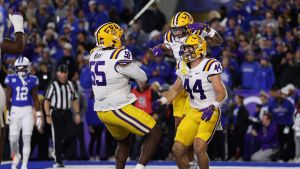
The landmark Louisiana state lawsuit over college athlete eligibility—which could result in former NFL players returning to college to play for LSU—is far from just a battle embroiling the college sports world. It’s become a local political football, with a cadre of elected officials, from district attorneys and state attorney general Liz Murrill to Gov. Jeff Landry himself, on opposite sides of the issue. Multiple neighboring states’ attorneys general have involved themselves as well.
Louisiana has a long history of local officials involving themselves in the workings of LSU football—look no further than the history of former Gov. Huey Long. But the lawsuit, Pyburn v. NCAA, has attracted a deep web of local political entanglements—which will be on display during Thursday’s pivotal court hearing on the case.
“Many rules get thrown out the window when it involves college sports,” Tulane sports law professor Gabe Feldman told Front Office Sports. “We have not only the DA, but the governor, and there are a lot of folks who are getting involved in this that you might not normally see in a legal case. Is it typical? No. But I don’t know that anything we’re seeing right now is typical.”
The lawsuit itself didn’t specifically challenge the eligibility rules surrounding professional athletes. It was one of many arguing the NCAA’s new age-based eligibility policy, which gives players five seasons of eligibility, should apply to players from the freshmen class of 2022 who had exhausted four years. Two weeks ago, judge William Jorden, himself an elected judge in Baton Rouge, granted a temporary restraining order allowing these athletes to play. LSU scooped up two of them: Dae’Quan Wright and Zxavian Harris. In response, the SEC passed a policy banning players who participated in NFL preseason from returning to school.
It was then that Landry—who had involved himself in the search to land Lane Kiffin as LSU head coach—decided to weigh in. Landry defended LSU’s position in comments to FOS, saying, “Don’t hate the player, hate the game,” adding: “Now the SEC is creating a legal mess over athletes it told were out of eligibility, only to change the rules afterward.”
In the wake of those comments, neither players nor LSU backed down. Players’ attorneys got the SEC added as a defendant in the case and party to the temporary restraining order alongside the NCAA. Kiffin confirmed Wright was working out with the team.
In the courtroom, both sides have acting district attorneys as members of their legal team. On the players’ side is Tony Clayton, the district attorney for the 18th judicial district of Louisiana (including West Baton Rouge). The SEC, on the other hand, has retained Jason Williams, the district attorney for Orleans Parish (which covers the New Orleans area). And this is far from the first time Williams and Landry have butted heads—during a separate dispute earlier this year, the Louisiana governor suggested Williams should be dis-barred.
Clayton has not responded to FOS interview requests this week; Williams did not immediately respond to a request for comment for this story.
If it sounds unusual that a district attorney—an elected official tasked with prosecuting criminal matters—is involved in a private civil case, that’s because it is. Louisiana allows DAs to continue with private practices during their tenure. However, a case at the Louisiana state Supreme Court involving Williams, called McQueen v. McQueen, is challenging that precedent.
The DAs aren’t the only ones. On Wednesday night, Louisiana attorney general Liz Murrill filed an amicus brief in the case suggesting her support for the players and LSU’s position.
“This case is a classic bait-and-switch,” her brief began, arguing that the NCAA’s rule changes put players in an untenable position. She also defended LSU, saying it was “caught between competing—and seemingly immovable—directives” between a court order allowing players to participate, and the SEC’s growing threats of sanctions. “Louisiana’s public universities and their student-athletes are participants in this convoluted arrangement, and have struggled under the ‘broken’ system for years now.”
Murrill filed her brief shortly after Georgia attorney general Chris Carr sent a letter to the SEC in support of the conference’s sanctions. “If LSU does in fact roster one or more pro athletes or demonstrates concrete plans to do so, we would strongly encourage the SEC to take all measures available to address this conduct, up to and including suspending and/or removing LSU from the Conference,” Carr wrote in the letter, obtained by FOS.
Ahead of the hearing Thursday, South Carolina attorney General Alan Wilson said: “Putting a previous NFL player on a college roster against the directive of the Southeastern Conference, not only circumvents the authority of the conference, but also undermines the spirit of college athletics. It is in the best interest of South Carolina colleges and universities to stand with my fellow Attorneys General against this practice and in support of the SEC.”
Landry fired back in a tweet Thursday, arguing that it was a “stretch” to call the athletes “NFL players.”
Not long after, Mississippi AG Lynn Fitch told FOS: “The University of Mississippi and Mississippi State University run two of the very best football programs in the country. I support their right to do what is necessary to protect the integrity of their programs and the integrity of the sport. I support their right to promote the best interests of their student-athletes.”
Both DAs arrived at Thursday’s hearing ready to defend their respective clients. So did Murrill, wearing a purple blouse and proclaiming, “Go Tigers!”.
Download the FOS App
The business of sports, in your pocket.



Scan the QR code to get the app now.